Zero-Click SEO: How to Win Visibility Without Clicks (2026 Guide)
Here is an uncomfortable truth for anyone who runs a website: most Google searches no longer end in a click.
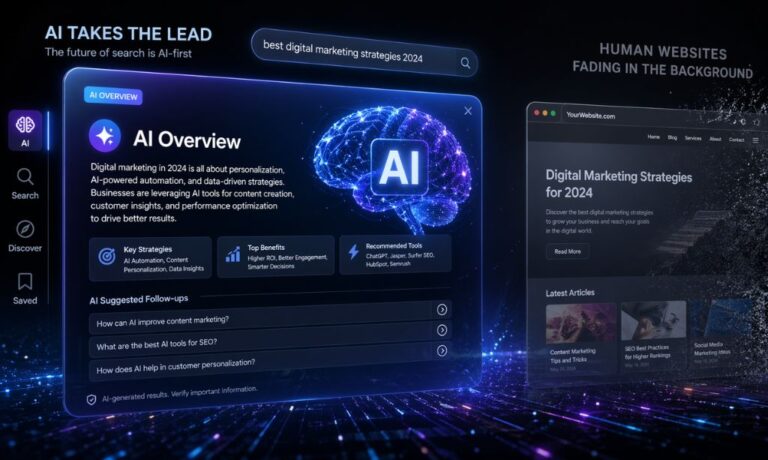
People type a question, get their answer right there on the results page — from a featured snippet, an AI Overview, or a knowledge panel — and move on. They never visit a single website. This is called a zero-click search, and it has become the norm rather than the exception.
That shift has created a new discipline: Zero-Click SEO — the practice of staying visible, building brand awareness, and capturing value even when users do not click through to your site.
It sounds counterintuitive. How do you win visibility when users do not click? The answer is that the definition of winning has changed. This guide explains what zero-click search really means in 2026, why it is happening, and the practical strategies that help you benefit from it instead of being buried by it.
Quick Summary: Zero-Click SEO at a Glance
|
Element |
What It Means |
|---|---|
|
What it is |
Optimizing for visibility when searches end without a click |
|
Why it matters |
Most searches now resolve on the results page itself |
|
Main goal |
Brand visibility, awareness, and authority — not just clicks |
|
Key surfaces |
Featured snippets, AI Overviews, knowledge panels, PAA boxes |
|
Hidden benefit |
Being cited builds brand recall and can increase brand awareness over time |
|
Measurement |
Impressions, branded search volume, brand mentions |
What Is Zero-Click Search?
A zero-click search is a search where the user gets their answer directly on the results page and does not click through to any website.
This happens when Google (or another search engine) shows the answer right in the results — through a featured snippet, an AI Overview, a knowledge panel, a calculator, a weather box, or a direct answer. The user’s question is resolved, so there is no reason to click further.
For example, if you search “how many ounces in a cup,” Google shows you the answer immediately. You do not need to visit a recipe site to find out. That is a zero-click search.
The scale of this is significant. According to SparkToro research, approximately 60.45% of U.S. Google searches ended without a click in 2024. SparkToro’s June 2026 follow-up, using Similarweb data, found this rose to 68.01% in the first four months of 2026. In other words, the majority of searches now end on the results page itself.
This is the reality every website owner now operates in — and Zero-Click SEO is about adapting to it.
Why Zero-Click Searches Are Rising
Several trends have combined to push zero-click searches to where they are today.
AI Overviews. Google’s AI-generated answer summaries now appear for a meaningful share of searches. According to Ahrefs’ November 2025 analysis, AI Overviews appeared in approximately 20.5% of U.S. Google searches — and they answer questions directly, often removing the need to click. Understanding how AI search is changing SEO gives you the full picture of this shift.
Featured snippets. These answer boxes have been pulling answers directly into search results for years, and they continue to resolve many queries without a click.
Knowledge panels and direct answers. For facts, definitions, conversions, and quick lookups, Google increasingly shows the answer instantly.
Better mobile experiences. On phones, where most searches now happen, people want fast answers without loading multiple pages. Zero-click results serve that need.
Changing user behavior. People have grown used to instant answers. Many now expect their question to be resolved on the results page — and search engines have adapted to meet that expectation.
None of these trends are reversing. Zero-click search is not a temporary phase. It is the new structure of search, and planning around it is simply realistic.
Is Zero-Click Search Bad for Your Website?
This is the question every website owner asks — and the honest answer is: it depends on how you adapt.
The challenge is real. If your traffic strategy depends entirely on informational queries that AI Overviews and featured snippets now answer directly, you will likely see declining click-through rates on that content. Ignoring this reality is risky.
But it is not all bad news. Here is the part many people miss: being the source that gets cited or featured in a zero-click result builds brand awareness, even without a click. Many publishers report increased brand visibility after being cited in AI Overviews, though large-scale public studies on branded search impact are still limited.
There is also nuance in what gets affected. Purely informational queries — definitions, quick facts, simple how-tos — are most affected by zero-click. But commercial and transactional queries, where users need to visit a site to compare options, make a purchase, or take action, still drive clicks reliably.
So zero-click search is not the end of website traffic. It is a shift that rewards brands who build visibility and authority — and punishes those who rely only on easily-answered informational content.
Where Zero-Click Results Appear
To optimize for zero-click search, it helps to know where these results show up:
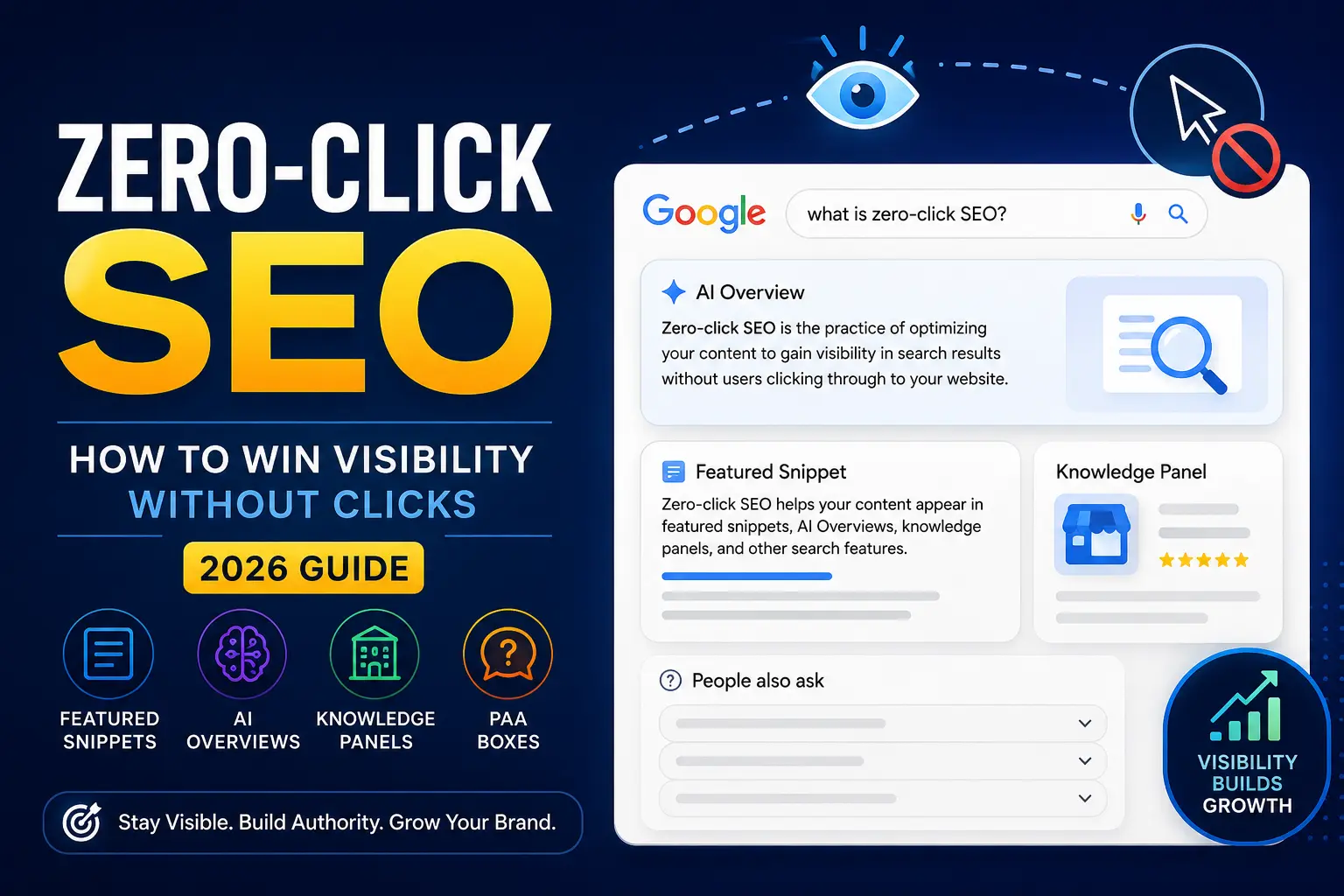
Featured snippets The highlighted answer box that appears at the top of many search results, pulling a direct answer from a webpage.
AI Overviews Google’s AI-generated summaries that synthesize information from multiple sources and appear above traditional results.
Knowledge panels The information boxes (often on the right side) that show facts about people, places, organizations, and things.
People Also Ask (PAA) boxes Expandable question-and-answer sections that address related queries directly in the results.
Direct answer boxes Instant answers for calculations, conversions, definitions, weather, sports scores, and similar quick lookups.
Local packs Map-based results for local searches that show business information directly.
Each of these surfaces represents a place where your content can be visible — even if the user does not click through.
Zero-Click SEO Strategies That Work
1. Win Featured Snippets
Featured snippets are one of the most valuable zero-click surfaces. Even without a click, appearing in the snippet position puts your brand at the very top of the results — building visibility and authority.
How to optimize for featured snippets:
- Answer specific questions directly and concisely — featured snippets often favor concise answers, typically around 40–60 words
- Use clear question-based headings that match how people search
- Structure content with lists, tables, and step-by-step formats — these are frequently pulled into snippets
- Place a clear, direct answer immediately after the question heading
- Cover the question thoroughly so Google trusts your page as the best answer
The content structure that wins featured snippets overlaps heavily with what works for AI search. A strong foundation in on-page SEO supports both.
2. Optimize for AI Overviews
AI Overviews are one of the newest and most visible zero-click surfaces. Being cited within an AI Overview puts your brand in front of users at the very top of the results — and builds the kind of brand recall that drives future searches.
How to improve your AI Overview presence:
- Write clear, direct answers that AI systems can easily extract
- Build genuine topical authority through deep, well-connected content
- Strengthen your E-E-A-T signals — credible authorship, accurate information, cited sources
- Use schema markup to help AI systems understand your content
- Add FAQ sections that map to the questions users actually ask
This is essentially generative engine optimization (GEO) applied to the zero-click context. The same practices that get you cited by AI also serve your zero-click strategy.
3. Build Brand Visibility, Not Just Clicks
This is the mindset shift at the heart of Zero-Click SEO.
In a zero-click world, being seen matters even when you are not clicked. When your brand name appears in a featured snippet, gets cited in an AI Overview, or shows up consistently across search results, you build recognition and trust — even without traffic.
How to build zero-click brand visibility:
- Aim to be the cited source in AI Overviews and featured snippets for your key topics
- Keep your brand name, messaging, and identity consistent across all search surfaces
- Build a recognizable presence so users start searching for you directly
- Focus on becoming a recognized authority in your niche, not just a page that ranks
Over time, this brand visibility translates into branded searches, direct visits, and a loyal audience — value that does not show up in a single click metric. Our guide on improving brand visibility in AI search results goes deeper on this.
4. Target Questions and PAA Boxes
People Also Ask boxes are a major zero-click surface — and a major opportunity.
These expandable question boxes appear for a huge range of searches. Getting your content featured in them puts your answer (and your brand) directly in front of users exploring a topic.
How to optimize for PAA boxes:
- Research the actual questions people ask about your topic — PAA boxes themselves are a great source
- Create dedicated content or FAQ sections that answer these questions clearly
- Use the exact question as a heading, followed by a direct, concise answer
- Cover related follow-up questions, since PAA boxes expand into more questions
Targeting questions also aligns your content with how people search in AI tools, making this a strategy that pays off across multiple surfaces. Strong keyword research in the age of AI helps you find these question opportunities.
5. Use Schema Markup
Schema markup helps search engines understand your content — and that understanding increases your chances of appearing in zero-click surfaces like rich snippets, FAQ results, and knowledge panels.
Useful schema types for zero-click visibility:
- FAQPage schema — can make your FAQ content eligible for rich results
- HowTo schema — structures step-by-step content for enhanced display
- Article schema — establishes content type and authorship
- Organization schema — supports knowledge panel and entity recognition
- Review/AggregateRating schema — can add rating stars to results
A note of honesty: schema markup does not guarantee any zero-click placement, and Google has specific eligibility rules for rich results. But it helps search engines classify and understand your content, which supports your overall visibility.
6. Capture Value Beyond the Click
Zero-Click SEO is not only about visibility — it is about capturing real value even when clicks do not happen.
Ways to capture value without a click:
- Build brand recall so users remember you and search for you directly later
- Earn the high-intent clicks that still happen on commercial and transactional queries
- Establish authority that makes your brand the trusted name in your niche
- Support future branded searches — the searches that come after someone sees your brand cited
- Support other channels — visibility in search reinforces your presence on social, email, and direct traffic
The goal is to think of search visibility as a long-term brand-building asset, not just a click-counting exercise.
How to Still Get Clicks in a Zero-Click World
Zero-click search does not mean clicks are dead. It means you have to earn them more deliberately. Here is how to still drive traffic:
Focus on queries that require a click. Commercial comparisons, detailed guides, tools, calculators, and transactional searches still drive clicks because users need to visit a site to complete their goal.
Give people a reason to click deeper. If a featured snippet answers part of a question, make sure the full answer — with more depth, examples, or tools — is clearly worth clicking for.
Create content AI cannot fully replace. Interactive tools, original research, detailed tutorials, community discussion, and unique data give users reasons to visit that a summary cannot satisfy.
Optimize your titles and meta descriptions. Even in a results page full of zero-click features, compelling titles and descriptions earn clicks from users who want more than a quick answer.
Build content depth that summaries cannot capture. A short AI summary cannot replace a comprehensive, genuinely useful resource. Depth is your defense against being fully summarized away.
The key insight: focus on the clicks that still require deeper engagement, and build brand visibility on the searches that end without one.
How to Measure Zero-Click Success
Traditional metrics like organic sessions do not capture zero-click value well. You need a broader measurement approach.
Impressions in Google Search Console Rising impressions show your content is appearing in search results — even if clicks are not rising at the same rate. High impressions with lower CTR can indicate zero-click visibility.
Branded search volume An increase in people searching for your brand name directly is one of the clearest signs that zero-click visibility is building brand awareness. Track this in Search Console and Google Trends.
Featured snippet and PAA appearances Monitor which queries show your content in snippets and PAA boxes. Some SEO tools track this automatically.
Brand mentions across the web Growing mentions of your brand — even without links — indicate rising recognition driven partly by search visibility.
AI citation tracking Check whether your content appears in AI Overviews and other AI-generated answers for your target queries. Our roundup of the best AI SEO tools in 2026 covers tools that help with this.
Common Zero-Click SEO Mistakes
Ignoring zero-click search entirely Pretending search still works the way it did five years ago is the biggest mistake. Adapting early gives you an advantage; ignoring the shift leaves you exposed.
Measuring success only by clicks If clicks are your only metric, you will miss the brand visibility value that zero-click search creates. Broaden your measurement framework.
Giving up on informational content Informational content still matters — it builds authority and feeds AI citations. The mistake is relying on it for direct traffic. Use it for visibility, and pair it with click-worthy commercial content.
Forgetting that some queries still drive clicks Not every search is zero-click. Commercial and transactional queries reliably drive traffic. Make sure your strategy includes content for these high-intent searches.
Neglecting brand building In a zero-click world, brand recognition is what turns visibility into long-term value. Treating SEO as purely technical and ignoring brand building leaves value on the table.
Skipping schema and structured content Content that is not structured for zero-click surfaces — no clear answers, no FAQ sections, no schema — misses opportunities to appear in snippets and AI Overviews.
Frequently Asked Questions
Q1: What is Zero-Click SEO?
Zero-Click SEO is the practice of optimizing your content to stay visible and build brand value even when users do not click through to your website. It focuses on appearing in search surfaces like featured snippets, AI Overviews, and People Also Ask boxes — and on building brand awareness and authority that pays off even without direct traffic. It reflects the reality that most searches now end without a click.
Q2: Why are most searches now zero-click?
Several trends have combined: AI Overviews answer questions directly, featured snippets resolve queries on the results page, knowledge panels show facts instantly, and mobile users increasingly want fast answers without loading multiple pages. According to SparkToro research, 60.45% of U.S. Google searches ended without a click in 2024. SparkToro’s June 2026 follow-up, using Similarweb data, found this rose to 68.01% in early 2026.
Q3: Is zero-click search killing website traffic?
It is reducing click-through rates for some content — particularly purely informational queries that get answered directly in search. But it is not killing website traffic overall. Commercial and transactional queries still drive clicks, and being cited in zero-click results builds brand awareness that creates value over time. The websites that adapt their strategy do well; those that rely only on easily-answered informational content struggle.
Q4: How do I benefit from zero-click search if people do not click?
The benefit comes from visibility and brand building. When your brand appears in a featured snippet or gets cited in an AI Overview, users see and remember it — which can lead to branded searches, direct visits, and trust over time. You also still earn the high-intent clicks on commercial queries. The value shifts from immediate clicks to long-term brand recognition and authority.
Q5: What content still gets clicks in a zero-click world?
Content that requires user action or deeper engagement still drives clicks: commercial comparisons, detailed buying guides, interactive tools and calculators, original research, in-depth tutorials, and transactional pages. When users need to compare options, make a purchase, or use a tool, they still click through. Quick informational answers are the content most affected by zero-click.
Q6: How is Zero-Click SEO related to AI search optimization?
They overlap heavily. AI Overviews are a major zero-click surface, so optimizing for AI citation is a core part of zero-click strategy. The practices that help you get cited by AI — clear answers, topical authority, E-E-A-T, schema markup — also help you win featured snippets and other zero-click surfaces. Zero-Click SEO and GEO are closely connected disciplines.
Q7: How do I measure success if not by clicks?
Track impressions (appearing in results), branded search volume (people searching for you directly), featured snippet and PAA appearances, brand mentions across the web, and AI citation presence. These metrics capture the visibility and brand value that zero-click search creates — value that traditional click-based metrics miss entirely.
Final Verdict
Zero-click search is not a problem to solve — it is a reality to work with.
The websites struggling in 2026 are the ones still measuring success purely by clicks while their informational traffic quietly declines. The websites thriving are the ones that adapted: they build brand visibility on zero-click surfaces, chase the clicks that are still winnable, and treat search presence as a long-term brand asset rather than a click-counting exercise.
Here is where to start:
1. Audit your content by query type. Identify which pages serve informational queries most affected by zero-click, and which serve commercial queries that still drive clicks. Adjust your strategy accordingly.
2. Optimize for visibility surfaces. Structure your key content to win featured snippets, AI Overview citations, and PAA appearances — with clear answers, FAQ sections, and schema markup.
3. Broaden how you measure success. Move beyond clicks to track impressions, branded search growth, and brand mentions — the metrics that actually capture zero-click value.
Zero-click search rewards brands that build genuine visibility and authority. Get that right, and you win in a search world where clicks matter differently than they used to.
Disclaimer: Search behavior, zero-click rates, and AI search features evolve over time. The statistics and guidance in this article reflect publicly available research and industry observation as of June 2026. Zero-click percentages vary by region, device, and query type. Always verify current data and test strategies with your own content.
Sources and Further Reading
Research and Data Sources
- SparkToro — 2024 Zero-Click Study (using Datos data) — sparktoro.com
- SparkToro — June 2026 Zero-Click Update (using Similarweb data) — sparktoro.com
- Ahrefs — AI Overview Frequency Analysis, November 2025 — ahrefs.com/blog
- Search Engine Journal — Zero-Click Search Coverage — searchenginejournal.com
- Search Engine Land — SERP Feature Analysis — searchengineland.com
Official Documentation
- Google Search Central — Featured Snippets & Structured Data — developers.google.com/search
- Schema.org — Structured Data Vocabulary — schema.org
Related Guides on TotalInfoHub
- How AI Search Is Changing SEO — totalinfohub.com/how-ai-search-is-changing-seo/
- Generative Engine Optimization (GEO) — totalinfohub.com/generative-engine-optimization-geo/
- Best Ways to Improve Brand Visibility in AI Search Results — totalinfohub.com/best-ways-to-improve-brand-visibility-in-ai-search-results/
- On-Page SEO — totalinfohub.com/on-page-seo/
- Keyword Research in the Age of AI — totalinfohub.com/keyword-research-in-the-age-of-ai/
- Best AI SEO Tools in 2026 — totalinfohub.com/best-ai-seo-tools/
Last reviewed: June 2026