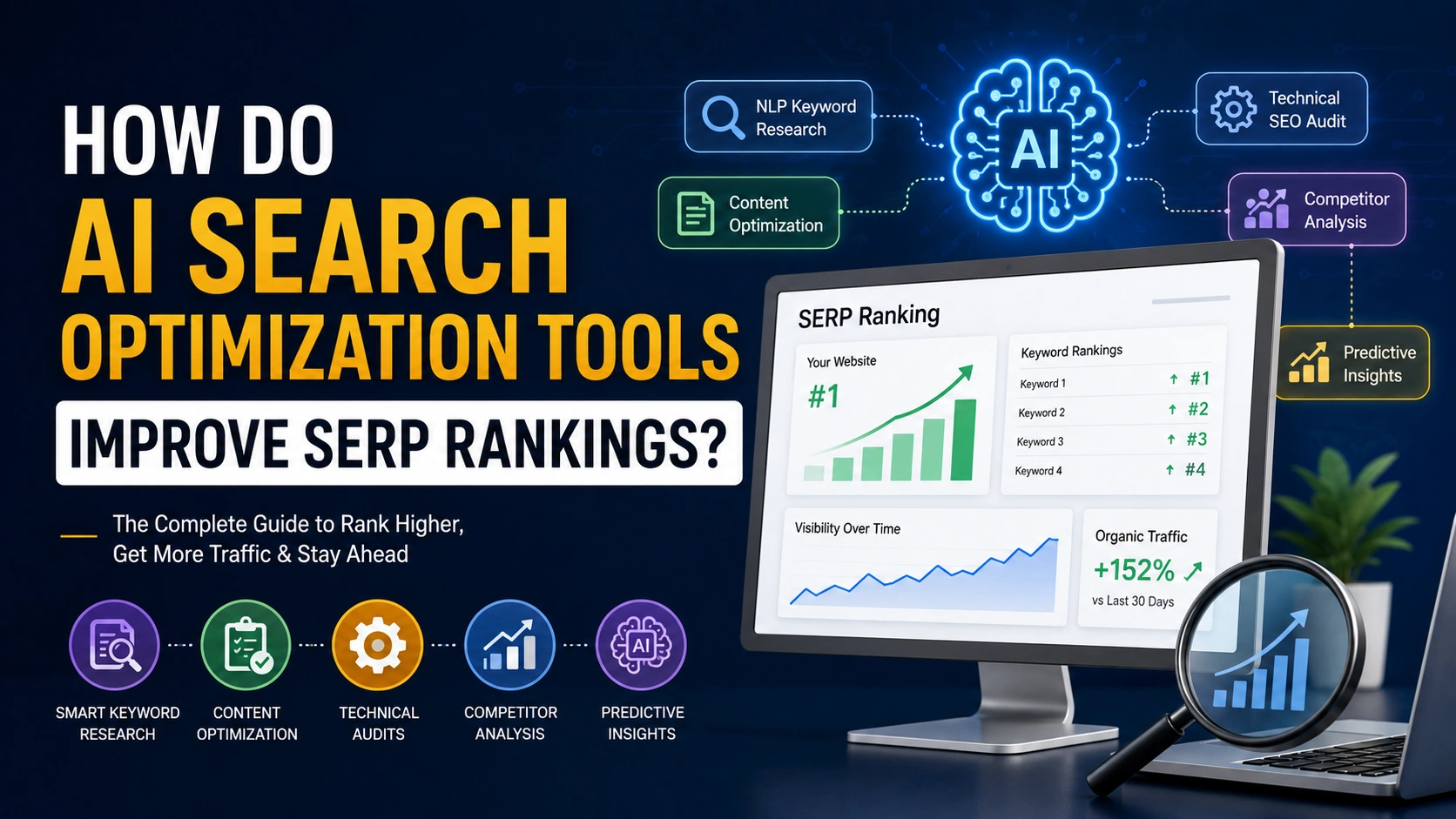
How Do AI Search Optimization Tools Improve SERP Rankings? (A Complete Guide)
Let’s be honest — ranking on the first page of Google used to feel like a guessing game. You’d stuff a few keywords in, build some backlinks, and hope for the best.
But search engines have changed. A lot.
Today, Google uses advanced AI and machine learning to understand context, intent, and quality — not just keywords. That means the old tricks don’t cut it anymore. And that’s exactly why AI-powered search optimization tools have become a game-changer for SEO professionals, bloggers, and small business owners alike.
So the real question is: how exactly do AI search optimization tools improve SERP rankings?
In this guide, we’re going to break it all down — clearly, practically, and without drowning you in jargon.
What Are AI Search Optimization Tools?
AI search optimization tools are software platforms that use artificial intelligence and machine learning to help you rank higher on search engine results pages (SERPs). Gone are the days of crossing your fingers and hoping your content sticks. These tools pull real data from thousands of top-performing pages and hand you a clear, step-by-step picture of what actually needs to change — no more shooting in the dark.
Think of them as a very smart assistant who has read millions of top-ranking pages, studied Google’s algorithm behavior, and can tell you exactly what to fix on your site — in minutes.
Popular examples include:
- Surfer SEO – for content optimization and NLP-driven keyword suggestions
- Semrush and Ahrefs – for backlink analysis, keyword tracking, and competitive intelligence
- Clearscope – for semantic content optimization
- MarketMuse – for topic authority and content gap analysis
- ChatGPT + plugins / Perplexity AI – for research, content ideation, and answer-engine optimization
How Do AI Search Optimization Tools Improve SERP Rankings? (7 Key Ways)
1. Smarter Keyword Research Using Natural Language Processing (NLP)
Traditional keyword research meant finding a word with high volume and low competition. AI tools go much deeper.
They use Natural Language Processing (NLP) to understand the meaning behind search queries — the same way Google does. So instead of just targeting “best coffee maker,” an AI tool might suggest:
- “best coffee maker for home use”
- “affordable drip coffee machine”
- “how to choose a coffee maker”
These are semantically related keywords — and using them together helps search engines understand your content is genuinely helpful and comprehensive.
Quick Tip: Google’s algorithm (especially Hummingbird and BERT updates) rewards content that covers a topic deeply, not content that just repeats one keyword over and over.
2. Content Optimization That Matches Search Intent
One of the biggest ranking factors today is search intent — what the user actually wants when they type something into Google.
AI tools analyze the top 10–20 ranking pages for your target keyword and identify:
- What type of content ranks (blog post, product page, list, how-to guide)
- What questions are being answered
- What subtopics are covered
- What word count and structure performs best
This means you’re not writing in the dark. You’re writing with a clear roadmap based on what’s already working.
For example, if you’re learning how to start a blog, an AI tool might tell you that top-ranking posts include a monetization section — something you may not have thought to include on your own.
3. Technical SEO Auditing at Scale
Even if your content is amazing, technical issues can kill your rankings. Things like:
- Slow page speed
- Broken internal links
- Missing meta tags
- Duplicate content
- Poor mobile experience
- Crawl errors
AI-powered tools can scan your entire website in minutes and flag these issues with priority scores — so you know what to fix first.
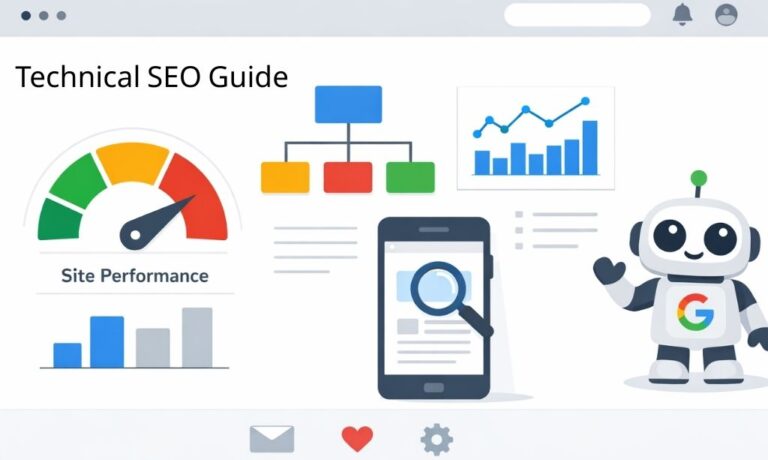
This is especially useful for larger websites where manually checking every page would take weeks. To go deeper on fixing these issues, check out this Technical SEO guide from beginner to advanced — it covers everything from crawlability to Core Web Vitals.
4. Competitor Analysis and Gap Identification
Want to know why a competitor ranks above you? AI tools can tell you — and help you close the gap.
They analyze competitor sites and show you:
- Keyword gaps – keywords they rank for that you don’t
- Backlink gaps – sites linking to them but not you
- Content gaps – topics they’ve covered that you haven’t
- Traffic trends – what’s working for them over time
Armed with this data, you can build a smarter content strategy that targets exactly what’s missing from your site.
5. Predictive Insights and Ranking Forecasts
Here’s where AI really shines. Instead of reacting to what happened last month, AI tools can predict what might happen next.
Some platforms use machine learning models to:
- Forecast ranking changes based on algorithm patterns
- Predict keyword difficulty trends before competition rises
- Suggest content topics that are gaining search momentum
This gives you a massive first-mover advantage — especially important now that we’re in the answer engine era of SEO’s future, where being early to a topic often means owning it.
6. AI-Powered On-Page SEO Recommendations
Getting on-page SEO right used to require a checklist, a lot of time, and a fair bit of experience. AI tools simplify this dramatically.
When you paste your content into an AI SEO tool, it gives you real-time recommendations like:
- Add the primary keyword in the H1 and first 100 words
- Include 3–5 related terms you’ve missed
- Shorten your sentences for better readability
- Drop in a FAQ section — Google loves pulling these directly into featured snippet boxes at the top of search results
- Improve your internal linking structure
These aren’t random suggestions — they’re based on analysis of what already ranks. To learn more about getting these elements right yourself, this on-page SEO guide is a great resource.
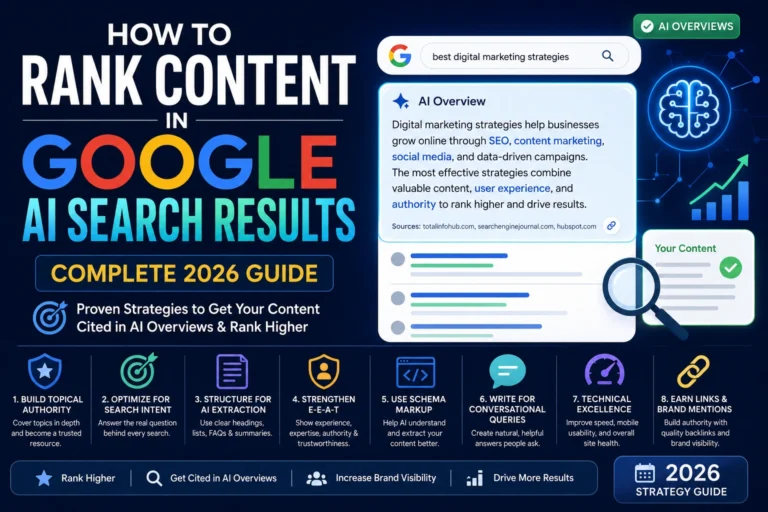
7. Optimizing for AI Search and Answer Engines
This is the newest — and arguably most important — frontier in SEO right now.
Search is evolving. Google’s AI Overviews, Bing Copilot, and tools like Perplexity and ChatGPT Search are changing how people find information. Instead of clicking ten blue links, users are getting direct answers.
AI search optimization tools help you:
- Structure content in a way that’s easily picked up by AI-generated summaries
- Frame your answers in plain, direct language that mirrors exactly how real people type their questions into search
- Cover your topic so thoroughly that AI engines start treating your site as a go-to reference worth citing
- Keep a close eye on whether your brand shows up — or gets skipped over — when AI tools generate their responses
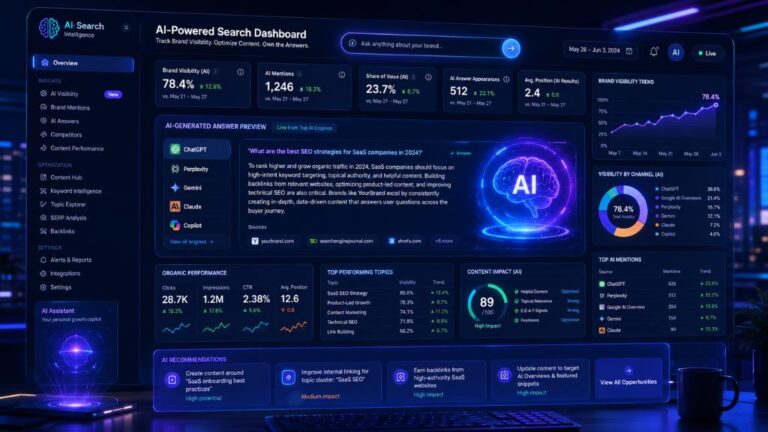
If you want to understand how to monitor this effectively, AI search monitoring platforms can significantly improve your SEO strategy — well worth exploring.
Key Benefits of Using AI Search Optimization Tools
Here’s a quick summary of the advantages these tools bring to the table:
- ✅ Saves hours of manual research — get data-backed insights in minutes
- ✅ Reduces guesswork — know what works before you publish
- ✅ Scales with your content — audit hundreds of pages at once
- ✅ Stays current — AI tools update based on algorithm changes
- ✅ Improves content quality — not just keyword density, but actual relevance
- ✅ Helps you compete with bigger brands — level the playing field with smarter strategy
- ✅ Prepares you for the future of search — including AI-powered answer engines
Who Should Use AI SEO Tools?
Honestly? Almost anyone who has a website and wants more traffic.
But they’re especially valuable for:
- SEO professionals who manage multiple clients and need to scale their workflow
- Digital marketers who want data-driven content decisions
- Bloggers who want to grow organic traffic without spending all day on research
- Small business owners who compete against larger brands with bigger budgets
If you’re also working on getting your brand noticed in AI-powered search results, don’t miss this guide on best ways to improve brand visibility in AI search results — it’s directly relevant to where search is heading.
AI SEO Tools vs. Traditional SEO: What’s the Difference?
|
Feature |
Traditional SEO |
AI SEO Tools |
|---|---|---|
|
Keyword Research |
Manual, time-consuming |
Automated, NLP-driven |
|
Content Optimization |
Based on experience/guesswork |
Data-backed, real-time scoring |
|
Technical Audits |
Manual crawling |
Full-site scans in minutes |
|
Competitor Analysis |
Basic comparison |
Deep gap analysis |
|
Ranking Prediction |
Not available |
Machine learning forecasts |
|
Search Intent Matching |
Approximate |
Precise, context-aware |
|
Scalability |
Limited |
Handles large sites easily |
The conclusion is simple: AI tools don’t replace your SEO knowledge — they amplify it.
A Note on Off-Page SEO
AI tools are powerful for on-site optimization, but don’t forget that backlinks and off-page signals still matter enormously for rankings. AI can help you identify where to build links and what content earns them naturally. Combine AI-driven content strategy with a solid off-page SEO approach and you’ll see results much faster.
Frequently Asked Questions (FAQ)
Q1: Can AI tools actually guarantee higher SERP rankings?
No tool can guarantee rankings — anyone who says otherwise is misleading you. What AI tools do is dramatically improve your chances by eliminating guesswork and pointing you toward what’s proven to work. That said, your actual outcome will vary. A highly competitive niche, a newer domain, or thin content can slow things down — no tool can fully override those realities.
Q2: Are AI SEO tools worth the cost for small businesses?
Yes, in most cases. Many tools like Ubersuggest or free tiers of Semrush offer significant value at low or no cost. Even paid tools often pay for themselves if they help you rank for even one or two competitive keywords that bring consistent organic traffic.
Q3: Do AI SEO tools work for local SEO?
Absolutely. Many AI tools have specific features for local keyword research, Google Business Profile optimization, and identifying local ranking factors. If you run a local business, these tools can be especially helpful for targeting area-specific searches.
Q4: Will AI replace human SEO experts?
Not anytime soon. AI tools are excellent at processing data and identifying patterns — but strategy, creativity, brand voice, and relationship-building (for link acquisition, for example) still require human judgment. The best SEO professionals are those who know how to use these tools effectively.
Q5: How often should I use AI SEO tools to check my rankings?
For most sites, a weekly or bi-weekly check is ideal. For competitive niches or during active campaigns, daily monitoring may be worthwhile. Many platforms offer automated alerts so you don’t have to check manually every day.
Final Thoughts
If there’s one thing this guide makes clear, it’s that ranking higher on Google today isn’t just about working harder — it’s about working smarter. And smarter, in 2025, means leaning on AI-powered tools that turn mountains of raw data into decisions you can actually act on.
From smarter keyword research and content scoring to technical audits and AI search readiness, these tools give you a competitive edge that’s hard to replicate manually. They don’t just help you rank — they help you understand why you rank, and what to do next.
Whether you’re a solo blogger trying to grow your audience or a seasoned SEO managing enterprise-level campaigns, embracing AI-powered tools isn’t optional anymore. It’s how you stay competitive in a search landscape that’s changing faster than ever.
Start with one or two tools, learn the data they surface, and let the insights guide your strategy. The results will speak for themselves.
Was this guide helpful? Share it with someone who’s trying to grow their search traffic — they’ll thank you for it.