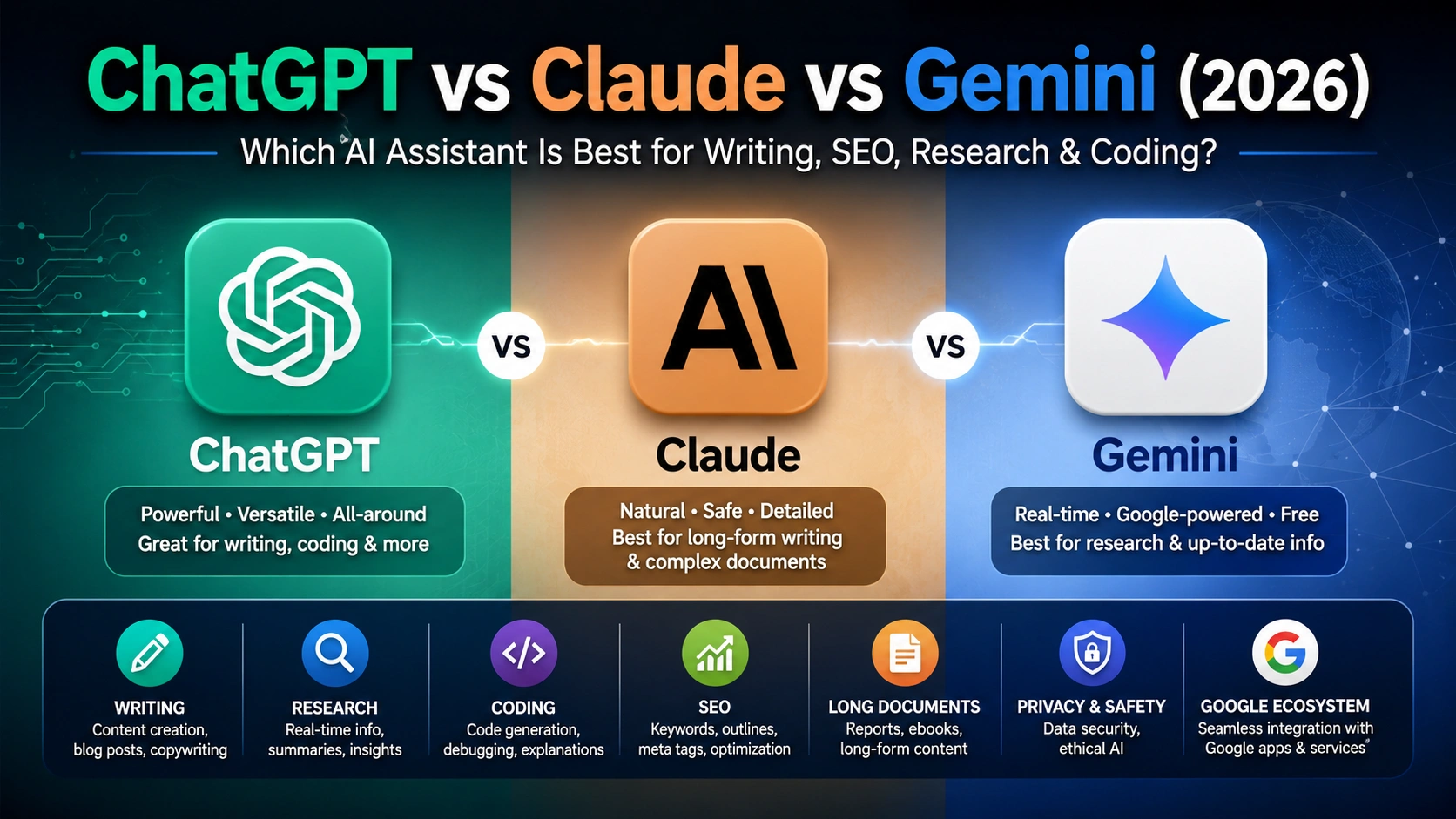
ChatGPT vs Claude vs Gemini (2026): Which AI Assistant Is Best for Writing, SEO, Research & Coding?
Too Many AI Tools, Not Enough Clarity
If you’ve spent any time online lately, you’ve probably noticed that everyone has an opinion on which AI chatbot is “the best.” Some swear by ChatGPT. Others insist Claude is smarter. And then there’s Gemini — Google’s answer to all of it.
But here’s the problem: most comparisons either go too deep into technical specs that nobody asked for, or they’re so surface-level they tell you nothing useful.
This guide is different.
We’re going to cut through the noise and do a real, honest comparison of ChatGPT vs Claude vs Gemini — what each one is genuinely good at, where they fall short, and most importantly, which one makes sense for you based on what you actually do.
Whether you’re a blogger, a digital marketer, a small business owner, or just someone curious about AI — by the end of this article, you’ll know exactly which tool deserves a spot in your daily workflow.
Let’s get into it.
A quick note on where this comparison comes from: Over the past year, we’ve used ChatGPT, Claude, and Gemini extensively — for SEO research, content creation, digital marketing campaigns, and daily productivity tasks. Everything in this article is based on real-world usage, not marketing claims or spec sheets.
⚡ Quick Verdict: Best AI Tool by Category
(Short on time? Here’s the fast version.)
|
Use Case |
Best AI Tool |
|---|---|
|
🏆 Best Overall AI |
ChatGPT |
|
✍️ Best for Writing |
Claude |
|
🔍 Best for Research |
Gemini |
|
💻 Best for Coding |
ChatGPT |
|
📄 Best for Long Documents |
Claude |
|
🆓 Best Free AI |
Gemini |
|
🔒 Best for Privacy |
Claude |
|
🔗 Best for Google Users |
Gemini |
Keep reading for the full breakdown — the details make a big difference.
A Quick Introduction to Each AI
Before we dive into the head-to-head comparison, let’s quickly understand who built what — and why it matters.
ChatGPT (by OpenAI)
ChatGPT is the one that started the mainstream AI boom. Launched in late 2022, it became the fastest-growing app in internet history. Today, it is one of the world’s most widely used AI assistants, offering both free and premium plans with advanced multimodal capabilities for writing, coding, research, and image analysis. OpenAI’s focus has always been on capability and breadth — making a tool that can do almost anything.
Claude (by Anthropic)
Claude is built by Anthropic, a company founded by former OpenAI researchers who wanted to build AI with safety as a core priority — not an afterthought. Claude tends to write in a more natural, human-like tone and is particularly praised for handling long documents and nuanced instructions better than its competitors.
Gemini (by Google)
Gemini is Google’s flagship AI model, designed to work seamlessly within the Google ecosystem — Gmail, Docs, Search, YouTube, and more. It has a unique advantage: real-time access to the web, which means it can pull current information without needing a plugin or paid subscription.
ChatGPT vs Claude vs Gemini: The Core Comparison
1. Writing Quality and Tone
This is probably the most important factor for bloggers, content marketers, and anyone creating written content.
ChatGPT is versatile. It can write in almost any style you ask — formal, casual, persuasive, technical. But without careful prompting, it sometimes produces content that feels a little… generic. You can tell it came from an AI.
Claude is where things get interesting. Its writing tends to feel warmer, more nuanced, and less robotic out of the box. It’s particularly good at following detailed instructions and maintaining a consistent tone throughout a long piece. If you’re writing blog posts, email sequences, or long-form content — Claude often needs the least editing afterward.
Gemini writes competently, but its real strength isn’t creative writing — it’s research-backed content. Because it has access to live web data, it can blend current information into its responses in a way the others can’t match without extra tools.
Winner for writing quality: Claude (with ChatGPT as a close second)
2. Research and Real-Time Information
This is a big one — especially if you create content about trending topics, current events, or anything time-sensitive.
- ChatGPT (Free) has a knowledge cutoff and no real-time browsing by default. The paid version (GPT-4o) can browse the web, but it’s behind a paywall.
- Claude can access web information in certain plans and integrations. However, Gemini still maintains a strong advantage when it comes to native Google Search integration and real-time research capabilities.
- Gemini wins this category outright. Even on the free tier, it can pull live information from Google Search and summarize it in seconds.
If you’re trying to understand how AI tools are reshaping search and research workflows, it’s worth reading this piece on how an AI search monitoring platform can improve your SEO strategy — it ties directly into how tools like Gemini are changing the way we gather and verify information.
Winner for real-time research: Gemini
3. SEO and Content Marketing Tasks
For SEO professionals and digital marketers, the question isn’t just “which AI writes well?” — it’s “which AI helps me rank?”
Here’s how each tool holds up for common SEO tasks:
ChatGPT:
- Great for generating keyword clusters and content outlines
- Can write meta descriptions, title tags, and alt text quickly
- Strong at creating variations of the same content for A/B testing
- With the right plugins, it integrates with tools like Surfer SEO
Claude:
- Exceptional at following detailed on-page SEO briefs
- Handles long-form content better without losing focus mid-article
- Great for rewriting existing content to sound more human (very useful for plagiarism issues — exactly what we addressed earlier)
- Less likely to pad content with filler sentences
Gemini:
- Pulls real-time search data, making it useful for trend-based content
- Integrates natively with Google Docs and Search Console
- Can summarize SERP data and suggest topic angles based on what’s currently ranking
If you’re building out a content strategy, a solid understanding of on-page SEO fundamentals will help you get the most out of whichever AI tool you choose.
Winner for SEO tasks: Tie between ChatGPT and Claude (depending on the task)
4. Handling Long Documents and Complex Instructions
This is where the gap between these tools becomes very clear.
ChatGPT handles long context reasonably well with GPT-4, but it can sometimes “forget” instructions given earlier in a long conversation — which gets frustrating fast.
Claude genuinely excels here. It has one of the largest context windows of any publicly available AI (up to 200,000 tokens in some versions), which means it can process an entire book, a full PDF report, or a lengthy content brief without losing track of what you asked at the start. For anyone doing technical research or working with large documents, this is a massive advantage.
Gemini falls somewhere in the middle — solid context handling, especially within Google Workspace, but not quite at Claude’s level for truly long or complex inputs.
Winner for long documents: Claude — by a significant margin
5. Coding and Technical Tasks
If you’re a developer or someone who uses AI to help with code, this section matters.
- ChatGPT is widely regarded as one of the strongest coding assistants available today. It excels at debugging, code generation, technical explanations, and problem-solving across multiple programming languages. For developers, it often serves as a dependable all-purpose AI assistant for both learning and professional software development.
- Claude is a capable coder, but it really shines when you need explanations alongside the code — it’s great at breaking down what the code does in plain language.
- Gemini is competitive but still slightly behind the other two for pure coding tasks, though it’s improving rapidly.
Winner for coding: ChatGPT
6. Privacy and Data Safety
This matters more than most people realize — especially for business owners and marketers handling client data.
- OpenAI (ChatGPT) has had some controversy around data usage. By default, conversations may be used to train future models unless you opt out.
- Anthropic (Claude) was literally built around AI safety. They have a stronger stated commitment to responsible data handling, and their model is designed to be more cautious about producing harmful or misleading content.
- Google (Gemini) — if you’re already worried about Google knowing everything about you, using Gemini probably doesn’t change that equation much. But for enterprise users, Gemini for Workspace has more robust privacy controls.
Winner for privacy-conscious users: Claude
7. Pricing and Accessibility
Let’s talk money — because the “best” tool is worthless if it’s too expensive for your budget.
|
Plan |
ChatGPT |
Claude |
Gemini |
|---|---|---|---|
|
Free Tier |
Yes (Free Plan Available) |
Yes (Claude 3 Haiku) |
Yes (Gemini 1.5 Flash) |
|
Paid Plan |
$20/month (Plus) |
$20/month (Pro) |
$19.99/month (Advanced) |
|
API Access |
Yes |
Yes |
Yes |
|
Best Free Value |
Moderate |
Good |
Very Good |
All three offer free tiers that are genuinely useful for light tasks. For heavy daily use, all three land around the same $20/month price point — so cost isn’t really a differentiator here.
8. Image Generation & Multimodal Features
In 2026, AI tools aren’t just about text anymore. The ability to analyze images, process PDFs visually, and generate images has become a core feature — and this is where the three tools differ quite noticeably.
ChatGPT (GPT-4o):
- Generates images directly using DALL·E 3 — right inside the chat interface
- Analyzes uploaded images with impressive detail (great for reviewing charts, infographics, or screenshots)
- Can read and extract content from PDFs and documents with strong accuracy
- By far the most complete multimodal package of the three
Claude:
- Excellent at analyzing and describing uploaded images — especially documents, screenshots, and diagrams
- Can process PDFs and extract insights from long visual documents
- Does not generate images natively — text and document analysis is its strength here
- Where it wins: combining image analysis with long-form written output (e.g., analyze a PDF report, then write a detailed summary)
Gemini:
- Strong image understanding, especially when tied to Google Lens and Google Search
- Can generate images through Google’s Imagen model (available in paid plans)
- Particularly useful for analyzing product images, web screenshots, or visual search tasks
- Native integration with Google Photos adds an extra layer of multimodal functionality
Winner for Image & Multimodal: ChatGPT — the most fully-featured out of the box. Gemini is a close second for Google ecosystem users.
Side-by-Side Comparison Table
|
Feature |
ChatGPT |
Claude |
Gemini |
|---|---|---|---|
|
Writing Quality |
⭐⭐⭐⭐ |
⭐⭐⭐⭐⭐ |
⭐⭐⭐ |
|
Real-Time Web Access |
Paid only |
Limited |
✅ Free |
|
Long Document Handling |
Good |
Excellent |
Good |
|
SEO Content Tasks |
Excellent |
Excellent |
Good |
|
Coding Assistance |
Excellent |
Very Good |
Good |
|
Privacy Focus |
Moderate |
High |
Moderate |
|
Google Workspace Integration |
❌ |
❌ |
✅ Native |
|
Free Tier Quality |
Moderate |
Good |
Very Good |
|
Human-Like Tone |
Good |
Excellent |
Good |
|
Image Generation |
✅ DALL·E 3 |
❌ |
✅ Imagen (Paid) |
|
Image & PDF Analysis |
Excellent |
Excellent |
Good |
|
Best For |
All-around & Coding |
Writing & Long Docs |
Research & Google Users |
Which One Should YOU Use? (Honest Recommendations)
This is the question everyone actually wants answered. Here’s a straightforward breakdown:
Choose ChatGPT if:
- You need a reliable, all-purpose AI for a wide variety of tasks
- Coding or technical work is part of your workflow
- You’re already in the OpenAI ecosystem and using GPT-powered tools
Choose Claude if:
- You write long-form content — blog posts, reports, scripts, or newsletters
- You need an AI that actually follows complex, multi-step instructions
- Privacy matters to you and you want less “robotic” output
- You’re running into plagiarism or AI-detection issues with other tools (Claude’s natural writing style tends to score better)
Choose Gemini if:
- You’re deep into Google’s ecosystem (Gmail, Docs, Drive, Search Console)
- You need real-time information without paying for a premium plan
- You’re creating content around trending or time-sensitive topics
The truth? Most serious content creators and marketers end up using two of these together. Claude for drafting and writing. Gemini or ChatGPT for research and ideation. It’s not always about picking just one.
How These AI Tools Fit Into a Bigger SEO Strategy
Here’s something worth understanding: AI chatbots are powerful, but they’re just one piece of a larger puzzle.
Ranking on Google still requires solid technical foundations, strong backlinks, and genuinely helpful content. These AI tools can help you create better content faster — but they can’t replace smart strategy.
If you’re building out that strategy from scratch, start with the basics:
- Get your technical SEO right from the ground up
- Build authority through smart off-page SEO tactics — backlinks, guest posts, and digital PR
- And if you’re thinking about starting a content-driven site, focus on picking a clear niche and publishing consistently
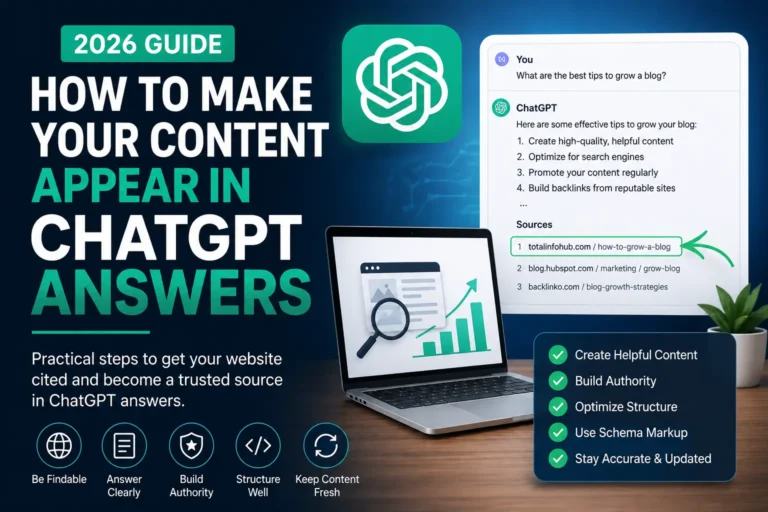
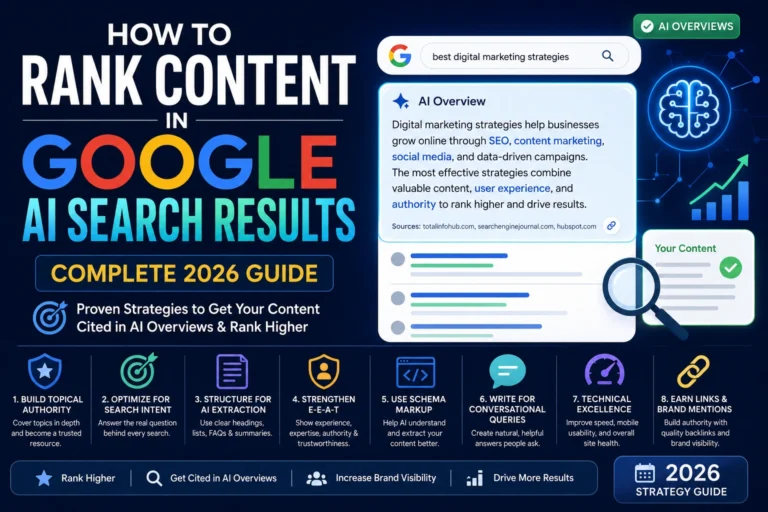
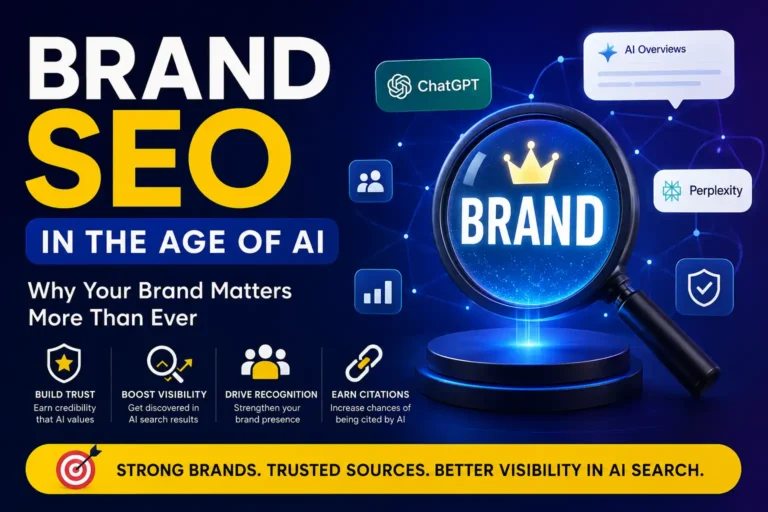
Also worth knowing — search itself is changing. AI tools like ChatGPT, Gemini, and Claude are increasingly becoming search engines themselves. Getting your brand cited in AI-generated answers is a real strategy now. This guide on improving brand visibility in AI search results explains exactly how that works.
And if you want to understand where all of this is heading, the future of SEO in the answer engine era is genuinely eye-opening reading.
Our Experience Using ChatGPT, Claude, and Gemini
Over the past year, we have used all three AI assistants hands-on — for content creation, SEO research, digital marketing campaigns, website optimization, and day-to-day productivity tasks. This isn’t a spec-sheet comparison pulled from press releases. Every observation in this article comes from real, repeated use across different types of projects.
Here’s what that experience actually showed us:
- ChatGPT proved most reliable when we needed quick answers, code snippets, or a versatile tool that could switch between tasks without missing a beat.
- Claude consistently produced the cleanest first drafts — the kind that needed the least editing before publishing. For long-form SEO content especially, it saved us significant time.
- Gemini became our go-to whenever we needed up-to-date information fast. Not having to switch tabs or verify outdated data made a genuine difference in research workflows.
The bottom line from real use: no single tool dominates every situation. The smartest approach is knowing which one to reach for depending on the task at hand.
Frequently Asked Questions (FAQ)
Q1: Is ChatGPT still the best AI in 2026?
ChatGPT remains one of the most capable and versatile tools out there in 2026 — especially for coding and general use. But “best” really depends on what you need. For writing and long documents, Claude often outperforms it. For real-time research, Gemini has the edge.
Q2: Is Claude better than ChatGPT for SEO content writing?
For most content writing tasks — especially long-form blog posts, detailed guides, and anything requiring a human tone — Claude tends to produce cleaner, less AI-sounding output. This makes it particularly useful for anyone concerned about AI content detection tools flagging their work.
Q3: Can I use Gemini for free with real-time search?
Yes. Gemini’s free tier includes real-time web access through Google Search — which is a significant advantage over ChatGPT and Claude’s free versions, both of which have knowledge cutoffs.
Q4: Which AI tool is safest for handling sensitive business information?
Claude, built by Anthropic, is generally considered the most privacy-conscious of the three. Anthropic’s core mission is AI safety, and that philosophy extends to how they handle data. That said, always read the terms of service of any AI tool before sharing sensitive client or business data.
Q5: Do I need to pay for these tools to get real value?
Not necessarily. All three have genuinely useful free tiers. Gemini’s free version arguably offers the most value — real-time search, solid writing, and Google integration at no cost. If you need heavy daily usage, advanced features, or API access, the ~$20/month paid plans are worth considering.
Q6: Can these AI tools replace a human SEO expert or content writer?
No — and any honest answer has to say that plainly. These tools are accelerators, not replacements. They can cut your research time in half and help you write a first draft in minutes, but strategy, brand voice, relationship-building, and real editorial judgment still require a human in the loop.
Q7: Which AI is best for beginners who’ve never used AI tools before?
Gemini is probably the most approachable starting point for beginners — especially if you already use Google products. ChatGPT’s interface is also very beginner-friendly. Claude is slightly more powerful for writing tasks but equally easy to use once you get started.
📚 Want to Go Deeper? Read These Next
If this comparison got you thinking about how AI fits into your broader content and SEO strategy, these guides will take you further:
- 🔍 How AI Search Is Changing the Future of SEO (2027 and Beyond) — understand where search is heading and how to prepare today
- 📈 How to Improve Brand Visibility in AI Search Results — get your brand cited in ChatGPT, Gemini, and other AI answers
- 🛠️ AI Search Monitoring Platforms That Improve Your SEO Strategy — tools to track how AI engines are treating your content
Final Thoughts
The ChatGPT vs Claude vs Gemini debate doesn’t have a single right answer in 2026 — and that’s actually good news. It means you have three genuinely capable, genuinely different tools to work with.
Here’s the bottom line:
- ChatGPT is your reliable all-rounder — great for a huge range of tasks and the strongest choice for code.
- Claude is your best writer — natural tone, excellent at long content, and the most privacy-friendly of the three.
- Gemini is your research partner — live web access and deep Google integration make it invaluable for current, research-backed content.
Pick the one that fits your workflow. Or use two of them together. The AI landscape is evolving fast — and staying flexible is probably the smartest strategy of all.
Found this comparison helpful? Share it with a colleague who’s still trying to figure out which AI tool to use — you might save them hours of trial and error.