How AI Search Is Changing SEO: The Definitive Guide (June 2026 Edition)
If Your SEO Strategy Is From 2024, You’re Already Behind
June 2026 Edition — Updated with verified data and platform changes.
There’s a version of this article that was written eighteen months ago. It warned that AI search was coming — that marketers should start paying attention, that the landscape was shifting.
That version is now outdated.
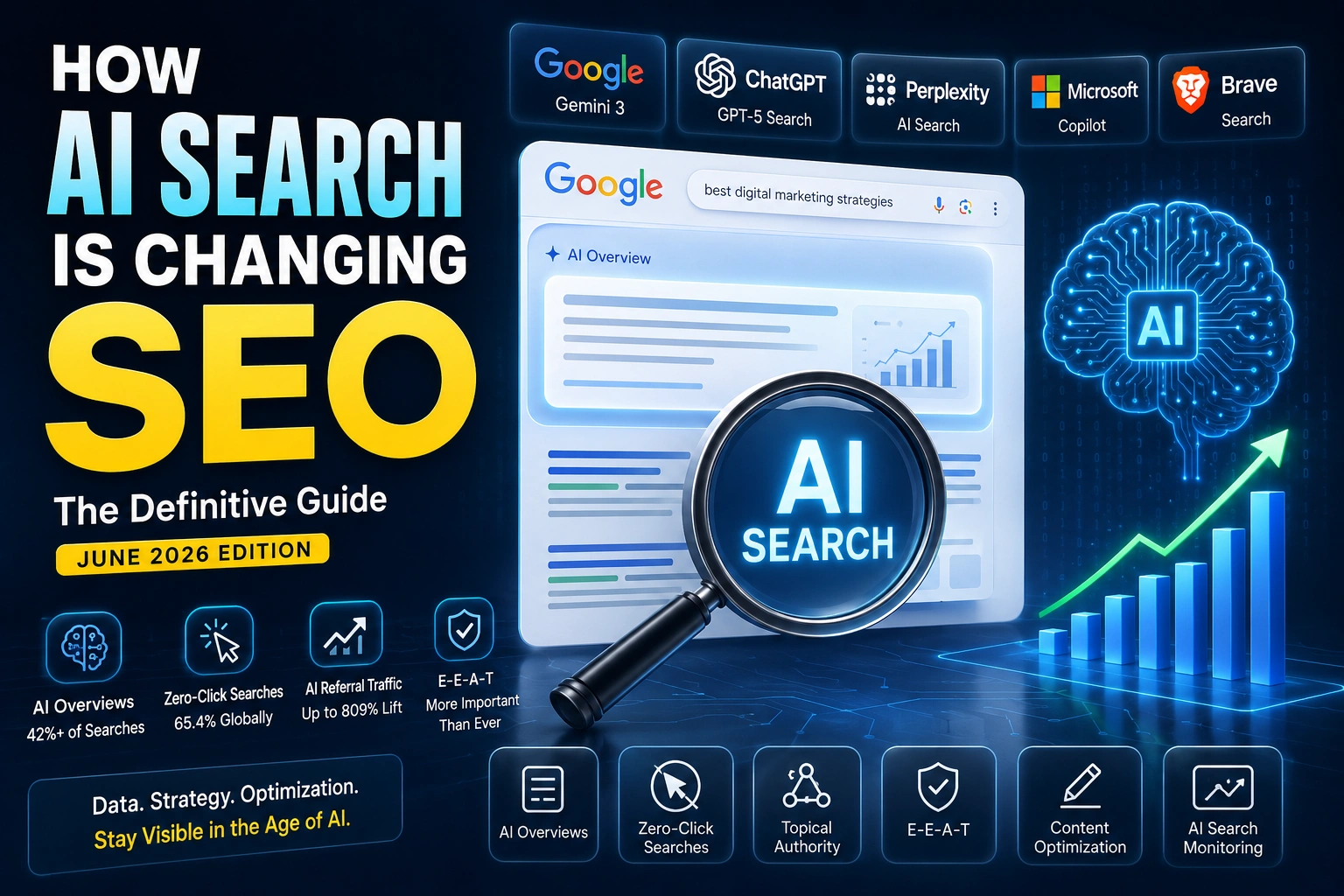
AI search didn’t just arrive. It took over. As of June 2026, 65.4% of all Google searches globally end without a single click — the user got what they needed directly from the results page, most often from an AI-generated summary. On mobile, that number climbs even higher, hitting between 71% and 77% depending on the query category.
Google’s search engine itself now runs on Gemini 3, rolled out in January 2026. ChatGPT Search — now powered by GPT-5 — has become a primary information retrieval tool for hundreds of millions of users worldwide. Perplexity, Brave Search, and a new wave of specialized AI engines are carving out their own loyal audiences.
For SEO professionals and digital marketers, this is the most consequential shift since Google first introduced PageRank. The old playbook — keyword research, on-page optimization, link building, track rankings — still has a role. But it’s no longer sufficient on its own.
This guide cuts through the noise. It tells you exactly what has changed as of June 2026, what the data actually shows, and — most importantly — what you should be doing differently right now.
A note on this guide: The statistics and platform details cited here reflect verified developments through June 2026. This is designed to be a working reference for SEO professionals navigating the AI transition in real time — not a theoretical overview.
📊 Fast Facts: The State of SEO in June 2026
According to recent industry studies from SparkToro, Semrush, Ahrefs, Similarweb, and multiple AI search tracking platforms, AI-powered search behavior has accelerated significantly throughout 2025 and 2026. The figures below reflect the current consensus across those sources.
|
Metric |
2024 Baseline |
June 2026 Reality |
|---|---|---|
|
Global zero-click search rate |
~49% |
65.4% |
|
Mobile zero-click rate |
~55% |
71–77% |
|
Queries showing AI Overviews |
~15% |
42%+ |
|
Google’s AI engine |
Gemini 1.5 |
Gemini 3 (Jan 2026) |
|
ChatGPT Search model |
GPT-4o |
GPT-5 (multimodal) |
|
AEO traffic lift (early adopters) |
Not tracked |
Up to 809% AI-referral traffic |
|
AI citation increase via structured AEO |
Baseline |
+221% in verified case studies |
|
Branded search lift from AI Overview citation |
N/A |
2.1x within 24 hours |
|
AI search engine platforms |
~4 mainstream |
8+ distinct platforms |
What “AI Search” Actually Means in 2026
The term “AI search” has evolved significantly since it first entered the mainstream vocabulary. In 2026, it no longer refers to a single feature or product — it describes an entirely new category of information retrieval.
At its core, AI search uses large language models (LLMs) to understand what a user is asking, synthesize information from multiple sources, and deliver a structured, conversational response — often without requiring the user to visit any external website.
Here are the platforms driving this shift as of June 2026:
Google Search + Gemini 3
Google increasingly relies on Gemini-powered AI systems across its entire search experience — a shift that deepened significantly with Gemini 3, introduced in January 2026. Rather than a single algorithm update, this represents a gradual architectural evolution toward AI-first search. Three features define the experience in 2026:
- AI Overviews now appear in over 42% of all searches, synthesizing answers from multiple ranked sources directly at the top of results pages
- AI Mode — Google’s dedicated conversational search interface — allows users to have multi-turn, context-aware conversations with the search engine, drilling deeper into topics without starting new queries
- Agentic AI features enable Google to handle complex, multi-step tasks on a user’s behalf — booking, researching, comparing, and summarizing across multiple sources in a single workflow
ChatGPT Search (GPT-5)
OpenAI’s search product has matured considerably. Powered by GPT-5, ChatGPT Search now functions as a persistent, multimodal assistant — capable of processing text, images, documents, and real-time web data in a single query. For hundreds of millions of users, it has replaced the traditional search box entirely for research-heavy tasks. Its ability to hold context across long conversations makes it particularly powerful for complex, multi-part questions.
Perplexity AI
Perplexity has established itself as the go-to AI search tool for professionals who prioritize source transparency. Its citation model — where every factual claim is linked to its source — has made it especially popular among researchers, journalists, and high-trust-requirement users.
Microsoft Bing Copilot
Still a significant player, particularly in enterprise environments and among Microsoft 365 users. Deep integration with Word, Excel, and Teams has made it a default AI research tool for many corporate teams.
The Emerging Tier: Niche AI Search Engines to Watch
Beyond the headline players, a new tier of specialized AI search engines has emerged — each targeting a specific use case and audience. SEO professionals should be paying attention to all of them.
Brave Search (Privacy-First)
Brave Search has grown rapidly among privacy-conscious users who are uncomfortable with the data practices of Google and Bing. It uses its own independent index — not dependent on Google’s or Microsoft’s infrastructure — and its AI summarization features operate without user tracking. For brands targeting tech-savvy, privacy-aware audiences, Brave Search visibility is increasingly relevant.
Consensus (Evidence-Based Research)
Consensus is an AI search engine built specifically for academic and scientific research. It pulls from peer-reviewed papers and presents evidence-based summaries with confidence ratings. For brands in health, science, finance, or any credibility-sensitive niche, getting cited in Consensus is a meaningful trust signal.
Amazon Rufus (AI-Powered Shopping)
Amazon’s AI shopping assistant, Rufus, has transformed product discovery on the platform. It synthesizes product reviews, Q&A data, and listing information to answer specific buyer questions conversationally. For e-commerce brands and anyone selling on Amazon, Rufus optimization — ensuring your product listings answer the questions Rufus is designed to surface — has become a distinct and necessary discipline.
Traditional SEO vs AI Search SEO: The Core Shift
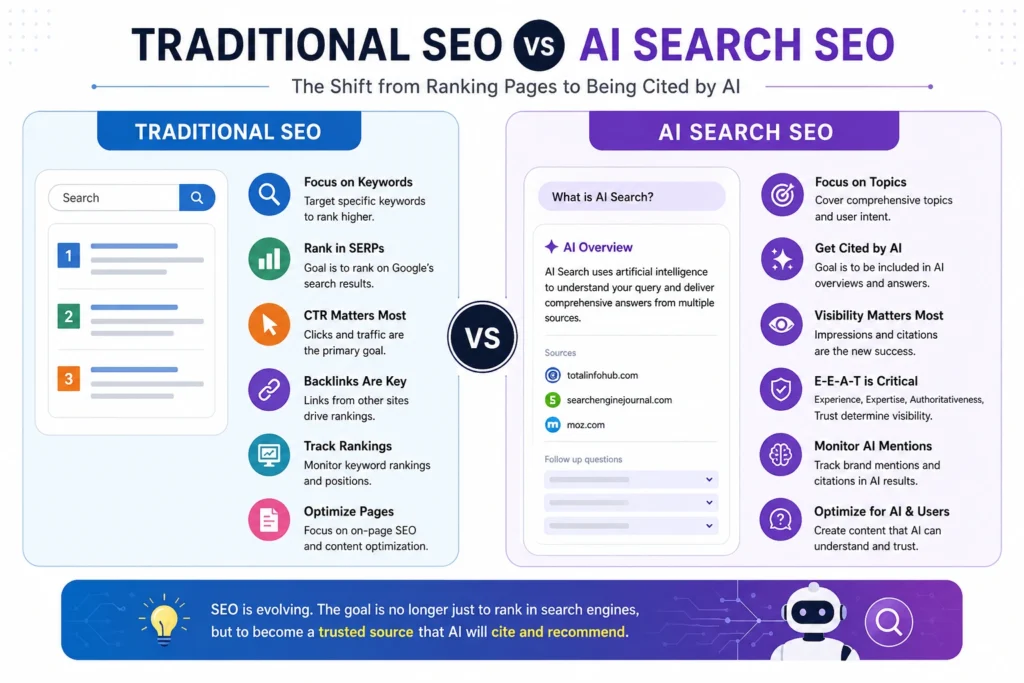
Before diving into the specifics, it helps to see the full picture side by side. This table captures the fundamental shift in how SEO strategy needs to be approached in 2026:
|
Dimension |
Traditional SEO |
AI Search SEO |
|---|---|---|
|
Primary focus |
Keyword targeting |
Topic and intent coverage |
|
Goal |
Rank in SERPs |
Get cited by AI engines |
|
Visibility metric |
Click-through rate (CTR) |
Citation frequency + branded search lift |
|
Query type |
Short-form keywords |
Conversational, natural language queries |
|
Content structure |
Keyword-optimized paragraphs |
Question-and-answer, FAQ, structured data |
|
Trust signals |
Backlinks dominate |
E-E-A-T + authority + backlinks combined |
|
Search intent |
Match the keyword |
Satisfy the full user goal |
|
What you track |
Position 1–10 rankings |
AI mention tracking + citation share |
|
Content depth |
One page per keyword |
Topic clusters with pillar + supporting pages |
|
Technical priority |
Crawlability and indexing |
Schema markup + structured data + speed |
|
Brand strategy |
Rankings = visibility |
Rankings + AI citations = visibility |
The most important takeaway from this table: AI search does not replace traditional SEO fundamentals — it extends them. Brands that treat these as separate strategies will invest inefficiently. Those that build an integrated approach — strong on both dimensions — will compound their advantage over time.
1. Zero-Click Searches Have Crossed the Tipping Point
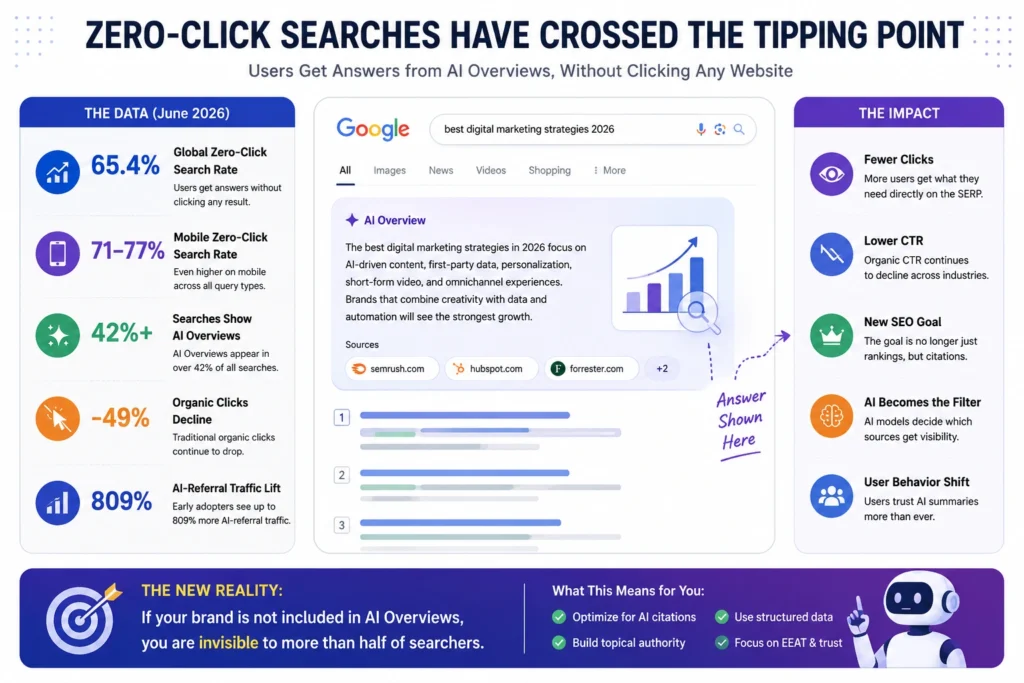
Let’s put the number in context: 65.4% of global searches now end without a click. On mobile devices — where the majority of searches happen — that figure reaches as high as 77% for certain query categories.
This isn’t a gradual trend to monitor. It has already happened. More than half of all search activity no longer generates website traffic.
The mechanism is straightforward. When Google’s AI Overview generates a complete, accurate answer to a query at the top of the results page — sourced from multiple ranked websites and presented in clean, readable prose — there is no reason for most users to scroll further. The query is resolved.
However — and this is critical — zero-click is not the complete picture.
Data from June 2026 reveals an important counterweight: brands that are cited within Google’s AI Overviews see a 2.1x increase in branded search volume within 24 hours of that citation appearing. Being referenced inside the AI summary — even without a direct click — elevates brand awareness in a measurable and rapid way.
The strategic implication is clear: the goal is no longer simply to rank in the ten blue links. The goal is to be the source the AI cites. That is the new definition of first position.
2. Google Gemini 3 Changes What “Ranking” Means
With Google increasingly relying on Gemini-powered AI systems across Search, AI Overviews, AI Mode, and other search experiences — a transition that accelerated significantly with the Gemini 3 rollout in January 2026 — the evaluation of content has become dramatically more sophisticated. This isn’t an algorithm update in the traditional sense — it is a fundamentally different system for understanding and ranking information.
Gemini 3 evaluates content along dimensions that previous algorithms could only approximate:
- Semantic depth — does this content genuinely cover the topic, or does it surface-level the subject with keyword-matched phrases?
- Factual coherence — are the claims internally consistent, sourced, and verifiable?
- Entity relationships — how does this content connect to established entities, facts, and authoritative sources across the web?
- User satisfaction signals — not just CTR, but whether users who engaged with this content found what they were looking for
AI Mode adds another layer. When users engage with Google’s conversational search interface, the system rewards content that answers the follow-up questions — the ones users ask after their first query. Sites with comprehensive topic coverage, strong internal linking, and deep FAQ content are naturally better positioned for this multi-turn search behavior.
Agentic AI is the frontier. Google’s agentic features — which handle complex multi-step tasks — draw on sources that demonstrate both authority and clarity. A travel agency whose site clearly answers every stage of the booking journey is more likely to be used as an agentic source than a site that only covers one part of the process.
3. The AEO Opportunity Is Real — and the Data Proves It
Answer Engine Optimization (AEO) — the practice of structuring content to be cited by AI systems — has moved from theoretical concept to documented performance driver.
The June 2026 data is striking:
- Structured AEO implementation has produced a 221% increase in AI citations for brands that committed to it systematically — meaning their content was referenced in AI-generated answers 221% more often after optimization
- Early AEO adopters have recorded up to an 809% increase in AI-referral traffic — direct traffic arriving at their site from AI-generated summaries that linked back to their content
These are not marginal improvements. They represent a category-level advantage for the organizations that moved early.
The brands seeing these results share common characteristics: they publish content structured around questions, use clear hierarchical formatting that AI systems can parse, cite credible sources, demonstrate genuine expertise, and maintain consistent publishing in their niche.
For a practical framework on how to make this work for your brand, this guide on improving brand visibility in AI search results covers the tactical implementation in detail.
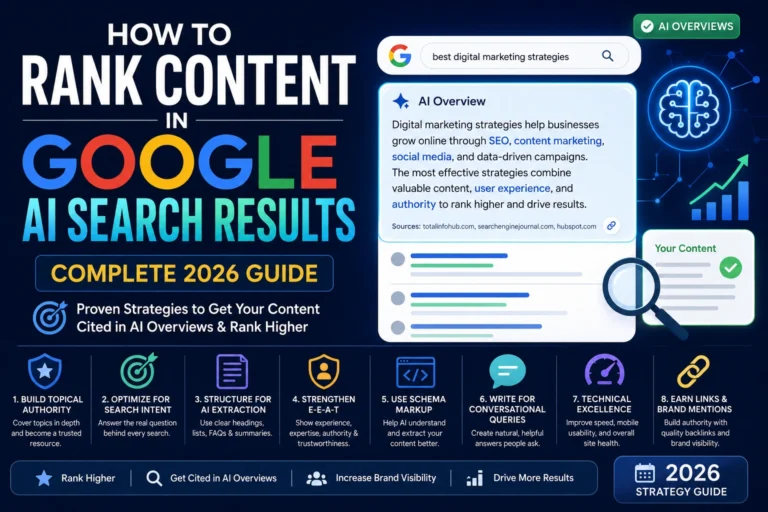
4. Topical Authority Has Replaced Keyword Strategy as the Core Discipline
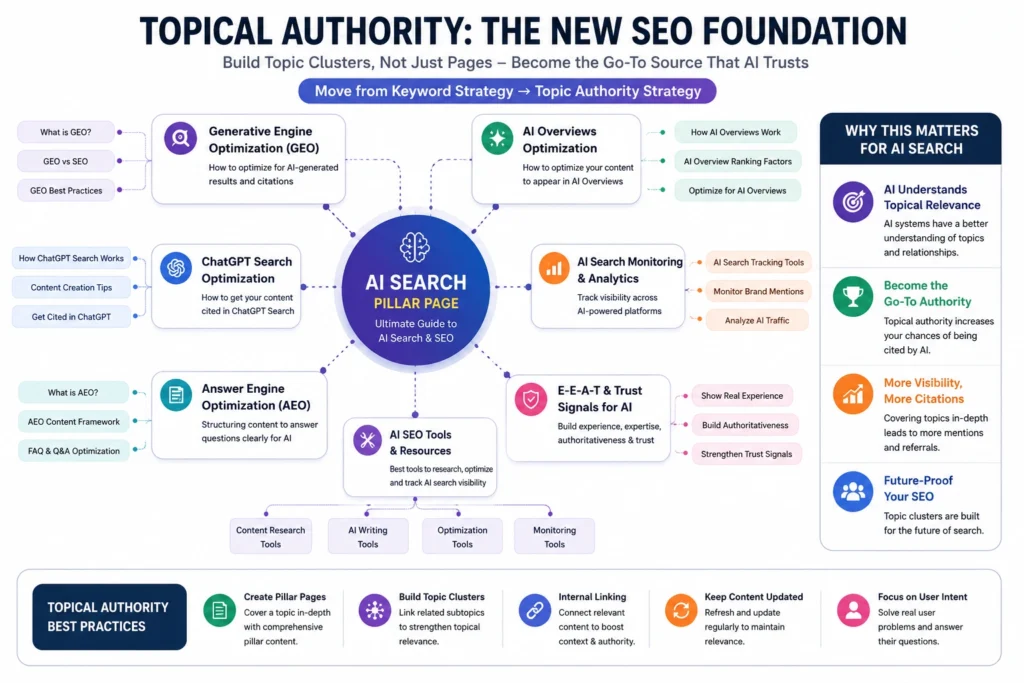
Here is a way to think about the shift: traditional SEO was about matching queries. AI search is about owning topics.
A site that has thirty well-researched, interconnected articles on a single subject signals something fundamentally different to a Gemini 3-powered evaluation than a site with thirty articles on thirty different subjects. The former demonstrates domain knowledge. The latter looks like a content farm.
Building topical authority in 2026 means:
- Structuring your site around content clusters — a comprehensive pillar page for each major topic, surrounded by supporting articles that address every meaningful subtopic and question
- Linking these articles to each other in a way that creates a navigable knowledge structure
- Covering the full spectrum of user intent within your topic — awareness, consideration, decision, and post-decision questions
- Publishing consistently enough that search systems recognize your site as an active, maintained resource
Every internal link in this cluster architecture is a signal. Every unanswered subtopic is a gap that a competitor can fill and use to outrank you. A thorough understanding of on-page SEO structure is the foundation on which this entire strategy rests.
5. E-E-A-T Is Now the Admission Ticket, Not a Differentiator
Three years ago, strong E-E-A-T signals helped content stand out. In June 2026, they are table stakes. Content without demonstrable experience, expertise, authoritativeness, and trustworthiness is not competing for AI citation — it is invisible to these systems by design.
AI models are, in essence, trained to do what Google’s quality guidelines have always described: surface content from people and organizations who actually know what they’re talking about. A generative model that confidently cites unreliable information exposes itself to reputational damage. The systems are therefore biased — heavily — toward sources that prove their credibility.
What credibility looks like to an AI system in 2026:
- Named authors with verifiable backgrounds and credentials
- Content that includes specific data, case studies, or original observations rather than generic restatements of common knowledge
- Clear organizational identity — who publishes this site, and why should it be trusted on this subject?
- External recognition — backlinks, mentions, citations from other credible sources in the space
- Recency signals — regularly updated content that reflects current realities, not content frozen in time
6. Conversational and Intent-Based Search Is the New Normal
The behavioral shift is now well-documented. Users — particularly those who have adopted AI search tools as their primary interface — no longer think in keywords. They think in questions, contexts, and goals.
A user asking ChatGPT Search or Google’s AI Mode does not type “best project management software.” They say something like: “I’m managing a remote team of twelve people across four time zones, mostly developers and designers. We’ve outgrown Trello. What project management tool would handle our workflow without overwhelming the team with complexity?”
This is a fundamentally different query — and it requires fundamentally different content to answer well.
Optimizing for conversational, intent-based search:
- Write in direct, natural language that mirrors how your audience actually speaks about their problems
- Structure content around the full context of a decision, not just the keyword at the center of it
- Use question-based H2 and H3 headings throughout your articles
- Build robust FAQ sections — these are among the most reliably cited content formats in AI-generated answers
- Anticipate follow-up questions and answer them in the same piece, or link to dedicated articles that do
7. Technical SEO Remains the Infrastructure — and AI Has Raised the Bar
There is a temptation, in the face of all this discussion about content quality and AI strategy, to deprioritize technical SEO. That would be a mistake.
AI crawlers — including Google’s Gemini-powered crawlers and the indexing bots used by Perplexity and other AI search engines — depend on technical accessibility. A site that is slow to load, difficult to crawl, structurally chaotic, or missing proper schema markup is not just harder to rank. It is harder for AI systems to extract, summarize, and cite.
Schema markup deserves particular emphasis in 2026. Structured data tells AI systems not just what your content says, but what type of content it is — an article, a FAQ, a how-to guide, a product, a review, a local business. This context is enormously useful to a system trying to decide whether your content is the right answer to a specific query.
Core technical priorities for AI-era SEO:
- Page speed and Core Web Vitals — AI systems favor fast, stable experiences
- Logical site architecture with clean, hierarchical URL structures
- Comprehensive Schema markup across all major content types
- Mobile experience parity — not just responsiveness, but genuine usability on small screens
- Crawlability — clean robots.txt, accurate sitemaps, no unnecessary blocks
The technical SEO guide remains one of the most practical references available for getting these fundamentals right at every level of technical complexity.
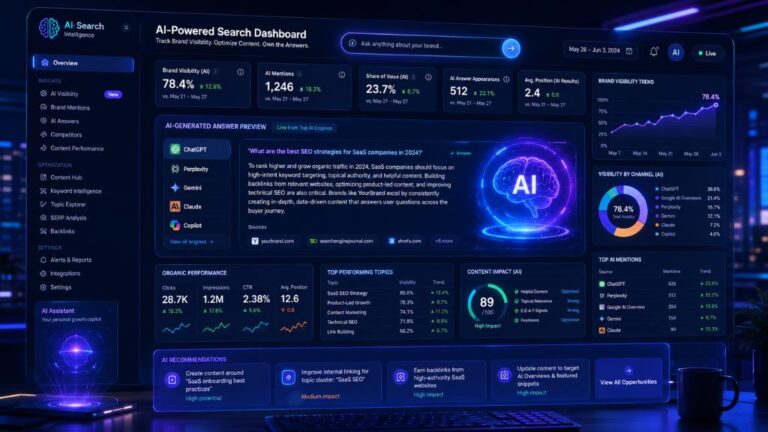
8. AI Search Monitoring Is Now a Core SEO Function
Twelve months ago, monitoring your AI search presence was an optional advanced practice. In June 2026, it is a core function of any serious SEO operation.
Traditional analytics — organic traffic, keyword rankings, click-through rates — still matter. But they now capture only part of the picture. They tell you nothing about:
- Whether your brand is being cited in AI Overviews, and for which queries
- How your AI citation share compares to competitors in your space
- Which of your pages are being used as sources in ChatGPT Search, Perplexity, or Gemini’s AI Mode
- How AI-generated descriptions of your brand or products compare to how you actually want to be represented
All of these are now measurable — and the brands measuring them have a material advantage over those that aren’t. This piece on how an AI search monitoring platform can improve your SEO strategy explains the landscape clearly and practically.
What Still Works — and What Has Been Left Behind
Still Delivering Results ✅
- Deep, well-researched content that covers topics comprehensively
- Strong topical authority built through content clusters and internal linking
- High-quality backlinks from credible, relevant sources
- Fast, technically sound, mobile-first websites with clean schema markup
- FAQ-rich, question-answering content structure
- Consistent publication cadence within a defined niche
- First-hand experience and original data in content
- Brand building — reputation and trust signals outside of rankings alone
Losing Effectiveness ❌
- Thin content ranking on keyword optimization alone
- Publishing isolated articles on disconnected topics with no cluster structure
- Ignoring AI citation presence while focusing only on traditional SERP rankings
- Generic “ultimate guide” content without genuine depth or original perspective
- Treating SEO as periodic maintenance rather than continuous strategy
- Neglecting schema markup and structured data as “optional extras”
- Chasing search volume without evaluating intent alignment
The AI Search Adaptation Playbook: 7 Steps for 2026
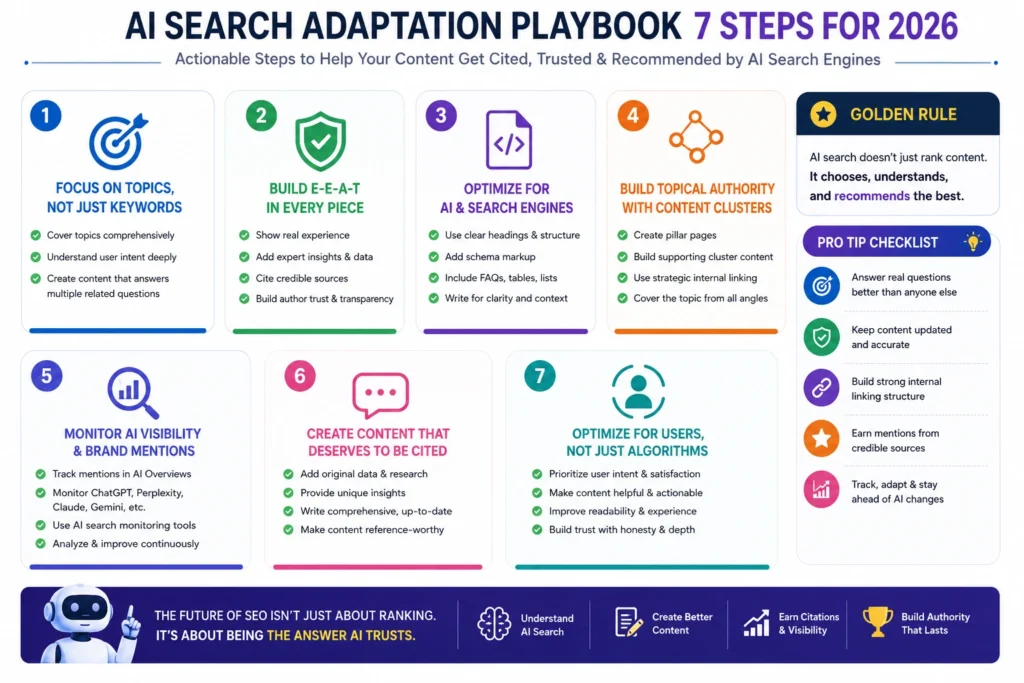
Step 1 — Audit for zero-click vulnerability Identify which of your highest-traffic pages serve purely informational queries. Assess whether those pages are generating citations within AI Overviews (which preserves brand visibility) or simply losing traffic without compensation. Prioritize accordingly.
Step 2 — Restructure around topic clusters Map your content to core topics. Build or strengthen pillar pages. Audit internal links. Fill subtopic gaps. The architecture of your site is now as important as any individual piece of content.
Step 3 — Implement structured AEO Reformat your key content pages with clear question-and-answer structure, FAQ sections, and schema markup. These formats are consistently the most cited in AI-generated answers. The 221% citation increase data points directly to this approach.
Step 4 — Upgrade your E-E-A-T signals Conduct an honest audit: does your site clearly communicate who you are, what your credentials are, and why your information should be trusted? If not, fix this before investing further in content production.
Step 5 — Add schema markup comprehensively If you have not yet deployed Article, FAQ, HowTo, and Organization schema markup across your relevant pages, this is a high-priority technical action. It directly improves AI system comprehension of your content.
Step 6 — Begin AI search monitoring Set up a systematic process for tracking your brand’s presence in AI-generated answers. Manual spot-checking plus a dedicated monitoring platform gives you the intelligence needed to make strategic content decisions.
Step 7 — Broaden your visibility targets Google is no longer your only audience. Evaluate your presence and citation frequency across Perplexity, ChatGPT Search, Bing Copilot, and — depending on your industry — Brave Search, Consensus, and Amazon Rufus. Each platform has distinct content preferences and citation patterns worth understanding.
Is SEO Dead? The Honest 2026 Answer
The “SEO is dead” narrative resurfaces with every major industry shift — after Penguin, after mobile-first, after BERT. It has always been wrong, and it remains wrong now.
What is true is this: the version of SEO that relies primarily on keyword matching, volume targeting, and link accumulation without reference to genuine content quality is dying. In the Gemini 3 era, these tactics produce diminishing returns, because the systems evaluating content have become sophisticated enough to distinguish between real authority and its simulation.
The version of SEO that focuses on building genuine expertise, serving real user intent, and maintaining technically sound content — that version is not dying. It is, in many ways, finally being rewarded the way it always should have been.
The professionals who will thrive are those who understand that AI search and human-centered content strategy are not in conflict. They are the same thing, viewed from two different angles.
For a longer view on where this trajectory leads, the analysis in this guide on the future of SEO in the answer engine era is well worth your time.
Frequently Asked Questions (FAQ)
Q1: What is Google AI Mode and how does it differ from regular search?
Google AI Mode is a dedicated conversational search interface powered by Gemini 3 that allows users to conduct multi-turn, context-aware research conversations with Google’s AI. Unlike standard search — which resets with each query — AI Mode retains context across an entire session, enabling users to progressively refine and deepen their research. For SEO purposes, content that answers follow-up questions and covers topics comprehensively performs better in this environment.
Q2: What does “65.4% zero-click rate” actually mean for my website traffic?
It means that nearly two-thirds of all Google searches globally are resolved on the results page itself, without the user visiting any website. This doesn’t mean organic traffic has collapsed — it means the distribution of that traffic has shifted significantly. High-intent commercial and transactional queries still drive clicks. Purely informational queries are the most affected. The strategic response is to pursue AI citation (which builds branded search) alongside traffic generation.
Q3: What is Agentic AI in the context of Google Search?
Agentic AI refers to Google’s ability to handle multi-step tasks autonomously on a user’s behalf — researching, comparing, booking, or summarizing across multiple sources and platforms in response to a complex request. For example, a user could ask Google to find the three best-reviewed accountants near them, summarize their services, and draft a comparison table. Sites whose content is clear, well-structured, and directly answers specific use-case questions are more likely to be used as sources in these agentic workflows.
Q4: How quickly can AEO improvements show results?
The 809% AI-referral traffic figure represents outcomes observed over 6–12 months of consistent implementation. That said, some improvements — particularly structural AEO changes like adding FAQ schema and question-based headings — can begin showing increased citation frequency within 4–8 weeks. AEO is not an overnight fix, but the compounding advantage it creates over time is substantial.
Q5: Should I optimize for Perplexity and ChatGPT Search separately from Google?
Each AI search platform has somewhat different citation preferences — Perplexity, for instance, places particular weight on source credibility and citation frequency. ChatGPT Search favors content that is comprehensive and clearly structured. However, the foundational requirements — genuine expertise, clear formatting, factual accuracy, strong E-E-A-T — are consistent across all platforms. A single well-executed content strategy, implemented with AI citation in mind, will typically perform across multiple platforms without requiring entirely separate optimization tracks.
Q6: Is Amazon Rufus relevant for non-e-commerce sites?
Amazon Rufus is primarily relevant to product-focused businesses and e-commerce brands. However, content sites that publish product reviews, buying guides, or consumer comparisons in categories sold on Amazon may find that optimizing those pages for Rufus-style question-answering increases referral traffic from users who research on Amazon before purchasing. It is a niche consideration, but one worth evaluating for relevant publishers.
Q7: How do backlinks factor into AI search citation?
Backlinks remain one of the most reliable trust signals for both traditional and AI search systems. A page that has earned links from credible, topically relevant sources is more likely to be treated as an authoritative reference by AI citation systems. The relationship between backlinks and AI citation is not perfectly correlated, but it is strongly directional — high-authority pages are cited more frequently. This is one reason off-page SEO strategy should not be deprioritized in favor of content-only approaches.
📚 Continue Your AI SEO Education
These guides go deeper on the strategies discussed above:
- 🔮 The Future of SEO in the Answer Engine Era — where the trajectory leads and how to position your site for what comes next
- 📈 How to Improve Brand Visibility in AI Search Results — a tactical framework for getting your brand cited by AI tools
- 🛠️ AI Search Monitoring Platforms That Improve Your SEO Strategy — how to track and measure your AI search presence systematically
Final Thoughts
The numbers from June 2026 tell a story that SEO professionals can no longer afford to interpret optimistically. A 65.4% zero-click rate. AI Overviews in 42% of all searches. Google’s core infrastructure rebuilt on a third-generation AI model. ChatGPT Search powered by GPT-5 serving hundreds of millions of users as a primary research tool.
This is not the beginning of a transition. The transition has happened.
What comes next — for the brands willing to adapt — is genuinely promising. The 221% citation increase and 809% AI-referral traffic lift that early AEO adopters are recording represent real, compounding advantage. The 2.1x branded search lift from AI Overview citations shows that AI visibility and brand growth are not in conflict. They reinforce each other.
The shift to AI-powered search is the biggest change to hit this industry in over a decade. But it rewards the same things that good content strategy has always rewarded: genuine expertise, clear communication, and a real commitment to serving the people trying to find you.
The professionals who understand that — and act on it now — will define the next era of organic search.
📎 Sources & Further Reading
The statistics and data points cited throughout this article — including the 65.4% zero-click rate, 42% AI Overview coverage, 2.1x branded search lift, 221% AEO citation increase, and 809% AI-referral traffic figures — are drawn from the following research sources and official documentation. We encourage readers to explore these directly for the most current data.
Zero-Click & Search Behavior Research
- SparkToro — Zero-Click Search Studies (sparkToro.com/research)
- Similarweb — Search Market Share & Traffic Reports (similarweb.com/blog)
- Rand Fishkin / SparkToro — Ongoing Click Rate Analysis
AI Search & Keyword Trend Reports
- Semrush — AI Search Trends & SERP Analysis Reports (semrush.com/blog)
- Ahrefs — AI Search Research & Organic Traffic Studies (ahrefs.com/blog)
- BrightEdge — AI Search Impact Research (brightedge.com/research)
AEO & Generative Engine Optimization Data
- Search Engine Land — AEO Case Studies & Industry Coverage (searchengineland.com)
- Search Engine Journal — AI Search Optimization Reports (searchenginejournal.com)
- Authoritas / Profound / Brandwatch — AI Citation Tracking Studies
Official Platform Documentation
- Google Search Central — AI Overviews, AI Mode & Structured Data Guidelines (developers.google.com/search)
- OpenAI — ChatGPT Search Documentation (openai.com/blog)
- Microsoft Bing — Copilot for Web Documentation (bing.com/webmasters)
- Perplexity AI — Publisher Documentation (perplexity.ai)
Gemini & Google AI Updates
- Google Blog — Gemini in Search Announcements (blog.google)
- Google DeepMind — Model Research & Releases (deepmind.google)
Note: AI search is a rapidly evolving field. Where possible, cross-reference these sources directly, as data points in this space are updated frequently.