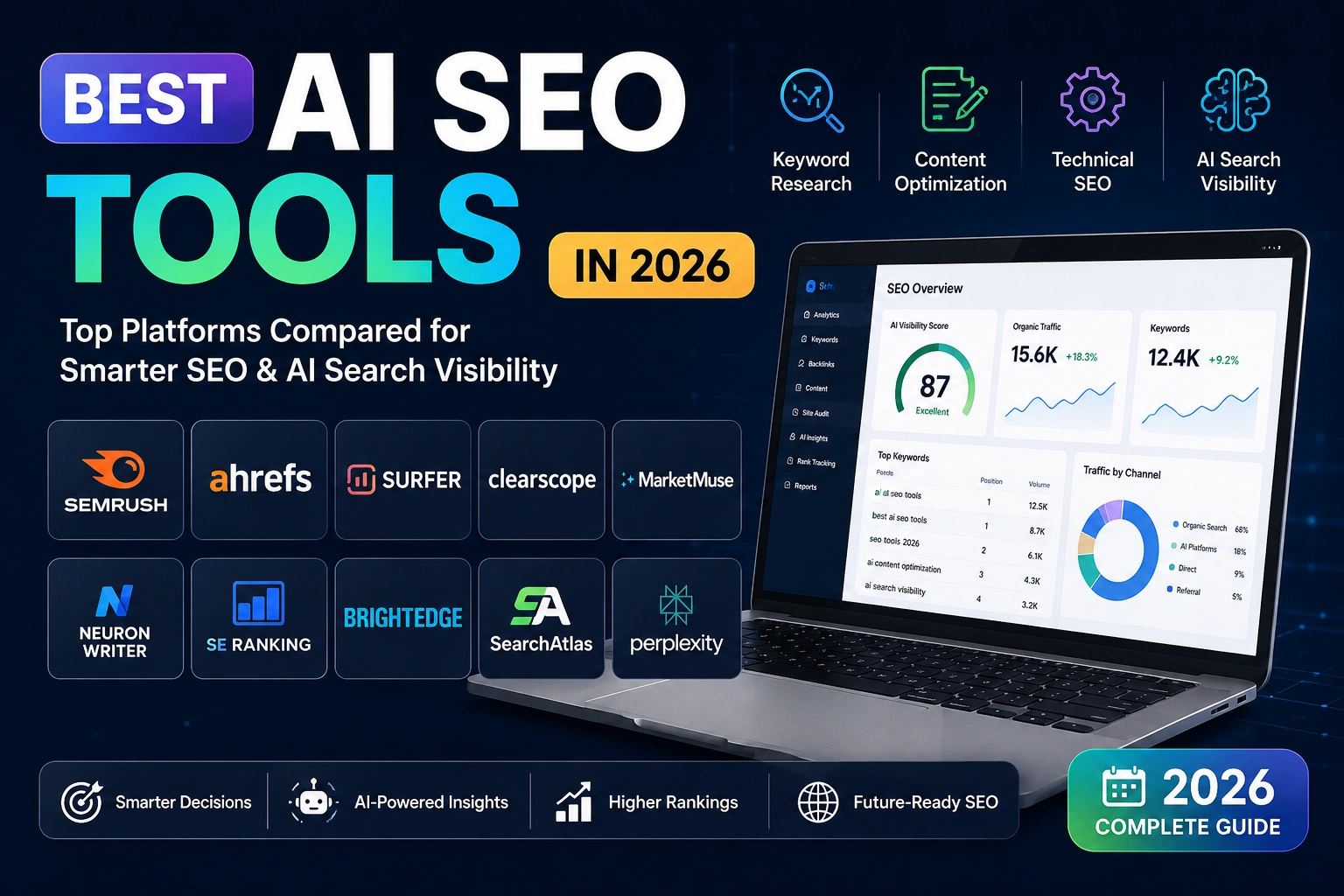
Best AI SEO Tools in 2026: The Complete Guide for Marketers, Bloggers & SEO Professionals
Why AI SEO Tools Matter More Than Ever in 2026
The SEO landscape in 2026 is significantly different from what it was just a few years ago.
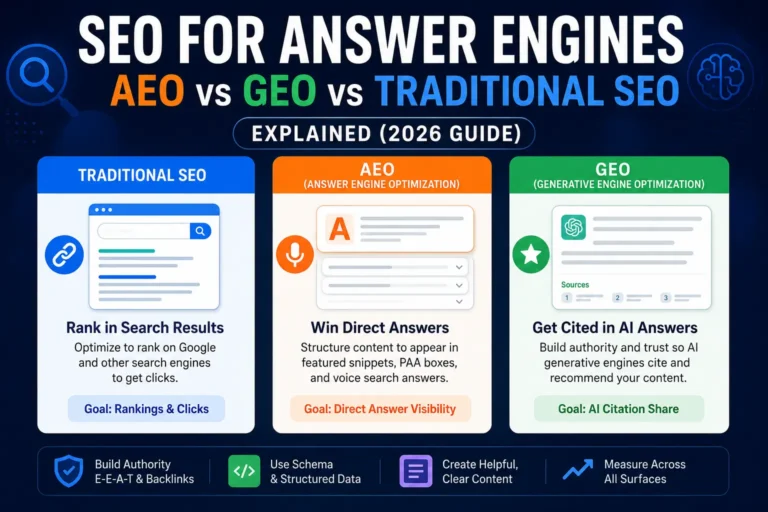
Search in 2026 looks nothing like it did three years ago. According to recent industry studies from SparkToro and Similarweb, around 65% of Google searches result in zero clicks, with mobile rates consistently higher than desktop. AI Overviews appear in roughly 15–21% of Google searches according to recent industry tracking data — a figure that continues to grow for informational and research-based queries. ChatGPT Search, Perplexity, Gemini, and other AI-powered search experiences are changing how people research and discover information online, adding entirely new visibility channels beyond traditional SERP rankings.
In this environment, doing SEO manually — relying on gut instinct, spreadsheets, and occasional keyword lookups — is like navigating a new city with a map from five years ago. Technically possible. Practically limiting.
AI SEO tools have evolved to match this new reality. The best ones in 2026 don’t just tell you what keywords to target. They analyze search intent at scale, identify topical gaps before your competitors do, optimize content for AI citation as well as traditional rankings, and monitor your visibility across both Google and generative AI platforms.
This guide covers the tools that are actually delivering results right now — with honest assessments of what each one does well, where it falls short, and who it’s best suited for.
How we evaluated these tools: Each platform in this guide was assessed against five criteria — AI search readiness, content optimization capability, technical SEO features, ease of use for non-developers, and value for money relative to the current SEO landscape.
⚡ Quick Comparison: Best AI SEO Tools at a Glance
|
Tool |
Best For |
Starting Price |
AI Search Ready |
Free Trial |
|---|---|---|---|---|
|
Semrush AI |
All-in-one SEO + content |
$139/month |
✅ Yes |
✅ 7 days |
|
Ahrefs |
Backlink & keyword research |
$129/month |
✅ Yes |
❌ No free trial; free tools via Ahrefs Webmaster Tools |
|
Surfer SEO |
Content optimization |
$99/month |
✅ Yes |
❌ No |
|
Clearscope |
Enterprise content teams |
$129/month |
✅ Yes |
❌ No |
|
MarketMuse |
Topical authority building |
Free / $99/month |
✅ Yes |
✅ Free plan |
|
NeuronWriter |
Budget content optimization |
$23/month |
✅ Yes |
✅ 7 days |
|
SE Ranking |
Mid-size businesses |
$129/month |
✅ Yes |
✅ 14 days |
|
BrightEdge |
Enterprise SEO |
Custom pricing |
✅ Yes |
❌ Demo only |
|
SearchAtlas |
AI search visibility |
$69/month |
✅ Strong |
✅ Free plan |
|
Perplexity Pro |
AEO & content research |
$20/month |
✅ Native |
❌ No |
⚠️ Pricing Note: Pricing and trial availability may change over time. Always check the official website before purchasing.
The Best AI SEO Tools in 2026 — In-Depth Reviews
1. Semrush AI — Best All-in-One Platform
If you could only choose one tool and needed it to cover the entire SEO workflow, Semrush is one of the most comprehensive SEO platforms available in 2026.
What started as a keyword research and competitive intelligence tool has evolved into a comprehensive AI-powered SEO suite. The 2025–2026 updates brought significant AI capabilities: an AI writing assistant integrated directly into the content editor, AI-generated content briefs, and the ContentShake AI feature that creates SEO-optimized drafts based on live SERP analysis.
What Semrush does particularly well:
- Keyword research across 20+ billion keywords with intent classification
- Competitive gap analysis — see exactly what your rivals rank for that you don’t
- Site audit with AI-prioritized issue scoring (tells you what to fix first, not just what’s broken)
- Position tracking with daily updates and SERP feature monitoring
- Semrush offers AI visibility and SEO intelligence features that help marketers monitor search performance and emerging AI-driven visibility signals
- Content optimization scoring with NLP-based recommendations
Where it falls short: The sheer breadth of Semrush can feel overwhelming for solo bloggers or small teams. And at $139/month for the entry-level Pro plan, it’s a meaningful investment — some features that were once included have moved to higher tiers.
Best for: SEO agencies, in-house marketing teams, consultants managing multiple clients.
Pricing: Pro $139/month | Guru $249/month | Business $499/month
2. Ahrefs — Best for Backlink Research and Keyword Intelligence
Ahrefs has one of the strongest backlink databases in the SEO industry — and in 2026, it has strengthened its AI capabilities considerably without losing the clean, focused interface that made it popular.
The AI features in Ahrefs’ current version center on two areas: AI-assisted content and keyword research features that help group related topics by search intent, and AI-generated content gap analysis that surfaces topic opportunities your site is missing relative to top competitors.
What Ahrefs does particularly well:
- Backlink analysis — one of the largest and most trusted backlink databases in the SEO industry
- Keyword Explorer with difficulty scores that reflect genuine ranking competition, not inflated estimates
- Content Explorer — find the best-performing content on any topic across the web
- Site Audit with crawl-based technical issue detection
- Rank Tracker with mobile/desktop split and SERP feature tracking
- AI-assisted content and keyword research features that save hours of manual organization
Where it falls short: Ahrefs’ content optimization features — while improving — are still not as strong as dedicated content tools like Surfer SEO or Clearscope. It also doesn’t have native content generation features, so you’ll likely pair it with a writing tool.
Best for: SEO specialists who prioritize link building, technical research, and competitive intelligence.
Pricing: Lite $129/month | Standard $249/month | Advanced $449/month (No free trial; free tools available for verified site owners through Ahrefs Webmaster Tools)
3. Surfer SEO — Best for Content Optimization
Surfer SEO has one of the clearest value propositions of any tool on this list: give it a keyword, and it will tell you exactly how to write content that ranks for it — based on a real-time analysis of the top-ranking pages.
Its Content Editor scores your article as you write, tracking keyword usage, headings, word count, and NLP terms derived from competitive analysis. A Surfer-optimized piece can help improve content quality and search relevance when used properly, particularly for mid-competition keywords.
In 2026, Surfer’s AI Humanizer and auto-optimize features have matured. You can generate an AI-written draft, run it through the optimizer, and get a polished, SEO-ready piece in significantly less time than manual writing alone.
What Surfer does particularly well:
- Real-time content scoring as you write or edit
- SERP Analyzer — deep dive into what makes top-ranking pages succeed
- Keyword Research with clustering and intent mapping
- AI-generated outlines and briefs based on competitive SERP data
- Audit tool for optimizing existing published content
- Integration with Google Docs, WordPress, and Jasper
Where it falls short: Surfer focuses almost entirely on on-page content optimization. It does not offer backlink data, technical site audits, or rank tracking as part of its core product. Think of it as a specialist, not a generalist.
Best for: Content writers, bloggers, and content marketing teams focused on producing optimized articles at volume.
Pricing: Essential $99/month | Scale $219/month | Scale AI $279/month (lower rates available on annual plans)
4. Clearscope — Best for Enterprise Content Teams
Clearscope occupies a specific and well-defined niche: it is the preferred content optimization tool for larger organizations where multiple writers, editors, and strategists collaborate on content at scale.
Its NLP-driven content grading is highly accurate, and the workflow integrations — WordPress, Google Docs, and custom CMS options — make it practical for teams rather than individuals. Where Surfer focuses on SERP-competitive scoring, Clearscope leans more heavily on semantic comprehensiveness — ensuring content covers a topic with enough depth and related terminology to satisfy AI-era search systems.
What Clearscope does particularly well:
- Content grading based on semantic richness and topical completeness
- Team collaboration features — multiple users, shared reports, role management
- Seamless integration into existing editorial workflows
- Consistent, reliable scoring that editorial teams can standardize around
- Keyword discovery tied directly to content performance data
Where it falls short: Clearscope is expensive relative to its feature set for solo users or small teams. At $129/month for the Essentials plan, it’s priced for organizational budgets. It also lacks technical SEO features — this is purely a content tool.
Best for: Content marketing teams at mid-size to enterprise companies with structured editorial processes.
Pricing: Essentials $129/month | Business $1,200/month | Enterprise — custom
5. MarketMuse — Best for Building Topical Authority
MarketMuse takes a different approach than most content optimization tools. Rather than optimizing a single piece of content, it analyzes your entire site’s content inventory and tells you where your topical authority is strong, where it’s weak, and exactly which articles to create or improve to outrank competitors across a topic cluster.
In the context of 2026’s SEO landscape — where topical authority has replaced keyword targeting as the core strategy signal — MarketMuse’s approach is exceptionally well-aligned with where search is heading. Understanding how AI search is changing SEO makes it clear why tools like MarketMuse have become more valuable, not less, as AI systems reward depth and coverage over individual keyword optimization.
What MarketMuse does particularly well:
- Topic modeling — visualize your site’s authority across entire subject areas
- Content briefs with recommended coverage based on competitive gap analysis
- First Draft AI — generates topic-complete drafts based on the brief
- Content inventory analysis — score every existing page and prioritize improvements
- Personalized difficulty scores based on your site’s specific authority level
Where it falls short: MarketMuse requires a meaningful time investment to extract full value. The platform’s depth is its strength and its complexity. The free plan is quite limited, and the paid plans can become expensive for individual bloggers as you move into the higher research and strategy tiers.
Best for: SEO strategists and content teams focused on systematic topical authority development.
Pricing: Free plan available | Optimize $99/month | Research $249/month | Strategy $499/month
6. NeuronWriter — Best Budget Tool for Content Optimization
NeuronWriter delivers a significant portion of what Surfer SEO and Clearscope offer at a fraction of the price — making it the standout choice for individual bloggers, freelance writers, and small businesses working with constrained budgets.
Its content editor uses NLP analysis and Google SERP data to generate optimization recommendations that are accurate and actionable. The built-in AI writing features — powered by advanced AI language models — allow you to draft, expand, and rewrite content directly within the platform.
What NeuronWriter does particularly well:
- Competitive NLP content analysis comparable to much more expensive tools
- AI content generation integrated directly into the optimization workflow
- SERP competitor analysis with content gap identification
- Internal linking suggestions — one of the most underrated features
- Affordable pricing that makes professional-grade optimization accessible
Where it falls short: NeuronWriter lacks the depth of data that Semrush or Ahrefs provide. It is purely a content optimization tool — no backlink research, no technical auditing, no rank tracking. For full SEO coverage, you would need to pair it with another platform.
Best for: Freelance writers, solo bloggers, and small businesses wanting professional content optimization without the enterprise price tag.
Pricing: Bronze $23/month | Silver $45/month | Gold $69/month
7. SE Ranking — Best for Growing Businesses
SE Ranking has carved out a strong position as the best-value comprehensive SEO platform for businesses that have outgrown free tools but aren’t ready for the complexity or cost of Semrush or Ahrefs.
Its 2026 AI features include an AI Content Writer integrated into the content module, AI-powered SERP analysis, and competitor research tools that surface actionable gaps without requiring deep SEO expertise to interpret. The interface is clean, well-organized, and accessible to marketers who aren’t full-time SEO specialists.
What SE Ranking does particularly well:
- Rank tracking with daily updates across multiple search engines and locations
- Website audit with prioritized technical issue recommendations
- Competitive research — keywords, traffic estimates, and ad strategy insights
- Content optimization module with NLP-based scoring
- White-label reporting — useful for agencies and freelancers managing client accounts
- AI content tools built natively into the platform
Where it falls short: SE Ranking’s backlink database, while useful, is smaller than Ahrefs’ or Semrush’s. For serious link building campaigns, you may find the data insufficient. It also lacks the advanced AI search visibility tracking that newer platforms have introduced.
Best for: Growing businesses, digital marketing agencies serving SMB clients, and in-house marketers at companies of 10–200 employees.
Pricing: Core $129/month | Pro $219/month | Business $369/month (check official site for current rates)
8. BrightEdge — Best for Enterprise SEO at Scale
BrightEdge is built for organizations managing hundreds or thousands of pages of content, often across multiple domains, markets, and languages. It is not a tool for individuals or small businesses — it is an enterprise platform with pricing and implementation complexity to match.
BrightEdge provides enterprise search data, AI-powered recommendations, and reporting tools for large-scale SEO teams. Its revenue-centric approach to prioritizing SEO actions is particularly useful for teams that need to justify investments to executive stakeholders.
What BrightEdge does particularly well:
- Enterprise-scale rank tracking and SERP monitoring
- Revenue-impact prioritization of SEO recommendations
- AI search citation tracking across major platforms
- Multi-market, multi-language SEO management
- Advanced reporting and executive dashboards
- Integration with enterprise data stacks (Salesforce, Adobe Analytics, etc.)
Where it falls short: BrightEdge is expensive — pricing is custom and typically runs to thousands of dollars per month. Implementation requires dedicated onboarding. It is definitively not built for agile teams or small-scale operations.
Best for: Enterprise SEO teams, large e-commerce operations, media companies, and global brands.
Pricing: Custom — typically $3,000–$10,000+/month
9. SearchAtlas (Otto SEO) — Best for AI Search Visibility
SearchAtlas and its Otto SEO platform have attracted significant attention among SEO professionals in 2026 for their AI-focused approach to search visibility.
While most platforms have retrofitted AI features onto traditional SEO toolsets, SearchAtlas was built from a more recent starting point and has prioritized AI search optimization features that older platforms are still catching up on. Otto SEO — its AI-powered optimization layer — is designed to help automate and recommend on-page SEO improvements across a site. Users should still review important changes before applying them, but in practice it significantly reduces the manual workload involved in large-scale optimization.
The platform’s AI citation tracking, AEO optimization features, and structured data tools make it particularly well-suited for brands focused on improving their visibility within AI-generated answers — not just traditional SERP rankings.
For a deeper understanding of how these visibility mechanisms work, this guide on improving brand visibility in AI search results explains the strategic foundation that tools like SearchAtlas are built to execute.
What SearchAtlas does particularly well:
- Otto SEO — automated on-page optimization at scale
- AI Overview and AI citation tracking
- Schema markup generation and implementation
- AEO content recommendations
- Local SEO features alongside national/international tracking
- Competitive AI share-of-voice analysis
Where it falls short: SearchAtlas is still maturing as a platform. Some features are less polished than those in more established tools, and the backlink research capabilities are not yet at the level of Ahrefs or Semrush. It is best used as a specialist tool within a broader stack, or as a primary tool for teams whose main focus is AI search optimization.
Best for: Forward-thinking SEO teams specifically focused on AI search visibility and AEO strategy.
Pricing: Starter $69/month | Growth $149/month | Pro $399/month | Agency $999/month
10. Perplexity Pro — Best AI Research Companion for AEO and Content Strategy
This entry might surprise you. Perplexity is not a traditional SEO tool — but for SEO professionals focused on AEO and content research, it has become a genuinely useful companion in the AI search era.
Using Perplexity Pro to query your target topics, track which sources it cites, analyze the structure of cited content, and identify gaps in how your brand or site appears in AI-generated answers provides a type of intelligence that no standard rank tracker offers. Think of it as a manual AEO testing environment rather than an automated SEO platform — valuable for understanding how AI systems consume and evaluate content in your niche.
When used alongside a dedicated AI search monitoring platform, Perplexity Pro creates a powerful picture of your current AI search presence and what it would take to improve it.
Best for: SEO professionals doing AEO research, content strategists, and anyone wanting to understand how AI search engines consume and evaluate content in their niche.
Pricing: Free tier available | Pro $20/month
Honorable Mentions: Also Worth Considering
The following tools didn’t make the top 10 list — either because they serve a more specific use case, are still maturing as platforms, or work best as add-ons to a broader SEO stack rather than standalone solutions. That said, each one is genuinely useful in the right context.
Frase Frase is a content optimization and brief-creation tool that competes in similar territory to Surfer SEO and NeuronWriter. It is particularly well-regarded for its AI-assisted content brief generation and question-research features. A solid choice for content teams wanting an affordable alternative to the more expensive platforms.
Screaming Frog (with AI-assisted workflows) Screaming Frog remains one of the most powerful technical SEO crawling tools available. It doesn’t natively generate AI content, but when combined with AI-assisted workflows for data analysis and issue prioritization, it delivers deep technical insights that browser-based tools often miss. Widely used by technical SEO specialists and agencies.
ContentKing ContentKing is a real-time SEO monitoring platform that continuously audits your site and alerts you to changes that could affect rankings — including content modifications, technical regressions, and structural shifts. Particularly valuable for larger sites where content changes frequently and monitoring needs to be ongoing rather than periodic.
OtterlyAI OtterlyAI is an emerging AI content optimization tool focused specifically on conversational and AI search optimization. Still maturing, but worth watching for teams building AEO-focused content strategies.
Ahrefs Brand Radar Ahrefs has been developing brand mention and visibility tracking features. Depending on current availability, Brand Radar may offer useful insights into how your brand appears across the web — useful context for both traditional SEO and AI citation strategy. Check Ahrefs’ official documentation for current feature availability.
How to Choose the Right AI SEO Tool for Your Needs
With ten platforms reviewed above, the natural question is: which one is right for you? The honest answer depends on four factors:
1. Your primary SEO goal
| Your Focus | Best Tool Match |
|---|---|
| All-in-one comprehensive SEO | Semrush AI |
| Backlink research + competitive intel | Ahrefs |
| Content optimization on a budget | NeuronWriter |
| Content optimization with team features | Clearscope |
| Topical authority strategy | MarketMuse |
| AI search visibility and AEO | SearchAtlas |
| Growing business, general SEO | SE Ranking |
| Enterprise scale | BrightEdge |
2. Your budget
- Under $30/month → NeuronWriter
- $69–$100/month → SearchAtlas or Surfer SEO
- $100–$150/month → MarketMuse (Optimize) or Ahrefs
- $129–$200/month → Semrush Pro, Clearscope, or SE Ranking
- Enterprise budget → BrightEdge
3. Your technical comfort level Semrush and Ahrefs have significant learning curves. NeuronWriter, SE Ranking, and Surfer SEO are considerably more accessible for users who aren’t full-time SEO specialists.
4. Your content vs. technical split If content creation is your primary output — blog posts, landing pages, articles — lean toward Surfer SEO, Clearscope, or MarketMuse. If technical auditing, rank tracking, and backlink research dominate your workflow, Semrush or Ahrefs serve you better.
Understanding what these tools do also requires a working knowledge of what good SEO looks like. A solid grounding in search engine positioning principles will help you use any of these platforms more effectively — because the tool is only as good as the strategy behind it.
Free vs Paid: What Can You Actually Get Without Spending?
This is a question worth addressing directly, especially for bloggers and small business owners working with limited budgets.
Genuinely useful free options in 2026:
- Google Search Console — The most important free SEO tool in existence. Tracks your actual search performance, identifies indexing issues, and shows which queries bring users to your site. Non-negotiable for any website.
- Google Analytics 4 — Essential for understanding how users behave after arriving from search.
- Ahrefs Webmaster Tools — Free for verified site owners. Gives crawl data, some keyword rankings, and backlink information for your own domain.
- MarketMuse Free Plan — Limited but functional for getting started with topic research.
- SearchAtlas Free Plan — Provides a baseline view of AI search visibility.
- Perplexity Free — Useful for manual AEO research and competitive citation analysis.
The honest reality: free tools will get you started, but they will not give you the competitive intelligence or content optimization depth needed to consistently outrank established sites in competitive niches. A mid-range investment in one solid tool — even $69–$129/month — typically returns its cost within a few months if used consistently.
Building a Complete AI SEO Stack for 2026
Rather than relying on one tool for everything, many professional SEO teams in 2026 run a small, focused stack — each tool doing what it does best:
The Lean Stack (Budget-conscious):
- SE Ranking (all-in-one core SEO) + NeuronWriter (content optimization)
- Total: ~$152/month
The Growth Stack (Most popular configuration):
- Ahrefs (research + backlinks) + Surfer SEO (content optimization) + SearchAtlas (AI visibility)
- Total: ~$397/month
The Enterprise Stack:
- BrightEdge (enterprise platform) + Clearscope (content) + dedicated AI monitoring tool
- Total: custom pricing
Whichever stack you build, the principle is the same: research, optimize, publish, track, iterate. The AI tools accelerate each stage — they don’t replace the strategic thinking that connects them.
For a deeper look at how these tools integrate into a broader SEO strategy, this guide on how AI search optimization tools improve SERP rankings is worth reading alongside this one.
Frequently Asked Questions (FAQ)
Q1: What is the best AI SEO tool for beginners in 2026?
SE Ranking and NeuronWriter are the most accessible entry points for beginners. SE Ranking provides a comprehensive overview of SEO health without overwhelming complexity, while NeuronWriter makes content optimization straightforward and affordable. Both offer free trials, which allows you to test the interface before committing.
Q2: Is Semrush still worth the price in 2026?
For agencies, consultants, and in-house teams managing meaningful SEO campaigns, yes — Semrush’s breadth of data and the quality of its AI-enhanced features justify the investment. For solo bloggers or small sites with limited budgets, it can be hard to use $139/month worth of features consistently. In that case, SE Ranking or a Surfer + Ahrefs combination often delivers better value.
Q3: Can AI SEO tools help me rank in Google’s AI Overviews?
Directly targeting AI Overview placement is still an emerging practice, but certain tools — particularly SearchAtlas and Semrush’s AI visibility features — now track AI Overview appearances and provide recommendations for improving citation frequency. The content strategies that drive AI Overview inclusion are also well-documented: comprehensive FAQ sections, structured data markup, strong E-E-A-T signals, and clear, factual writing.
Q4: How is AI SEO different from traditional SEO?
The core difference is the shift from ranking for individual keywords to being cited as a trusted source across entire topics. Traditional SEO optimized pages for specific search queries. AI SEO optimizes for topical authority, semantic completeness, and the kind of structured, credible content that AI systems extract and summarize. For a full breakdown of this shift, this guide on how AI search is changing SEO covers it comprehensively.
Q5: Do I need separate tools for ChatGPT Search and Google SEO?
Not necessarily. The content qualities that earn citation in ChatGPT Search — accuracy, structure, depth, clear attribution — overlap substantially with what earns strong Google rankings. That said, monitoring your presence specifically within AI-generated answers requires either manual testing or a dedicated AI citation tracking tool. The good news is that one well-executed content strategy, built around genuine topical authority, tends to perform across both environments.
Q6: What’s the difference between Surfer SEO and Clearscope?
Both optimize content using NLP analysis, but they serve different users. Surfer SEO is more competitive-analysis driven — it analyzes what’s currently ranking and tells you how to match or beat it. Clearscope focuses more on semantic completeness and is built for collaborative teams with editorial workflows. For solo creators, Surfer is generally more actionable. For organized content teams, Clearscope’s workflow features justify its higher price.
Q7: Are these tools useful for small local businesses?
Yes, with some nuance. SE Ranking has particularly strong local SEO features. Semrush and Ahrefs both include local keyword tracking and Google Business Profile insights. For hyperlocal SEO — targeting a specific city or neighborhood — these tools help identify exactly what local competitors rank for and where your visibility gaps are. Combine them with a well-maintained Google Business Profile and consistent local citation building for the strongest results.
📚 Continue Reading: Build Your Complete AI SEO Strategy
These guides from TotalInfoHub complement this tool comparison and cover the strategic side of AI-era SEO:
- 🔍 How AI Search Is Changing SEO (June 2026 Edition) — the full strategic picture of what’s shifted and why
- 📊 How AI Search Optimization Tools Improve SERP Rankings — the mechanics behind how these tools move the needle
- 🤖 ChatGPT vs Claude vs Gemini (2026) — choosing the right AI assistant to pair with your SEO tools
- 📈 Best Ways to Improve Brand Visibility in AI Search Results — beyond rankings, into AI citations
- 🛠️ AI Search Monitoring Platform: Improve Your SEO Strategy — how to track your presence across AI search engines
Final Thoughts
The best AI SEO tool in 2026 is not the one with the most features. It is the one you will actually use consistently — the one that fits your workflow, your budget, and your specific SEO goals.
For most growing websites and content businesses, a combination of one strong research and tracking platform (Semrush, Ahrefs, or SE Ranking) and one content optimization tool (Surfer SEO, NeuronWriter, or Clearscope) covers the essentials. If AI search visibility is a priority — and in 2026, it should be for anyone serious about organic growth — adding SearchAtlas or a dedicated AI citation monitoring tool completes the picture.
The tools are better than they have ever been. But they remain tools. The strategy, the consistency, the willingness to build genuine topical authority over time — that still comes from you.
Disclosure: Pricing, features, free trials, and AI capabilities for the tools mentioned in this article may change over time. The information above reflects our best understanding as of June 2026. Always check each tool’s official website before making a purchase or business decision.
📎 Sources & Further Reading
Zero-Click Search & AI Search Behavior Data
- SparkToro — Zero-Click Search Studies (sparktoro.com/research) — source for zero-click percentage data
- Similarweb — Search Market Share & Traffic Intelligence Reports (similarweb.com/blog)
- Search Engine Land — AI Overviews Coverage & Industry Analysis (searchengineland.com)
- Search Engine Journal — AI Search Trends & SEO Tool Coverage (searchenginejournal.com)
Official Tool Pricing & Documentation (always verify current pricing at each official site)
- Semrush Pricing — semrush.com/prices
- Ahrefs Pricing — ahrefs.com/pricing
- Surfer SEO Pricing — surferseo.com/pricing
- Clearscope Pricing — clearscope.io/pricing
- MarketMuse Pricing — marketmuse.com/pricing
- SE Ranking Pricing — seranking.com/prices
- SearchAtlas Pricing — searchatlas.com/pricing
- NeuronWriter Pricing — neuronwriter.com/pricing
SEO Strategy & AI Search Research
- Google Search Central — Official Best Practices & AI Overviews Documentation (developers.google.com/search)
- Google Search Quality Evaluator Guidelines — E-E-A-T framework (static.googleusercontent.com)
- BrightEdge Research — Enterprise AI Search Impact Reports (brightedge.com/resources)
- Ahrefs Blog — SEO Research & Case Studies (ahrefs.com/blog)
- Semrush Blog — AI SEO Trends & Tool Updates (semrush.com/blog)
Note: Statistics and pricing information referenced in this article were reviewed in June 2026 and may change over time.
This guide is reviewed and updated regularly as tools release new features and pricing changes. Last reviewed: June 2026.