Perplexity SEO: How to Rank in AI Answer Engines (2026 Guide)
More people are starting parts of their research journey on AI answer engines like Perplexity instead of relying only on traditional Google search.
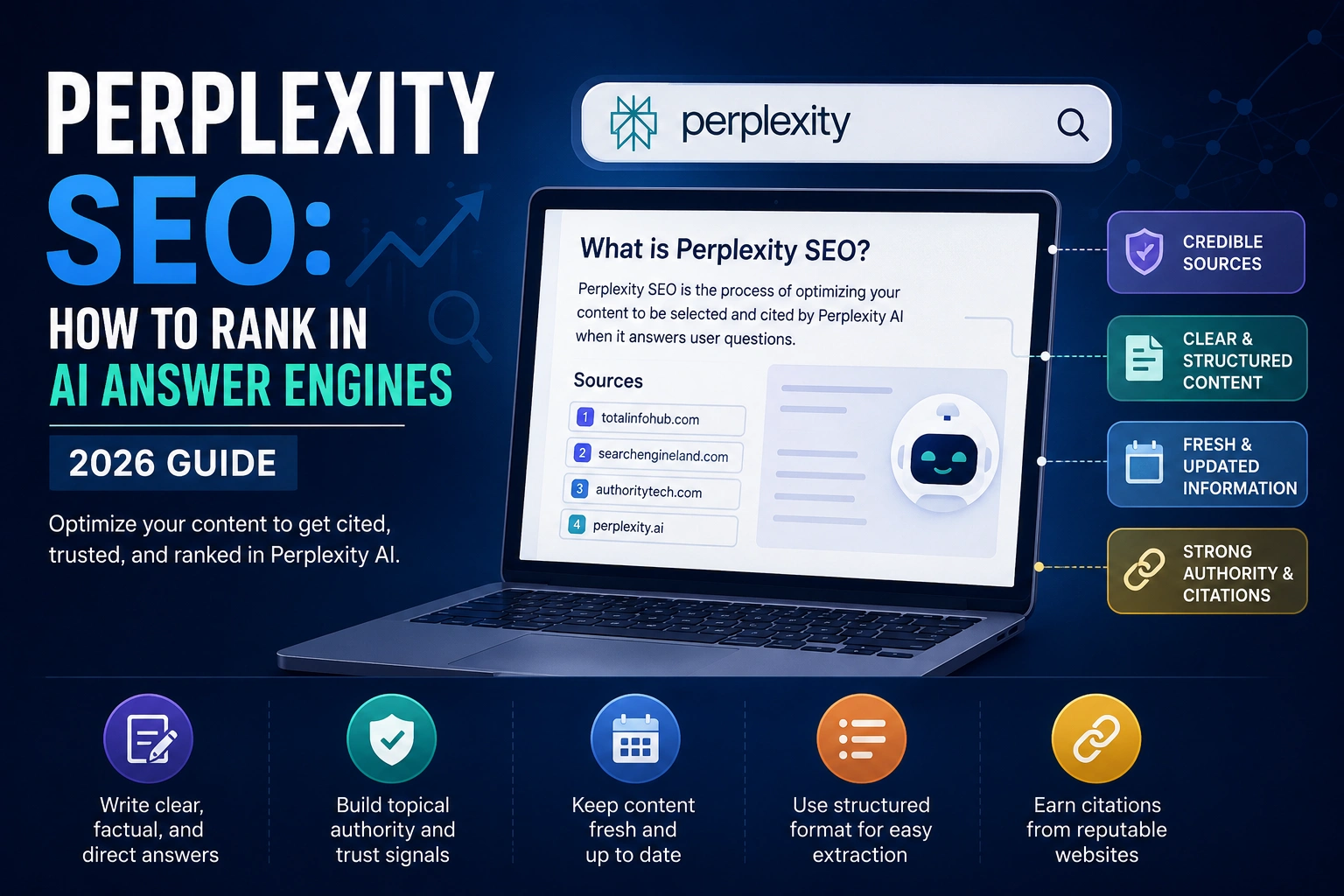
Perplexity is an AI answer engine — you ask it a question, and it gives you a clear, written answer with links to the sources it used. For website owners, that last part matters enormously. If Perplexity cites your content as a source, your brand gets seen by people who may never have found you through traditional search.
That is where Perplexity SEO comes in — the practice of optimizing your content so Perplexity selects, trusts, and cites it when answering user questions.
This guide breaks down how Perplexity actually chooses its sources, what kind of content it favors, and the practical steps you can take to get referenced. The language is simple, and every recommendation is something you can act on.
Quick Summary: What Perplexity SEO Involves
|
Element |
What It Means for Perplexity SEO |
|---|---|
|
Goal |
Get cited as a source in Perplexity’s answers |
|
Main signal |
Clear, factual, well-sourced content from credible domains |
|
Content format |
Direct answers, structured layout, FAQ sections |
|
Authority |
Strong E-E-A-T signals and external citations |
|
Freshness |
Recently updated content can have an advantage, especially where timeliness matters |
|
Measurement |
Manual citation checks + referral traffic tracking |
What Is Perplexity and Why Does It Matter?
Perplexity is an AI-powered answer engine. Instead of returning a list of ten blue links the way Google does, it reads multiple sources, combines what it finds, and writes a direct answer to your question — with numbered citations linking back to the sources it used.
This makes Perplexity feel less like a search engine and more like a knowledgeable research assistant. You ask, it answers, and it shows its work.
Its user base has grown quickly, especially among people who want fast, cited answers without opening multiple pages. For content creators and businesses, this growth represents a new visibility channel — one that works differently from traditional search and rewards clear, trustworthy, and well-structured content.
If your audience includes researchers, professionals, or anyone who prefers cited answers, being visible on Perplexity is becoming as important as ranking on Google. And because the optimization approach overlaps heavily with generative engine optimization (GEO), the effort you put into Perplexity SEO supports your visibility across other AI platforms too.
How Perplexity Is Different from Google
Understanding the difference shapes how you approach Perplexity SEO.
Google returns a ranked list of links. You scan the results, click a few, and find your answer yourself. Success in Google SEO means ranking high enough that people click your link.
Perplexity writes the answer for you and cites its sources inline. You often get what you need without leaving the page. Success in Perplexity SEO means becoming one of the cited sources in that written answer.
There are a few other practical differences worth knowing:
Perplexity often appears to prioritize recently updated content, especially for topics where freshness matters. Industry observations suggest content updated within the last 30 days can have a measurable advantage. Outdated content is less likely to be cited.
Perplexity values clear sourcing. Because it shows its citations to users, it leans toward content that is factual, well-attributed, and from credible domains — content it can confidently stand behind.
Perplexity reads multiple sources per answer. A single answer often cites three to four different sources. This means you do not need to beat everyone — you need to be one of the trusted sources on a topic.
Perplexity can access live web results for many queries, which makes freshness and current information more important. Unlike AI tools with fixed knowledge cutoffs, this allows it to surface newer sources and more up-to-date answers. That is one reason recently updated content often has a stronger chance of being cited, especially on fast-changing topics.
How Perplexity Chooses Which Sources to Cite
Perplexity does not publish a detailed ranking formula, so much of what we know comes from observed citation patterns and industry analysis rather than official documentation. Based on those observations, several factors appear to influence which sources get cited.
Credibility of the domain Well-established sites with a track record of accurate information appear to get cited more consistently. This reflects the broader pattern across AI search tools — trust signals matter.
Clarity and directness of the answer Content that answers a question clearly and early is easier for Perplexity to extract and attribute. Buried answers are harder to use.
Factual accuracy and sourcing Because Perplexity shows citations to users, it appears to favor content that is factual and itself well-sourced. Content that cites credible references signals reliability.
Freshness Perplexity often appears to prioritize recently updated content, especially for topics where freshness matters. Industry observations suggest content updated within the last 30 days can have a measurable advantage. Regularly updated pages have an edge over stale ones, especially in fast-moving subject areas.
Topical relevance and depth Content that thoroughly addresses the specific question — and the topic around it — appears more likely to be selected than thin or tangential content.
It is worth being honest here: nobody outside Perplexity knows the exact weighting of these factors. What we have is informed observation. The good news is that these factors align closely with what makes content genuinely good — which means optimizing for Perplexity mostly means producing better, clearer, more trustworthy content.
Perplexity SEO Strategies That Actually Work
1. Write Clear, Factual, Direct Answers
Perplexity is built to extract answers. The clearer your answer, the easier it is to extract and cite.
Lead each section with a direct response to the question it addresses. State the fact or answer first, then add context and detail afterward. Avoid long introductions before getting to the point.
A practical test: if someone asked Perplexity the exact question your section answers, could the tool lift a clean, accurate sentence or two from your content? If yes, you are structured well. If the answer is tangled up in a long paragraph, simplify it.
Keep your writing factual and precise. Perplexity is used heavily for research, and it favors content it can confidently present as accurate.
2. Strengthen Your Source Credibility
Perplexity tends to favor credibility signals based on observed citation patterns. Well-sourced content from established domains appears to get cited more consistently, based on industry observation.
You build that credibility over time through several things:
- Clear authorship — named authors with relevant expertise and credentials
- Accurate information — content that holds up to scrutiny and stays factually correct
- Your own citations — when your content references credible sources, it signals that your information is grounded rather than invented
- A clear organizational identity — an About page, contact details, and transparent ownership all build trust
This is the same E-E-A-T foundation that supports visibility across AI search tools. Strong credibility signals do double duty — helping you on Perplexity, Google AI Overviews, and other platforms at once.
3. Keep Your Content Fresh and Updated
Freshness matters more on Perplexity than on many traditional search platforms.
Because Perplexity pulls live web information and is widely used for current, research-oriented questions, it often appears to prioritize recently updated content, especially for topics where freshness matters. Industry observations suggest content updated within the last 30 days can have a measurable advantage. A guide updated in 2026 is more likely to be cited than an identical guide last touched in 2023.
Practical steps:
- Review and update your important pages regularly
- Add current data, recent examples, and updated figures where relevant
- Update your “last reviewed” date when you make meaningful changes
- Refresh statistics and references so your content stays accurate
This does not mean rewriting everything constantly. It means keeping your key content current enough that it remains a reliable, citable source.
4. Structure Content for Easy Extraction
The way you organize content directly affects how easily Perplexity can use it.
Use question-based headings. Headings phrased as actual questions match how people ask Perplexity things — and make it easier for the tool to map your content to a query.
Add FAQ sections. Question-and-answer pairs are among the most extractable content formats. A clear FAQ section gives Perplexity ready-made answers it can cite.
Use lists and clear formatting. Numbered steps, bullet points, and short paragraphs are easier to parse than dense blocks of text.
Implement schema markup. Structured data — particularly FAQPage and Article schema — helps AI systems understand your content’s structure and type. It does not guarantee citation, but it removes friction.
The principles here overlap heavily with how to rank content in Google AI search results — clear structure helps you across every AI answer engine, not just Perplexity.
5. Build Topical Depth
Perplexity, like other AI engines, appears to favor sources that demonstrate genuine depth on a subject rather than surface-level coverage.
Publishing a single article on a topic is less powerful than building a connected cluster of content that covers the subject thoroughly — the main question, the related questions, and the surrounding context.
When your site demonstrates that it genuinely understands a topic across multiple well-linked pages, it becomes a more natural citation source. This topical authority builds over time and pays off across all AI search platforms. Approaching your content with strong keyword research in the age of AI helps you map out the full range of questions worth covering.
6. Earn Citations from Other Trusted Sites
When credible websites reference your content, it strengthens your overall authority — and that authority appears to influence how AI engines treat your site as a source.
This is not just about backlinks for traditional SEO. It is about building the kind of external validation that signals trustworthiness to AI systems.
Ways to earn these references:
- Publish original research, surveys, or data that others want to cite
- Create genuinely useful reference content that becomes a go-to resource in your niche
- Get quoted as an expert in industry publications and interviews
- Build relationships with other credible publishers in your space
Each credible mention strengthens your position as a trustworthy entity — which supports both Perplexity SEO and broader brand visibility in AI search results.
Content Types Perplexity Tends to Cite
Based on observed citation patterns, certain content formats appear more frequently in Perplexity’s answers:
Well-researched guides and explainers In-depth content that thoroughly answers a question is a natural fit for an engine built to provide complete answers.
Data and original research Perplexity is used heavily for factual research. Original data, surveys, and statistics give it credible material to cite when making factual claims.
Clear definitions and reference content Content that defines terms, explains concepts, and serves as a reference resource aligns well with how people use Perplexity.
Comparison content Articles that compare options, tools, or approaches give Perplexity structured information to summarize when users ask “what’s the difference between X and Y?”
FAQ and Q&A content Direct question-and-answer formats are highly extractable and map naturally to the questions users ask.
Authoritative news and analysis For current topics, well-sourced reporting and analysis from credible outlets is frequently referenced.
The common thread: clear, factual, well-structured content from sources Perplexity can trust.
Perplexity SEO vs Traditional SEO vs GEO
These approaches overlap, but each has a distinct focus.
|
Aspect |
Traditional SEO |
Perplexity SEO |
GEO (broader) |
|---|---|---|---|
|
Primary target |
Google ranked links |
Citations in Perplexity answers |
Citations across all AI engines |
|
Main goal |
Rank and earn clicks |
Become a cited source on Perplexity |
Become a cited source everywhere |
|
Key strength |
Backlinks + keywords |
Credibility + freshness + clarity |
Authority + structure + entity recognition |
|
Freshness importance |
Moderate |
High |
Varies by platform |
|
Measurement |
Rankings, traffic |
Citation checks, referral traffic |
AI citation share, branded search |
The practical reality: Perplexity SEO is a specialized slice of GEO. Most of what helps you on Perplexity also helps you on Google AI Overviews and ChatGPT Search. You do not need a completely separate strategy — you need strong, credible, well-structured content, with extra attention to freshness and sourcing for Perplexity specifically.
For the bigger picture, our guide on GEO covers how all these AI platforms fit together.
Common Mistakes to Avoid
Publishing thin content and expecting citations Perplexity favors substance. Short, generic content rarely gets cited regardless of how well it is structured. Depth and accuracy come first.
Letting content go stale Because Perplexity favors freshness for many topics, outdated content loses citation potential over time. Neglecting updates is a slow way to disappear from AI answers.
Ignoring source credibility Content from sites with weak authority signals, no clear authorship, and no external validation is less likely to be trusted. Building credibility is not optional.
Writing for keywords instead of questions Perplexity users ask full, natural questions. Content optimized only for short keyword phrases is less aligned with how people actually query the platform.
Treating Perplexity as completely separate from other SEO Perplexity SEO is part of a connected AI search strategy. Optimizing only for Perplexity while ignoring traditional SEO and broader GEO weakens your overall results — these efforts reinforce each other.
Making unverifiable claims Because Perplexity presents cited information to users as fact, it favors content it can trust. Exaggerated or unsupported claims work against you. Accuracy is a citation advantage.
How to Track Your Perplexity Visibility
Measuring Perplexity SEO requires a different approach than traditional rank tracking. Here is what works:
Manual citation checks Ask Perplexity the questions your content targets and see whether your site appears in the cited sources. Note which pages get cited and what content format they use. This is the most direct method — and it is free.
Referral traffic tracking When users click through from a Perplexity citation, it can generate referral traffic. Check your website analytics for referrals from Perplexity to see whether your citations are driving visits.
Branded search monitoring Increases in people searching for your brand name can indicate growing visibility across AI platforms, including Perplexity. Track branded search trends in Google Search Console.
AI monitoring tools Some platforms now offer AI citation tracking that includes Perplexity. Features change frequently, so verify current capabilities before relying on any tool. Our roundup of the best AI SEO tools in 2026 covers the monitoring options available.
Frequently Asked Questions
Q1: What is Perplexity SEO?
Perplexity SEO is the practice of optimizing your content so the Perplexity AI answer engine selects and cites it when answering user questions. Unlike traditional SEO, which focuses on ranking in Google’s link results, Perplexity SEO focuses on becoming one of the trusted sources Perplexity references in its written answers. The core requirements are clear writing, factual accuracy, strong credibility signals, and fresh, well-structured content.
Q2: How is ranking in Perplexity different from ranking in Google?
In Google, success means appearing high in the ranked list of links so people click through to your site. In Perplexity, success means being cited as a source within the AI-written answer. Perplexity also places more emphasis on freshness and clear sourcing than traditional Google rankings, because it presents cited information directly to users and pulls from live web data.
Q3: Does freshness really matter for Perplexity SEO?
Yes — more than for many traditional search scenarios. Perplexity pulls live web information and is widely used for current, research-oriented questions. It often appears to prioritize recently updated content, especially for topics where freshness matters. Industry observations suggest content updated within the last 30 days can have a measurable advantage. Keeping your important pages updated improves your chances of being cited, especially in fast-moving subject areas.
Q4: Can small websites get cited by Perplexity?
Yes. Perplexity does not exclusively favor large domains. A smaller site with genuinely accurate, well-sourced, and clearly structured content on a specific topic can get cited — sometimes more reliably than a larger site with thinner coverage of that exact question. Niche expertise, presented credibly, is a real advantage.
Q5: Do I need a separate strategy for Perplexity and Google AI Overviews?
Not entirely. The foundations overlap heavily — clear structure, factual accuracy, strong credibility signals, and topical depth help you across both. Perplexity places extra weight on freshness and sourcing, so paying attention to those specifically helps. But a single strong content strategy, executed well, tends to support visibility across multiple AI engines at once. This is the core idea behind GEO.
Q6: Does schema markup help with Perplexity SEO?
Schema markup helps AI systems understand your content’s structure and type, which can support how easily your content is parsed and extracted. However, no schema type guarantees citation in any AI engine, including Perplexity. Think of schema as removing friction and improving comprehension — a helpful supporting practice rather than a guaranteed path to citation.
Q7: How do I know if Perplexity is citing my content?
The most direct method is manual checking — ask Perplexity questions related to your content and see whether your site appears in the cited sources. You can also monitor your website analytics for referral traffic from Perplexity, and track branded search volume as an indirect signal of growing AI visibility. Some dedicated AI monitoring tools also track Perplexity citations, though capabilities vary.
Final Verdict
Perplexity SEO is not a gimmick or a passing trend. It reflects a genuine shift in how people find information — and a new opportunity for content creators who get ahead of it.
The encouraging part is that optimizing for Perplexity mostly means doing the things good content creators should already be doing: writing clearly, staying accurate, keeping content fresh, building genuine authority, and structuring information so it is easy to understand and extract.
If you want to start improving your Perplexity visibility, focus on three things first:
1. Audit your most important pages for clarity and freshness. Make sure each one answers its core question directly and reflects current information.
2. Strengthen your credibility signals. Add clear authorship, cite your sources, and make your organizational identity obvious.
3. Start checking your citations manually. Ask Perplexity the questions your content targets and see where you currently stand. That baseline tells you exactly what to improve.
Perplexity SEO is still early enough that consistent, deliberate effort creates a real advantage. The creators who build credible, fresh, well-structured content now will be the ones Perplexity reaches for as the platform continues to grow.
Disclaimer: AI answer engines like Perplexity evolve rapidly, and their citation behavior is not fully documented publicly. The guidance in this article is based on industry observation and publicly available information as of June 2026. Always test and verify with your own content and queries, as platform behavior can change.
Sources and Further Reading
Official and Industry Sources
- Perplexity AI — Official Website — perplexity.ai
- Google Search Central — Structured Data Guidelines — developers.google.com/search
- Search Engine Journal — AI Search and Perplexity Coverage — searchenginejournal.com
- Search Engine Land — AI Answer Engine Analysis — searchengineland.com
Related Guides on TotalInfoHub
- Generative Engine Optimization (GEO) — totalinfohub.com/generative-engine-optimization-geo/
- How to Rank Content in Google AI Search Results — totalinfohub.com/how-to-rank-content-in-google-ai-search-results/
- How AI Search Is Changing SEO — totalinfohub.com/how-ai-search-is-changing-seo/
- Best Ways to Improve Brand Visibility in AI Search Results — totalinfohub.com/best-ways-to-improve-brand-visibility-in-ai-search-results/
- Keyword Research in the Age of AI — totalinfohub.com/keyword-research-in-the-age-of-ai/
- Best AI SEO Tools in 2026 — totalinfohub.com/best-ai-seo-tools/
Last reviewed: June 2026