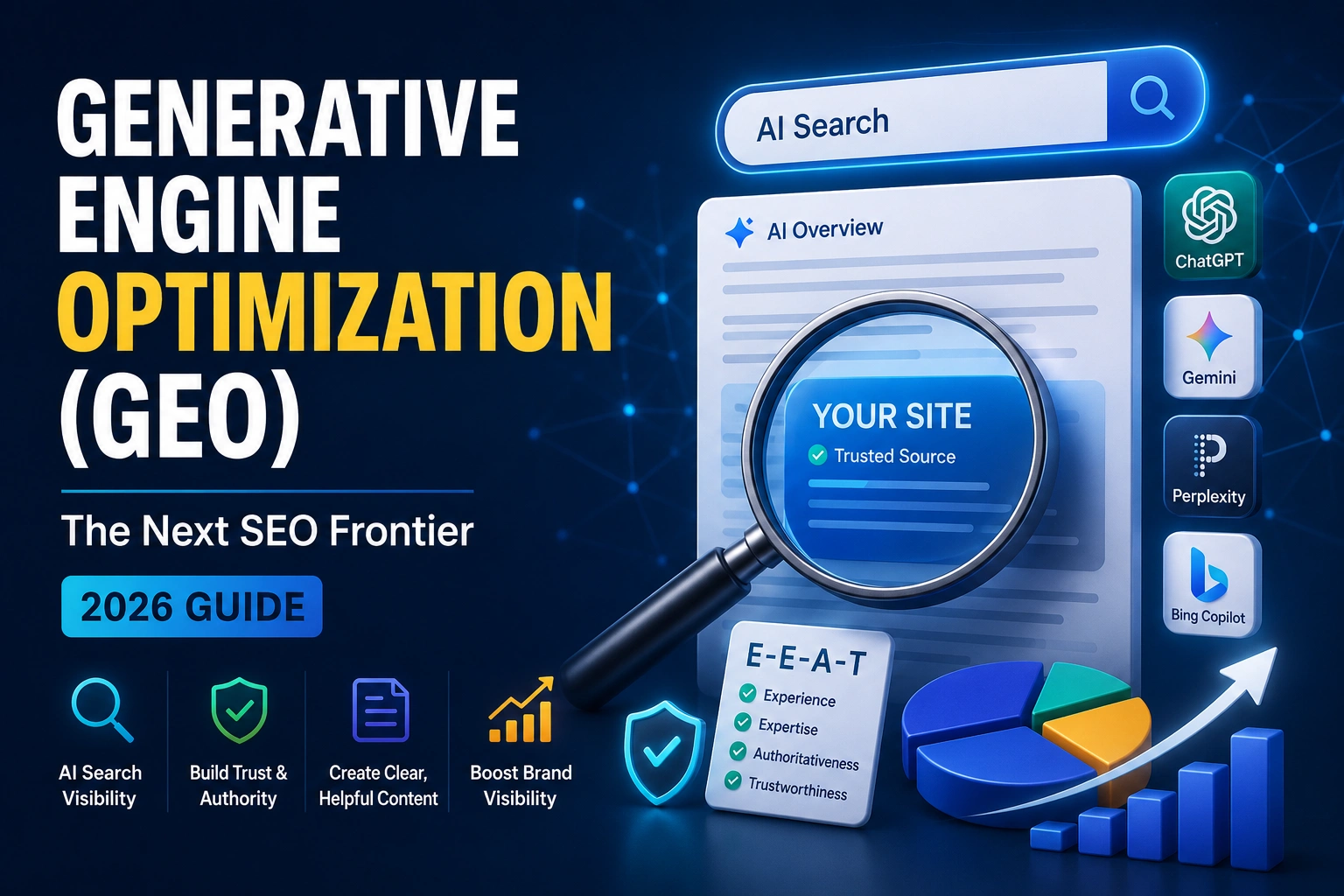
Generative Engine Optimization (GEO): The Next SEO Frontier (2026 Guide)
The way we find information has shifted dramatically over the past few years.
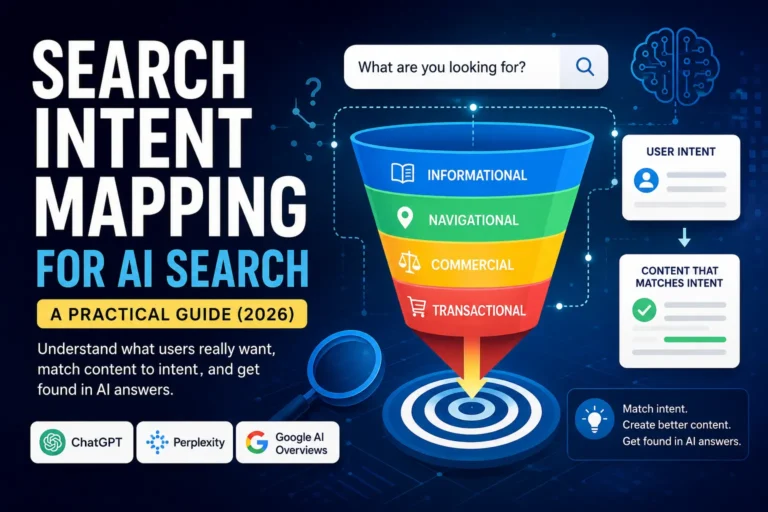
In the past, you would enter a search term, scan a page of links, and visit a few sites to piece together your answer. These days, a huge number of people simply ask ChatGPT, Perplexity, or Google’s AI Overview — and a complete, polished answer shows up right away, no clicking required.
That shift has created a new discipline: Generative Engine Optimization, or GEO.
GEO means shaping your content so it shows up inside AI-generated answers — rather than only competing for position in the traditional ranked results. Rather than fighting for a top spot on Google’s first page, the aim is to be the source an AI tool references when it responds to your audience’s questions.
This guide covers what GEO is, why it matters in 2026, and exactly what to do about it — in plain language, without the jargon.
Quick Summary: GEO vs Traditional SEO vs AEO
|
Dimension |
Traditional SEO |
AEO (Answer Engine Optimization) |
GEO (Generative Engine Optimization) |
|---|---|---|---|
|
Target |
Google’s ranked link results |
Featured snippets, PAA boxes |
AI-generated answers (ChatGPT, Gemini, Perplexity) |
|
Goal |
Rank in top 10 blue links |
Win the direct answer box |
Get cited as a source in AI responses |
|
Traffic type |
Click-through traffic |
Zero-click + some clicks |
Brand visibility + AI referral traffic |
|
Key signals |
Backlinks, keywords, CTR |
Clear answers, schema, structure |
E-E-A-T, topical authority, citations, structure |
|
Measurement |
Keyword rankings |
Featured snippet wins |
AI citation share, branded search volume |
|
Content format |
Long-form keyword pages |
Concise direct answers |
Authoritative, structured, citable content |
What Is Generative Engine Optimization (GEO)?
GEO stands for Generative Engine Optimization.
It refers to the process of optimizing your content so that AI-powered search tools — like Google AI Overviews, ChatGPT Search, Perplexity AI, and Microsoft Bing Copilot — select your content as a source when generating answers for users.
The term was formally introduced in a 2024 research paper by academics from Princeton University and IIT Delhi, along with independent researchers. The paper was later published at KDD ’24. They studied how different content characteristics affected whether AI engines chose certain sources over others in generated responses.
They found a consistent pattern: content with strong structure, credible information, and clear writing was selected more often as a source in AI-generated responses than content that lacked those qualities.
In simple terms, GEO is about making your content easier for AI systems to understand, trust, and pull into their answers.
Why GEO Matters Right Now
Here is the honest picture of search in 2026.
According to Ahrefs’ September 2025 analysis of 146 million SERPs, AI Overviews appear in approximately 20.5% of U.S. Google searches. That number is higher for informational and research queries — exactly the type of content most blogs and business websites publish.
SparkToro and Datos research found that approximately 60.45% of U.S. Google searches ended without a click in 2024. More recent industry data suggests this rose to around 68% in early 2026. Users are getting what they need directly on the search results page.
What this means practically: ranking on page one is no longer enough to guarantee traffic from informational queries. If an AI system summarizes the answer to a question and your content is not the cited source, your ranking does not matter to that user.
But here is the part most people overlook. Being cited inside an AI Overview — even without a click — builds brand awareness. Research shows a correlation between AI Overview citations and increases in branded search volume, meaning more people search directly for your brand name after seeing it cited by an AI tool.
GEO is not just about traffic anymore. It is about visibility in a search environment that has fundamentally changed. Understanding how deeply this shift runs is worth your time — our guide on how AI search is changing SEO covers the full picture.
How AI Engines Decide What to Cite
AI search tools do not rank content the same way Google’s algorithm does. Backlinks and keyword frequency are not their main concern. What they are really after is the clearest, most reliable, and most genuinely helpful response to whatever the user asked.
Several things shape whether an AI system picks your content as a source:
Clarity and directness These tools pull out precise answers to precise questions. When your content opens with a straightforward answer — instead of hiding it beneath several paragraphs of setup — it becomes far easier for an AI to lift and credit it.
Authority and trust signals Content from sources that are well-cited by others, have clear authorship, and demonstrate genuine expertise is weighted more heavily. This is the heart of E-E-A-T (Experience, Expertise, Authoritativeness, Trustworthiness) — Google’s quality framework, which AI systems broadly reflect in their source selection behavior.
Topical coverage depth AI engines tend to favor sources that cover a subject comprehensively, not just surface-level. A site that has published multiple interconnected pieces on a topic is more likely to be treated as authoritative than one with a single article.
Structured content Question-based headings, FAQ sections, clear numbered lists, and organized layouts all make it easier for AI systems to parse and extract useful information from your pages.
Schema markup Structured data — particularly FAQPage, HowTo, and Article schema — helps AI systems understand exactly what type of content is on each page and what specific information can be extracted from it.
GEO vs Traditional SEO vs AEO: Key Differences
These three terms get confused frequently. Here is a clear breakdown.
Traditional SEO focuses on ranking in Google’s standard link results. The goal is to appear in the top ten blue links for target keywords. Success is measured in rankings and organic click-through traffic.
AEO (Answer Engine Optimization) is about capturing featured snippets, People Also Ask results, and voice search responses inside the regular search results. The aim is to be the one direct answer Google highlights at the very top of a results page.
GEO (Generative Engine Optimization) takes this a step further. Here the objective is to show up within AI-written responses across several platforms — Google AI Overviews, ChatGPT Search, Perplexity, and the rest. These tools pull together information from many sources and credit citations along the way. With GEO, you are working to be one of those credited sources.
All three matter in 2026. They reinforce each other — good traditional SEO improves your authority signals, which improves your GEO potential. But they require different content approaches and different measurement frameworks. Our comparison of AI SEO vs Traditional SEO explores this relationship in more detail.
The 8 Core GEO Strategies
1. Write Direct-Answer Content
This is the most immediately actionable GEO strategy.
These tools are built to pull precise answers out of content. When you make that easy — by opening each section with a clear, short answer — your content gets lifted and credited far more often than writing that flows as one long narrative.
What this looks like in practice:
- Turn your H2 and H3 headings into actual questions: “What is generative engine optimization?” works better than “Understanding the basics”
- Give the answer in your opening sentence or two, then add the surrounding context afterward
- Keep those answers short and grounded in fact
- Put a dedicated FAQ section on every important page — these question-and-answer pairs rank among the formats AI tools reference most often
The structural principle is simple: if a user asked this question to an AI, could that AI easily extract your answer and attribute it to your page? If yes, your content is well-positioned. If not, restructure.
2. Build Real Topical Authority
AI engines favor sources that demonstrate deep, consistent expertise in a subject area — not just a single good article.
Industry observations suggest that sites with comprehensive topic coverage — a main pillar piece supported by multiple related articles addressing subtopics, related questions, and adjacent concepts — are more likely to be referenced by AI systems than sites with isolated content.
This means your GEO strategy should think at the topic level, not just the keyword level. Map out the full landscape of questions your audience has. Publish content that addresses each layer. Link these articles together so AI crawlers can navigate the full scope of your coverage.
As this builds up, your site develops the kind of subject-area presence that makes it a natural reference point — not for a single search, but across an entire topic. Our guide on keyword research in the age of AI walks through how to handle this topic-first kind of research.
3. Strengthen Your E-E-A-T Signals
E-E-A-T stands for Experience, Expertise, Authoritativeness, and Trustworthiness. Google describes it as a quality evaluation framework rather than a direct ranking factor — but the signals that demonstrate E-E-A-T are heavily reflected in which sources AI systems trust and cite.
Experience Bring real-world observations, case studies, and your own first-hand data into the content. Saying “when we tested this, here is what happened…” lands with more credibility than simply repeating points other sources have already covered.
Expertise Use named authors with verifiable credentials and relevant experience. Anonymous content lacks the attribution signals that AI systems use to evaluate source credibility.
Authoritativeness Get cited by other credible sources in your industry. Mentions, backlinks, and references from authoritative sites build the external validation that AI systems recognize.
Trustworthiness Keep your information accurate and updated. Cite your sources where relevant. Maintain a clear organizational identity — About pages, contact information, and transparent authorship all contribute.
4. Use Schema Markup Properly
Schema markup tells AI systems exactly what type of content is on your page — not through prose, but through structured data that machines read directly.
The most valuable schema types for GEO:
|
Schema Type |
What It Does for GEO |
|---|---|
|
FAQPage |
Maps question-and-answer pairs for direct AI extraction |
|
Article / BlogPosting |
Establishes content type, authorship, and publication date |
|
HowTo |
Structures step-by-step processes for AI summarization |
|
Organization |
Builds entity recognition for your brand |
|
BreadcrumbList |
Helps AI understand site structure and topic hierarchy |
|
Review / AggregateRating |
Adds trust signals to product or service content |
An important clarification: Google states that structured data is not required for AI Overviews, and there is no schema type specifically designed for GEO. However, schema markup helps AI systems correctly understand and classify your content — which supports the overall citation process. Think of it as removing friction, not guaranteeing placement.
5. Optimize for Conversational Queries
The way people phrase questions to AI search tools is fundamentally different from how they type keywords into a traditional search box.
Traditional search query: email marketing tools Conversational AI query: What email marketing platform is best for a small online store sending fewer than 5,000 emails per month?
These are different requests. The second one is longer, more specific, and context-rich — and it rewards content that addresses nuance rather than just matching a keyword.
How to optimize for conversational queries:
- Research the actual questions your audience asks using Google’s People Also Ask boxes, Reddit, Quora, and customer conversations
- Write content that addresses the full context of a question — not just the headline term
- Anticipate follow-up questions and answer them in the same piece
- Use natural, conversational language throughout — the way your audience actually speaks about the topic
6. Get Cited by Other Authoritative Sources
This is one of the most powerful — and most underused — GEO strategies.
When other credible websites, publications, and platforms reference your content, your brand becomes part of a web of citations that AI systems recognize as a trust signal. This is not just about backlinks for PageRank. It is about building the kind of external validation that tells AI engines your content is worth citing.
Practical ways to earn citations:
- Publish original research, surveys, or data that others in your industry will reference
- Write in-depth guides that become reference resources in your niche
- Get quoted as an expert source in industry publications, podcasts, and news coverage
- Create content that addresses questions journalists and researchers commonly need answered
Each mention builds your entity authority — the AI-era equivalent of domain authority. Strategies for expanding this visibility are covered in detail in our guide on improving brand visibility in AI search results.
7. Build Your Brand as a Recognized Entity
AI systems think in entities — people, organizations, products, and concepts with clearly defined attributes and relationships. Brands that are recognized entities in the AI knowledge graph get cited more readily than brands that exist only as domain names.
How to build entity recognition:
- Maintain consistent brand name, description, and contact information across your website, social profiles, and business directories
- Claim and optimize your Google Business Profile
- If a Wikipedia page exists for your brand, keep it current — or work toward earning one
- Use Organization schema on your About and Contact pages
- Get your brand mentioned consistently across authoritative platforms in your industry
Entity building is a long-term strategy. But brands that invest in it now have a compounding advantage — the more an AI system recognizes your brand as a defined entity, the more likely it is to cite you across a wide range of related queries.
8. Monitor Your AI Search Presence
Improvement depends on measurement — you cannot fix what you are not tracking. GEO introduces a fresh measurement layer that sits alongside your usual SEO analytics, and most everyday tools will not pick it up on their own.
Methods to track your GEO performance:
Manual spot-checking Run your target queries through Google and watch for whether an AI Overview shows up. Take note of which sources get credited. Repeat the process in Perplexity and ChatGPT Search. It costs nothing and tells you a lot — though it gets tedious once you are checking many queries.
Google Search Console Pages generating high impressions but unusually low CTR may be appearing in AI Overviews without driving clicks. This pattern is worth monitoring regularly.
Branded search tracking Increases in branded search volume — people searching directly for your brand name — can indicate that your brand is being cited in AI-generated answers and building awareness. Track branded keyword trends in Search Console.
Dedicated AI monitoring tools Platforms like SearchAtlas and Semrush offer varying levels of AI citation tracking. Features change frequently — verify current capabilities on each tool’s official website before committing. Our roundup of the best AI SEO tools in 2026 covers the monitoring landscape in detail.
Which AI Engines Should You Optimize For?
GEO is not a single-platform discipline. Each major AI search engine has somewhat different citation tendencies — but the foundational requirements are consistent across all of them.
Google AI Overviews Appears in approximately 20.5% of U.S. Google searches (Ahrefs, September 2025). Heavy emphasis on E-E-A-T, schema markup, and clear content structure. The queries that bring up AI Overviews most often are informational and how-to searches.
ChatGPT Search (powered by GPT technology) Widely used as a primary research tool. Favors comprehensive, well-structured content from recognizable sources. Strong on factual accuracy — content with clear attribution and cited sources performs better.
Perplexity AI Research-focused platform that explicitly cites sources with links. Tends to favor credibility signals based on observed citation patterns. Well-sourced content from established domains appears to get cited more consistently, based on industry observation. Transparency and factual accuracy are especially important here.
Microsoft Bing Copilot Deeply integrated with Microsoft 365 ecosystem. Draws on Bing’s index with AI synthesis. Similar foundational requirements to Google AI Overviews.
Emerging niche platforms Brave Search (privacy-focused), Consensus (academic research), and others serve specific audience segments. For brands in relevant niches, these deserve attention too.
The practical takeaway: building genuinely excellent, well-structured, authoritative content tends to work across all these platforms simultaneously. You do not need separate content strategies for each engine — you need one very good strategy executed consistently.
GEO Mistakes to Avoid
Treating GEO as a quick fix Getting cited in AI-generated answers is not the result of a single optimization task. It builds over time through consistent quality, topical depth, and authority signals. Approaching it as a checklist item rather than an ongoing strategy produces poor results.
Optimizing structure without improving substance Bolting FAQ sections and schema markup onto thin, generic writing will do little for your AI citation rates. These tools gravitate toward content that is genuinely useful and credible. Good structure makes strong content easier to extract — but it cannot rescue weak content.
Ignoring traditional SEO GEO and traditional SEO are not separate tracks. Your backlink profile, technical health, and keyword relevance all feed into the authority signals that AI systems use. Neglecting traditional SEO to focus only on GEO weakens both.
Expecting citation to translate directly into traffic Being cited in an AI Overview does not always produce a click. Brand awareness is a real benefit of AI citation — but if your only goal is immediate traffic, GEO alone will not deliver that. Build a strategy that values both visibility and direct traffic.
Skipping entity building Many content teams focus exclusively on page-level optimization and ignore brand-level entity signals. Both matter. A page that ranks well but comes from an unrecognized entity is less likely to be cited than a slightly less optimized page from a recognized, trusted source.
Measuring only with traditional metrics Keyword rankings and organic sessions do not capture AI citation performance. If you measure GEO success only with traditional analytics, you will miss what is actually happening to your brand in AI-generated results.
How to Measure GEO Performance
Building a GEO measurement framework takes some deliberate setup. Here is what to track:
AI citation frequency Manual checks across Google AI Overviews, ChatGPT Search, and Perplexity for your target queries. Note which pages are cited, what content format they use, and whether your domain appears. Schedule this regularly rather than sporadically.
Impression-to-CTR ratio in Search Console Pages with unusually high impressions but low click-through rates may be gaining AI Overview visibility. Cross-reference with manual checks to confirm.
Branded search volume trends Rising branded search volume — trackable in Google Search Console and Google Trends — often correlates with increased AI citation presence. It is an indirect signal but a meaningful one.
Referral traffic from AI platforms Some AI tools generate referral traffic when users click through from cited sources. Check your analytics for direct referrals from ChatGPT, Perplexity, and similar platforms.
Share of voice in AI answers For competitive markets, tracking which competitors get cited for your target topics — versus your own citations — gives you a benchmark for progress. Some AI monitoring platforms attempt to automate this comparison.
For a practical look at how to set this up systematically, our guide on AI search monitoring platforms is a good next step.
Frequently Asked Questions
Q1: What is the difference between GEO and SEO?
Traditional SEO focuses on ranking in the standard link-based search results. GEO focuses on getting cited inside AI-generated answers — a different output entirely. In traditional SEO, success means appearing in the top ten ranked links. In GEO, success means appearing as a cited source when an AI tool synthesizes an answer. Both matter in 2026, and the signals that support them overlap significantly — but the content formats and measurement approaches differ.
Q2: Is GEO the same as AEO (Answer Engine Optimization)?
They are closely related but not identical. AEO typically refers to optimizing for featured snippets and direct answers within Google’s traditional search results. GEO extends beyond that to include AI-generated responses across multiple platforms — ChatGPT Search, Perplexity, Bing Copilot, and Google AI Overviews. GEO is the broader discipline; AEO is a subset of it focused specifically on search engines.
Q3: Can small websites and blogs compete in GEO?
Yes — and in certain ways, more easily than in fiercely competitive traditional SEO. AI systems do not exclusively favor large, established domains. A small site with genuinely deep topical coverage, clear E-E-A-T signals, and well-structured content can get cited in AI-generated answers even when it cannot compete with major domains for high-volume traditional rankings. Niche expertise cited accurately tends to outperform generic content from large sites on specific questions.
Q4: Does schema markup guarantee AI Overview inclusion?
No. Google explicitly states that structured data is not required for AI Overviews, and there is no schema type specifically designed for AI citation. Schema markup helps AI systems understand and classify your content more accurately — which supports citation potential — but it does not guarantee placement. Content quality, authority, and structural clarity are the primary factors.
Q5: How long does GEO take to show results?
There is no fixed timeline. Structural improvements — adding FAQ sections, question-based headings, and clearer direct answers — can influence citation patterns within weeks for pages that already have some authority. Building topical authority and entity recognition is a longer process, typically requiring consistent effort over several months before compounding results become clear. GEO is a durable strategy, not a quick fix.
Q6: Which content types work best for GEO?
Content that gives direct answers to specific questions usually does best. Practical walkthroughs, carefully researched comparison pieces, plain-language definitions of industry terms, and FAQ-heavy reference pages sit among the formats AI tools cite most. Original research and data pull citations too, since these systems search for credible references when stating facts. The future of SEO in the answer engine era explores how content strategy is evolving alongside these patterns.
Q7: Do backlinks still matter for GEO?
Yes — but the relationship is indirect. Backlinks build domain authority and external citation signals that AI systems factor into source trustworthiness evaluations. A page with strong backlinks from credible, relevant sources is more likely to be treated as a reliable reference than an equally well-written page with no external validation. Traditional off-page SEO and GEO are not competing priorities — they reinforce each other. Ranking well in traditional search also increases the likelihood that AI systems encounter and index your content in the first place.
Final Verdict
GEO does not take the place of traditional SEO. Think of it instead as the next layer built on top of it.
Many brands gaining visibility in AI-driven search results today are not replacing traditional SEO — they are expanding it. The core principles still matter: strong content, technical SEO, and authority. What has changed is the added focus on clear answers, structured information, deeper topical coverage, and stronger trust signals that AI systems can interpret more easily.
If your content strategy already prioritizes quality, accuracy, and clear audience value, you are closer to GEO-ready than you probably realize. The gap is usually in structure and visibility — not substance.
Three things to focus on first:
1. Restructure your key pages around question-based headings and direct-answer formatting. Add or expand FAQ sections. Implement FAQPage schema.
2. Audit your topical coverage for your most important subject areas. Identify gaps. Fill them with focused, well-researched supporting content.
3. Start measuring your AI presence — even manually. Knowing where you currently appear (and where you do not) in AI-generated answers gives you a real baseline to improve from.
GEO is still early enough that consistent, deliberate effort creates a meaningful advantage. The brands that build this capability now will have a compounding head start over those who wait.
Disclaimer: AI search features, citation behavior, and platform capabilities evolve rapidly. The information in this article reflects current industry knowledge and publicly available research as of June 2026. Always refer to official platform documentation for the most current guidance.
Sources and Further Reading
Research and Academic Sources
- Aggarwal et al. (2024) — GEO: Generative Engine Optimization — Princeton University, IIT Delhi, and independent researchers. Published at KDD ’24.
- Ahrefs — AI Overview Frequency Analysis, September 2025 (146 million SERPs)
- SparkToro — In 2026, Less than One Third of Google Searches Still Send a Click
Official Documentation
- Google Search Central — AI Overviews & Structured Data — developers.google.com/search
- Google Search Quality Evaluator Guidelines
- Schema.org — Structured Data Vocabulary — schema.org
Industry Coverage
- Search Engine Journal — GEO and AI Search Coverage — searchenginejournal.com
- Search Engine Land — AI Overview Research — searchengineland.com
Related Guides on TotalInfoHub
- How AI Search Is Changing SEO — totalinfohub.com/how-ai-search-is-changing-seo/
- How to Rank Content in Google AI Search Results — totalinfohub.com/how-to-rank-content-in-google-ai-search-results/
- AI SEO vs Traditional SEO — totalinfohub.com/ai-seo-vs-traditional-seo/
- Best Ways to Improve Brand Visibility in AI Search Results — totalinfohub.com/best-ways-to-improve-brand-visibility-in-ai-search-results/
- Best AI SEO Tools in 2026 — totalinfohub.com/best-ai-seo-tools/
- The Future of SEO in the Answer Engine Era — totalinfohub.com/answer-engine-era-seo-future-2027/
Last reviewed: June 2026