SEO for Answer Engines: AEO vs GEO vs Traditional SEO Explained (2026 Guide)
For years, SEO meant one thing: get your page to rank near the top of Google’s results so people click through to your site.
That definition is no longer complete.
Today, people get answers from AI Overviews, ChatGPT, Perplexity, and voice assistants — often without visiting a single website. To stay visible, you now need SEO for answer engines: optimizing your content so these AI-powered systems select, trust, and present your information when answering user questions.
This has created some confusion. Three terms now get used constantly — SEO, AEO, and GEO — and people often mix them up. This guide clears that up. You will learn what each one means, how they differ, where they overlap, and exactly how to optimize for answer engines in 2026. The language is simple, and every point is something you can act on.
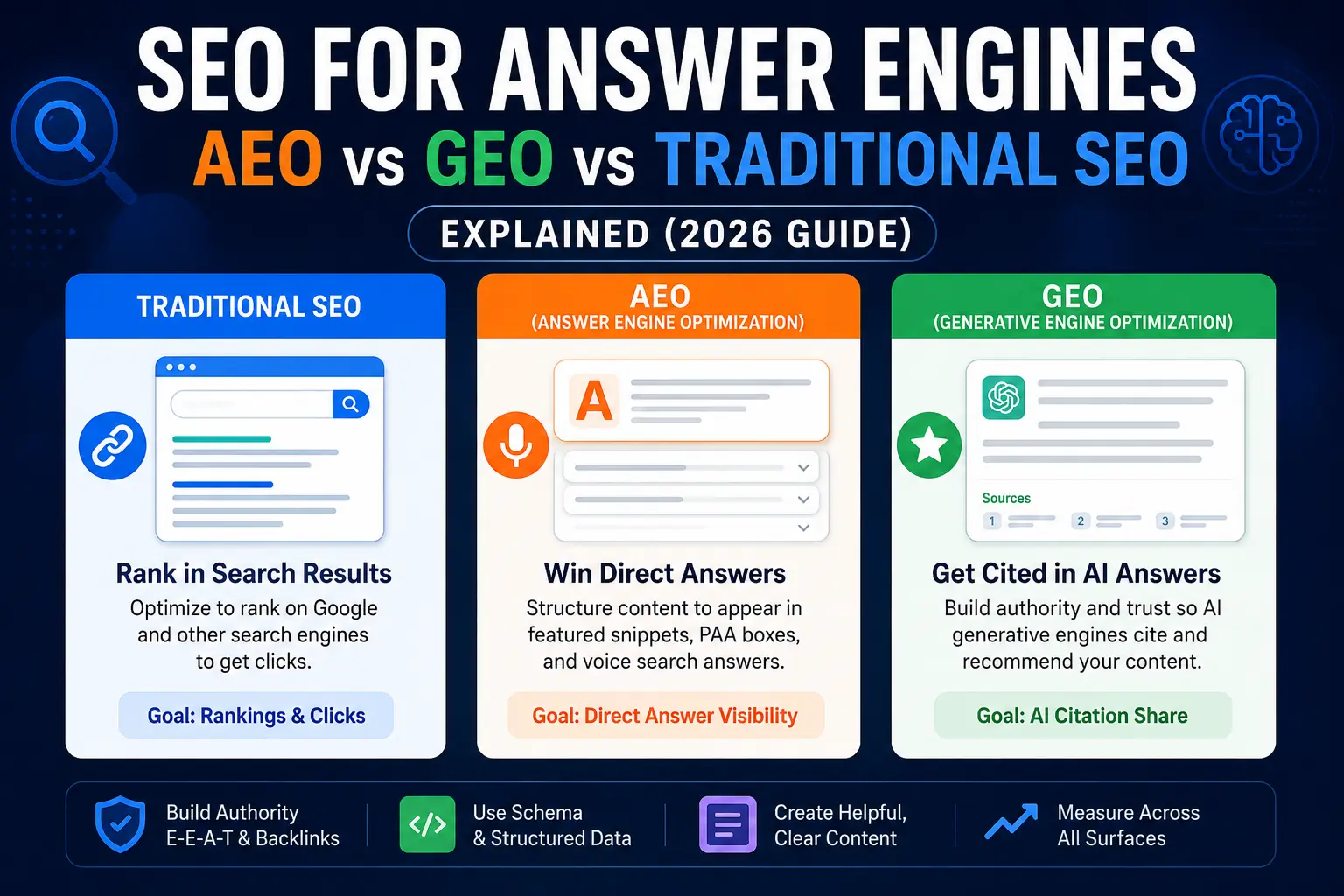
Quick Comparison: SEO vs AEO vs GEO
|
Aspect |
SEO |
AEO |
GEO |
|---|---|---|---|
|
Full name |
Search Engine Optimization |
Answer Engine Optimization |
Generative Engine Optimization |
|
Main goal |
Rank in search results |
Win direct answers across search surfaces |
Get cited in AI-generated answers |
|
Targets |
Google, Bing ranked links |
Featured snippets, voice, PAA |
AI Overviews, ChatGPT, Perplexity |
|
Output type |
List of links |
One direct answer |
Synthesized AI response |
|
Key signals |
Backlinks, keywords, content |
Clear answers, schema, structure |
E-E-A-T, authority, citations |
|
Success metric |
Rankings, clicks |
Direct answer visibility |
AI citation share |
What Are Answer Engines?
An answer engine is a search tool that gives you a direct answer instead of just a list of links.
Traditional search engines like Google (in their classic form) return ranked links. You click through and find the answer yourself. Answer engines do the work for you — they read sources, understand your question, and deliver a direct response.
Examples of answer engines in 2026 include:
- Google AI Overviews — AI-written summaries placed above Google’s regular results
- ChatGPT Search — conversational answers with web access
- Perplexity AI — research-focused answers with cited sources
- Microsoft Bing Copilot — AI answers integrated into Bing
- Voice assistants — Siri, Google Assistant, and Alexa often delivering spoken answers from web and structured sources
The shift toward answer engines is why optimizing for them has become essential. According to Ahrefs, which analyzed 146 million search results in research published on November 9, 2025, AI Overviews appeared in approximately 20.5% of U.S. Google searches. Question-based queries triggered AI Overviews 57.9% of the time. People increasingly get what they need without clicking — a trend explored in depth in our guide on zero-click SEO.
What Is SEO? (The Foundation)
SEO stands for Search Engine Optimization. It is the practice of optimizing your website to rank higher in traditional search engine results — the ranked list of links that Google and Bing display.
SEO has three core pillars:
On-page SEO — optimizing individual pages with relevant keywords, clear headings, internal links, and quality content. Our on-page SEO guide covers this in detail.
Off-page SEO — building authority through backlinks and brand mentions from other credible websites.
Technical SEO — making sure your site is fast, crawlable, mobile-friendly, and structurally sound. Our technical SEO guide walks through the essentials.
SEO is not going away. It remains the foundation that everything else builds on. A site that ranks well in traditional search has the authority and technical health that answer engines also reward. Rather than replacing SEO, AEO and GEO build on top of it.
What Is AEO (Answer Engine Optimization)?
AEO stands for Answer Engine Optimization. It focuses on getting your content selected as the direct answer to a question — in featured snippets, voice search results, and People Also Ask boxes.
It is worth noting that Answer Engine Optimization (AEO) is an industry term rather than an official Google framework. Different SEO publications define it slightly differently — some focus narrowly on featured snippets and voice search, while others use it more broadly to include AI answer systems.
The goal of AEO is to be the single, clear answer that a search engine surfaces directly, rather than just one of many ranked links.
AEO focuses on:
- Featured snippets — the highlighted answer box sitting at the top of Google’s results
- People Also Ask (PAA) boxes — drop-down sections that pair related questions with answers
- Voice search answers — the response a voice assistant reads aloud
- Direct answer boxes — instant answers for facts, definitions, and calculations
AEO works by giving answer engines exactly what they need: clear, concise, direct answers to specific questions. Content optimized for AEO uses question-based headings, leads with the answer, and structures information so it is easy to extract.
AEO is often seen as the link connecting traditional SEO to the newer GEO. It handles answer features inside regular search engines, while GEO reaches into AI-written responses spread across multiple platforms.
What Is GEO (Generative Engine Optimization)?
GEO stands for Generative Engine Optimization. It focuses on getting your content cited and referenced by generative AI systems — the tools that create written answers by synthesizing information from multiple sources.
While AEO targets answer features within search engines, GEO extends across the full range of AI answer engines: Google AI Overviews, ChatGPT Search, Perplexity, and others.
GEO focuses on:
- Getting cited as a source in AI-generated answers
- Building the topical authority that makes AI systems trust your content
- Strengthening E-E-A-T signals that influence which sources AI cites
- Structuring content so AI can extract and attribute it accurately
GEO is the newest widely discussed discipline among the three, reflecting the rapid rise of generative AI search. The term GEO (Generative Engine Optimization) was introduced by Princeton University researchers in their KDD ’24 paper, where they found certain content optimizations could improve visibility in generative engine responses by up to 40%. For a complete breakdown of how it works, our dedicated guide on generative engine optimization (GEO) covers the strategies in depth.
The key thing to understand: GEO is not separate from good SEO. It builds on the same foundations — quality content, authority, and technical health — and adds specific elements that AI systems reward.
SEO vs AEO vs GEO: Key Differences Explained
These three disciplines are related but distinct. Here is how to think about each one clearly.
SEO is about ranking. The goal is to appear high in the list of search results so people click through to your site. Success is measured in rankings and clicks. SEO is the broad foundation.
AEO is about being the answer. The goal is to be the direct response a search engine surfaces — in a featured snippet, voice result, or PAA box. Success is measured in answer box wins. AEO is a specialized focus within search engines.
GEO is about being cited. The goal is to be referenced as a source in AI-generated answers across multiple platforms. Success is measured in AI citation presence. GEO is the broadest in terms of platforms covered.
Think of it as a progression:
- SEO got you ranked in the links
- AEO gets you into the answer boxes
- GEO gets you cited in the AI responses
All three matter in 2026. They are not competing approaches — they are layers of a single, connected strategy. The comparison between AI SEO and traditional SEO explores this relationship further.
How They Work Together
Here is the most important insight in this entire guide: SEO, AEO, and GEO are not three separate jobs. They are three layers of one effort.
Strong SEO creates the foundation. When your site has authority, quality content, and technical health, it becomes a credible source. That credibility feeds directly into AEO and GEO — answer engines favor sources that already demonstrate authority.
Good AEO improves your GEO. The clear, direct, question-answering structure that wins featured snippets is the same structure that helps AI systems extract and cite your content. Optimizing for one helps the other.
Effective GEO reinforces your brand. Being cited across AI platforms builds brand recognition, which leads to more branded searches and more authority — which in turn supports your traditional SEO.
It is a virtuous cycle. Rather than choosing between SEO, AEO, and GEO, the smart approach is to build one strong content strategy that serves all three at once: quality content, clear structure, strong authority, and technical health.
How to Optimize for Answer Engines
Here is a practical, unified approach that improves your visibility across SEO, AEO, and GEO simultaneously.
1. Write Clear, Direct Answers
Lead each section with a direct answer to the question it addresses. State the answer first, then expand with context. This single practice helps you win featured snippets (AEO), get cited by AI (GEO), and improve content quality (SEO).
2. Use Question-Based Headings
Phrase your H2 and H3 headings as the actual questions people ask. This matches how users search in both traditional and AI search, making your content easier to match and extract.
3. Add FAQ Sections
Question-and-answer pairs are among the most extractable content formats across all answer engines. A clear FAQ section serves featured snippets, PAA boxes, and AI citations at once.
4. Build Topical Authority
Cover your subject thoroughly through connected, in-depth content. Answer engines favor sources that demonstrate genuine expertise across a topic, not just a single page. Strong keyword research in the age of AI helps you map the full range of questions to cover.
5. Strengthen E-E-A-T Signals
Experience, Expertise, Authoritativeness, and Trustworthiness influence which sources answer engines trust. Use named authors, cite credible sources, keep information accurate, and maintain a clear organizational identity.
6. Implement Schema Markup
Structured data helps answer engines understand your content’s type and structure. FAQPage, HowTo, and Article schema support visibility across answer surfaces — though no schema guarantees placement.
7. Maintain Technical Health
Fast loading, mobile-friendliness, clean crawlability, and proper site structure all support visibility across every type of answer engine. Technical problems undermine even excellent content.
8. Keep Content Fresh
Answer engines often favor current content. Ahrefs found AI-cited content is 25.7% fresher on average than traditionally ranked content. Perplexity also emphasizes freshness alongside research quality and citation density. Regularly update your important pages to keep them accurate and citable. Our guide on Perplexity SEO covers freshness in more detail.
Common Mistakes to Avoid
Treating SEO, AEO, and GEO as separate strategies They are layers of one effort. Trying to run them as three disconnected projects wastes resources and produces weaker results than an integrated approach.
Abandoning SEO to chase AI optimization SEO is the foundation. Neglecting traditional SEO weakens the authority and technical health that AEO and GEO depend on.
Burying your answers Answer engines extract direct answers. If your answer is hidden after long introductions, it is harder to surface in any answer format.
Ignoring content structure Without question-based headings, FAQ sections, and clear formatting, your content is harder for answer engines to parse and use.
Skipping E-E-A-T Answer engines favor credible sources. Anonymous, unsourced, or thin content struggles to get selected as an answer or cited by AI.
Measuring only with traditional metrics Rankings and clicks do not capture answer engine visibility. If you only measure clicks, you miss the brand value that AEO and GEO create.
How to Measure Success Across All Three
Each discipline has its own signals, but a unified measurement approach captures the full picture.
For SEO: Keyword rankings, organic traffic, and click-through rates in Google Search Console.
For AEO: Featured snippet appearances, PAA presence, and impressions for question-based queries. Some SEO tools track snippet ownership.
For GEO: Manual citation checks in AI Overviews, ChatGPT Search, and Perplexity. Note which queries cite your content.
Across all three: Branded search volume and brand mentions are powerful unified signals. When your visibility grows across answer engines, more people search for your brand directly — a trend you can track in Search Console and Google Trends.
Dedicated tools help with this measurement. Our roundup of the best AI SEO tools in 2026 covers the options for tracking visibility across traditional and AI search.
Frequently Asked Questions
Q1: What is the difference between SEO, AEO, and GEO?
SEO (Search Engine Optimization) focuses on ranking in traditional search results. AEO (Answer Engine Optimization) focuses on becoming the direct answer in featured snippets, voice search, and PAA boxes. GEO (Generative Engine Optimization) focuses on getting cited in AI-generated answers across platforms like Google AI Overviews, ChatGPT, and Perplexity. They are related layers of one connected strategy rather than competing approaches.
Q2: Do I need to choose between SEO, AEO, and GEO?
No. These are complementary, not competing. Strong SEO creates the foundation of authority and technical health that AEO and GEO build on. The best approach is a single, unified content strategy — quality content, clear structure, strong authority — that serves all three at once. Optimizing for one tends to improve the others.
Q3: Is AEO the same as featured snippet optimization?
AEO includes featured snippet optimization, but it is broader. AEO covers all the direct-answer surfaces within search engines — featured snippets, People Also Ask boxes, voice search answers, and direct answer boxes. Featured snippet optimization is one important part of AEO, not the whole thing.
Q4: Which matters most in 2026 — SEO, AEO, or GEO?
None of them matters most in isolation — they work together. SEO remains the essential foundation. AEO captures answer surfaces in traditional search. GEO captures the growing space of AI-generated answers. As AI search continues to expand, GEO is becoming increasingly important, but it depends on the SEO foundation beneath it. A balanced strategy across all three is the most resilient approach.
Q5: How is optimizing for answer engines different from traditional SEO?
Traditional SEO optimizes for ranking in a list of links and earning clicks. Optimizing for answer engines focuses on being selected as the answer — whether that is a featured snippet, a voice response, or a citation in an AI-generated answer. It requires clearer, more direct answers, stronger content structure, and a focus on authority and accuracy, since answer engines present your information directly to users.
Q6: Does schema markup help with AEO and GEO?
Schema markup helps answer engines understand your content’s type and structure, which can support visibility across answer surfaces like rich results and FAQ displays. However, no schema type guarantees placement in featured snippets, AI Overviews, or any answer format. Think of schema as a helpful supporting practice that improves comprehension — not a guaranteed path to being featured.
Q7: Can small websites compete in AEO and GEO?
Yes. Answer engines do not exclusively favor large domains. A smaller site with clear, accurate, well-structured content on a specific topic can win featured snippets and get cited by AI systems — sometimes more reliably than larger sites with thinner coverage of that exact question. Niche expertise, presented credibly and clearly, is a genuine advantage in answer engine optimization.
Final Verdict
The rise of answer engines has not made SEO obsolete. It has expanded what SEO means.
In 2026, getting found requires thinking in three connected layers: SEO to build your foundation and rank in search, AEO to win the answer boxes within search engines, and GEO to get cited in AI-generated responses across platforms. These are not separate jobs competing for your attention — they are layers of one unified strategy.
The encouraging part is that one set of fundamentals powers all three at once: clear and direct answers, well-organized content, real subject-matter depth, dependable E-E-A-T signals, and a technically sound site. Nail these, and your presence strengthens across regular search results, answer boxes, and AI-written responses together.
Here is where to start:
1. Strengthen your SEO foundation. Make sure your technical health, content quality, and authority are solid — everything else builds on this.
2. Optimize your content structure. Add question-based headings, FAQ sections, and clear direct answers that serve AEO and GEO at the same time.
3. Build and measure your authority. Strengthen E-E-A-T signals, earn citations, and track your visibility across rankings, answer boxes, and AI citations.
The way people look for information is being reshaped by answer engines. The brands that treat SEO, AEO, and GEO as a single connected discipline — and keep at it consistently — are the ones that will hold their visibility as search keeps changing.
Disclaimer: Answer engine technology and AI search features evolve rapidly. The guidance in this article reflects industry understanding and publicly available information as of June 2026. Citation behavior and ranking factors are not fully documented publicly. Always test strategies with your own content and verify current best practices through official documentation.
Sources and Further Reading
Official Documentation
- Google Search Central — Featured Snippets & Structured Data — developers.google.com/search
- Schema.org — Structured Data Vocabulary — schema.org
Industry Research and Coverage
- Princeton University — GEO: Generative Engine Optimization (KDD ’24 / arXiv 2024) — arxiv.org/abs/2311.09735
- Ahrefs — AI Overview Analysis, November 2025 (146 million search results) — ahrefs.com/blog
- Search Engine Journal — AEO and AI Search Coverage — searchenginejournal.com
- Search Engine Land — Answer Engine Analysis — searchengineland.com
Related Guides on TotalInfoHub
- Generative Engine Optimization (GEO) — totalinfohub.com/generative-engine-optimization-geo/
- Perplexity SEO — totalinfohub.com/perplexity-seo/
- Zero-Click SEO — totalinfohub.com/zero-click-seo/
- AI SEO vs Traditional SEO — totalinfohub.com/ai-seo-vs-traditional-seo/
- How to Rank Content in Google AI Search Results — totalinfohub.com/how-to-rank-content-in-google-ai-search-results/
- On-Page SEO — totalinfohub.com/on-page-seo/
Last reviewed: June 2026