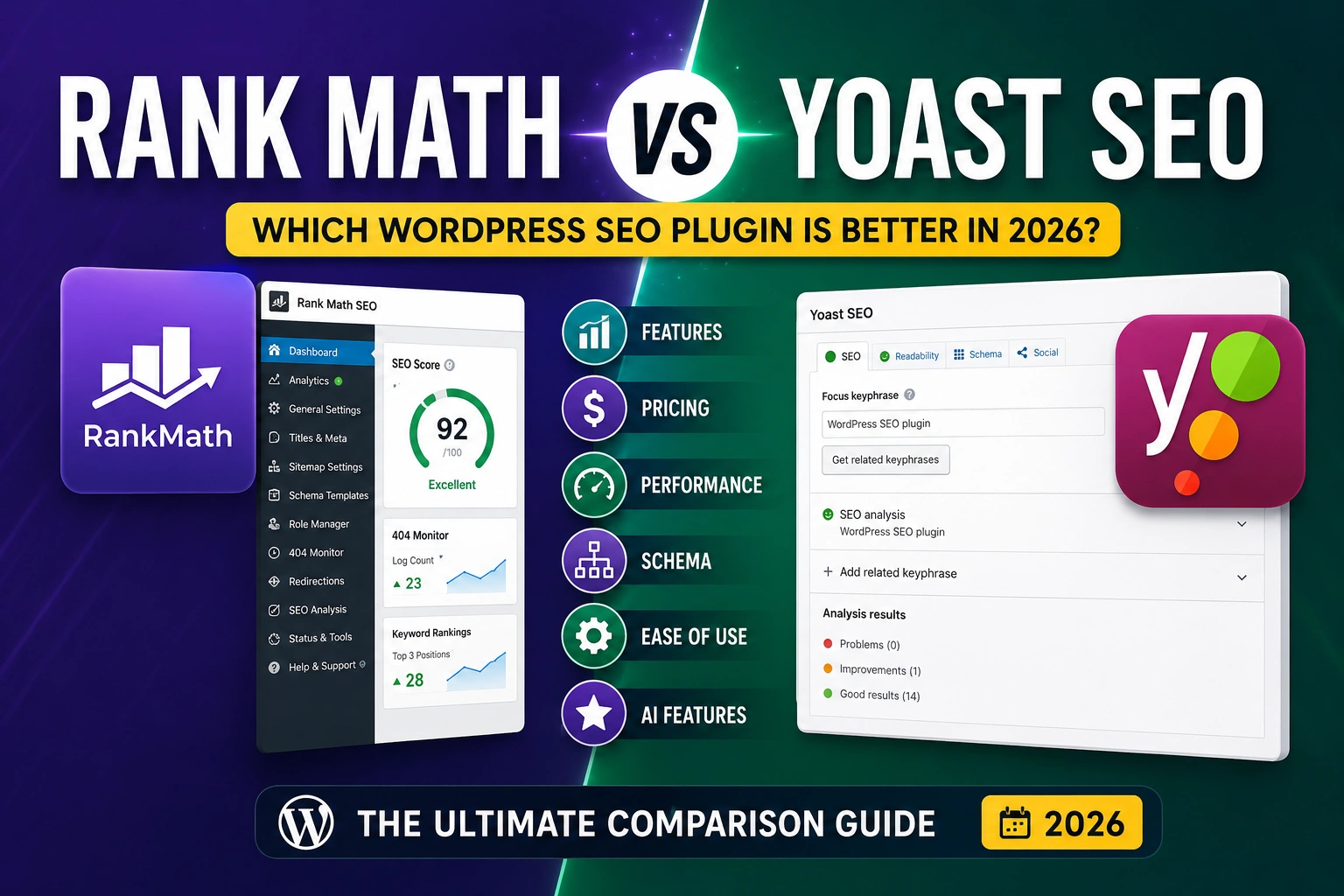
Rank Math vs Yoast SEO: Which WordPress SEO Plugin Is Better in 2026?
If you run a WordPress website, the question of which SEO plugin to use is one you will almost certainly face early on. And for most of the past decade, that conversation eventually came down to two names: Rank Math and Yoast SEO.
Yoast SEO has been around since 2008 — a veteran plugin with over 10 million active installations and a reputation built over years of reliable on-page SEO guidance. Rank Math launched in 2018 and quickly built a following by offering significantly more features in its free tier than Yoast, a cleaner modern interface, and a more aggressive development roadmap.
In 2026, both plugins have evolved considerably. Both now include AI-powered content suggestions. Both have deepened their schema markup capabilities. Both have introduced features designed to help content rank not just in traditional SERPs but in the increasingly important AI search landscape.
So which one should you use?
The honest answer is: it depends on who you are and what you need. This comparison breaks down every meaningful difference — clearly and without unnecessary padding — so you can make an informed decision.
About this guide: Feature comparisons are based on publicly available plugin documentation, changelogs, and independent testing as of June 2026. Pricing figures are approximate and subject to change — always verify on each plugin’s official website.
Quick Verdict: Rank Math vs Yoast at a Glance
|
Category |
Rank Math |
Yoast SEO |
Winner |
|---|---|---|---|
|
Free tier features |
Extensive |
Limited |
🏆 Rank Math |
|
Ease of use (beginners) |
Moderate |
Excellent |
🏆 Yoast |
|
Schema markup |
Advanced, built-in |
Basic (rich in Premium) |
🏆 Rank Math |
|
AI features |
Yes (Content AI) |
Yes (Yoast AI) |
Tie |
|
GSC integration (free) |
✅ Yes |
❌ No |
🏆 Rank Math |
|
Redirect manager (free) |
✅ Yes |
❌ Premium only |
🏆 Rank Math |
|
404 monitor (free) |
✅ Yes |
❌ No |
🏆 Rank Math |
|
Multiple focus keywords (free) |
✅ 5 (expandable via filter) |
❌ Premium only |
🏆 Rank Math |
|
Readability analysis |
Basic |
Excellent (Flesch) |
🏆 Yoast |
|
Trust & track record |
Since 2018 |
Since 2008 |
🏆 Yoast |
|
Pricing (entry Premium) |
~$83.88–$95.88/year |
~$118.80/year |
🏆 Rank Math |
|
WooCommerce SEO (free) |
✅ Yes |
❌ Premium only |
🏆 Rank Math |
|
Performance impact |
Modular architecture |
Mature optimized plugin |
Tie |
|
Best overall |
Advanced users, SEO professionals |
Beginners, content writers |
Depends on user |
Overview: What Are These Plugins?
Rank Math
Rank Math was developed by MyThemeShop and launched publicly in 2018. It entered a market dominated by Yoast and differentiated itself immediately by offering features in its free version that competitors charged for — including multiple focus keywords, schema markup, a redirect manager, a 404 monitor, and Google Search Console integration.
The strategy worked. Rank Math grew rapidly to over 4 million active installations and has continued adding features aggressively, including AI-powered content optimization (Content AI), a keyword rank tracker, and enhanced support for structured data types relevant to AI search.
Rank Math uses a modular architecture — individual features can be turned on or off from a central dashboard, keeping the plugin lightweight for users who do not need every capability.
Yoast SEO
Yoast SEO was founded by Joost de Valk and launched in 2008, making it one of the oldest and most established WordPress SEO plugins in existence. With over 10 million active installations, it remains the most widely installed WordPress SEO plugin globally.
Yoast built its reputation on accessibility. Its traffic light system — green for good, orange for needs work, red for problems — made on-page SEO guidance understandable to non-technical users who had never thought about keyword optimization before. This simplicity became its defining characteristic.
Yoast was acquired by Newfold Digital in 2021, and since then has continued developing its feature set — including AI writing assistance and improved schema support.
Feature-by-Feature Comparison
On-Page SEO Analysis
Both plugins analyze your content as you write, scoring it against a set of on-page SEO criteria — keyword density, title tag optimization, meta description length, internal linking, image alt text, and more.
Rank Math uses a 100-point SEO score that evaluates a broader range of factors. It checks keyword presence across title, URL, meta description, first paragraph, H tags, and image alt text. It also evaluates content length, semantic keywords (related terms), and internal/external link ratios. The scoring is granular and gives specific recommendations for improvement.
Yoast SEO uses its well-known traffic light system. The analysis focuses on the core on-page factors and is presented in a way that is immediately understandable. Yoast’s readability analysis — which evaluates sentence length, passive voice usage, transition words, and Flesch reading ease score — is more thorough than Rank Math’s readability tools and is particularly useful for content writers who want guidance on writing clarity alongside keyword optimization.
Verdict: Rank Math for depth of SEO analysis; Yoast for readability guidance. For a deeper understanding of what both plugins are helping you optimize, our on-page SEO guide covers the principles behind these recommendations.
Schema Markup
Schema markup — structured data that helps search engines understand the context of your content — has become increasingly important in the AI search era. AI systems use schema to classify content types and extract structured information efficiently.
Rank Math has one of the most comprehensive built-in schema markup generators available in a free WordPress SEO plugin. The free version supports 16+ schema types — Article, FAQ, HowTo, Product, Review, Recipe, Event, and more — through a visual builder that does not require manual JSON-LD coding. Rank Math Pro expands this to 20+ schema types including Course, Job Posting, and advanced types. FAQ schema can be added directly within the post editor on both free and Pro.
Yoast SEO includes basic schema markup in its free version (Article and other standard types). More advanced schema support, including breadcrumb schema customization and richer structured data, is available in Yoast Premium. Yoast’s schema graph system — which links structured data entities across a site — is technically sophisticated, but less visually accessible than Rank Math’s interface.
Verdict: Rank Math wins clearly for schema markup, particularly in the free tier. Given how central schema has become for both traditional rankings and AI search visibility, this is a meaningful practical advantage. Our guide on how to rank content in Google AI search results covers why schema matters so much in 2026.
XML Sitemap
Both plugins generate XML sitemaps automatically and submit them to search engines.
Rank Math generates sitemaps with granular control — you can include or exclude specific post types, taxonomies, and individual pages. It also supports image sitemaps and video sitemaps. The sitemap module is fast and clean.
Yoast SEO also generates reliable XML sitemaps with content type filtering. Both plugins handle this well and the practical difference for most users is minimal.
Verdict: Tie — both are reliable for sitemap generation.
Redirect Manager
Rank Math (free) includes a built-in redirect manager. You can create 301, 302, and other redirect types directly from the WordPress dashboard without a separate plugin.
Yoast SEO offers a redirect manager only in Yoast Premium — it is not available in the free version.
Verdict: Rank Math wins clearly. A redirect manager is an essential SEO tool, particularly when restructuring content or changing URLs. Having it in the free tier is a genuine practical advantage.
404 Monitor
Rank Math (free) includes a 404 error monitor that logs pages returning 404 errors — directly within the plugin dashboard. This helps identify broken links and pages that need to be redirected, without requiring a separate monitoring tool.
Yoast SEO does not include a 404 monitor in either its free or premium versions.
Verdict: Rank Math wins by default — Yoast does not offer this feature.
Local SEO
Rank Math (free) includes a Local SEO module with support for business name, address, phone number, opening hours, and Local Business schema markup — all from within the plugin.
Yoast SEO Local SEO is now included in Yoast Premium. As of July 2025, Yoast bundled Local SEO, News SEO, and Video SEO into the Premium plan — making these features available without separate add-on purchases.
Verdict: This narrows the gap between the two plugins on local SEO. Rank Math still includes local SEO in its free tier, while Yoast now includes it in Premium. For users already paying for Yoast Premium, local SEO is now available at no additional cost.
WooCommerce SEO
Rank Math (free) includes WooCommerce SEO optimization — product schema, breadcrumbs, product-level meta optimization — without additional cost.
Yoast SEO offers WooCommerce SEO through a separate paid add-on (Yoast WooCommerce SEO). Again, verify current availability and pricing on Yoast’s official website.
Verdict: Rank Math wins for WooCommerce users on a budget.
AI-Powered Features
Both plugins have introduced AI-powered content optimization features — reflecting the broader shift toward AI-assisted content creation.
Rank Math Content AI is an add-on (available in Pro and higher plans) that analyzes top-ranking pages for your target keyword and provides AI-generated content suggestions, related keyword recommendations, and NLP term analysis. It is designed to help users create content that aligns with what is currently ranking for a given query — a use case that connects directly to how AI SEO differs from traditional SEO.
Yoast AI (available in Yoast Premium) includes AI-powered title and meta description generation, helping users produce optimized snippet copy more efficiently. Yoast’s AI features are more tightly integrated into the basic content workflow — less research-focused than Rank Math’s Content AI, but more accessible for users who simply want writing assistance within the editor.
Verdict: Rank Math for research-driven AI content optimization; Yoast for AI-assisted meta copy generation. Both are evolving rapidly.
Google Search Console Integration
Rank Math (free) integrates directly with Google Search Console, surfacing keyword ranking data, impression data, and click data within the WordPress dashboard. This means you can see which keywords your posts rank for without leaving WordPress.
Yoast SEO does not offer native GSC integration. Users need to log into Google Search Console separately or use a dedicated analytics plugin.
Verdict: Rank Math wins clearly — native GSC data within WordPress is a meaningful convenience, especially for bloggers and content creators who want performance insights without multiple tabs.
Social Media (Open Graph & Twitter Cards)
Both plugins handle Open Graph meta tags (for Facebook sharing) and Twitter Card meta tags, allowing you to control how your content appears when shared on social media.
Rank Math supports Facebook, Twitter, Pinterest, and other platforms with preview functionality in the post editor.
Yoast SEO also handles Open Graph and Twitter Cards well, with a clean social preview feature in the post editor sidebar.
Verdict: Tie — both handle social metadata effectively.
Ease of Use: Which Is More Beginner-Friendly?
This is one of the most meaningful practical differences between the two plugins.
Yoast SEO was built with non-technical users in mind from day one. The setup wizard is approachable, the traffic light scoring system is immediately understandable, and the recommendations are written in plain language. A first-time blogger who has never thought about SEO can install Yoast and get actionable guidance within minutes. If you are starting a blog for the first time and want immediate clarity on whether your posts are optimized, Yoast’s interface makes that easy.
Rank Math has improved significantly in usability but still carries more complexity. The modular system, extensive settings, and granular controls that power users appreciate can feel overwhelming to beginners. The setup wizard is helpful and the 100-point scoring system is intuitive enough, but the depth of the plugin means there is more to navigate before it feels comfortable.
Verdict: Yoast SEO for ease of use, particularly for beginners. Rank Math rewards users who are willing to invest time in learning the interface.
Free vs Premium: What Do You Actually Get?
This comparison is one of the most important considerations for budget-conscious users.
Rank Math Free vs Premium
The free version of Rank Math is genuinely feature-rich. Here is what the free tier includes:
- 5 focus keywords by default (expandable via filter)
- Advanced schema markup builder (16+ types in free, 20+ in Pro)
- Built-in redirect manager (301, 302, etc.)
- 404 error monitor
- Google Search Console integration
- Local SEO module
- WooCommerce SEO
- XML sitemap (including image and video sitemaps)
- Breadcrumb navigation
- Role manager
- SEO analysis for posts, pages, and custom post types
Rank Math Pro adds:
- Unlimited focus keywords
- Content AI (AI-powered content optimization)
- Keyword rank tracker
- Google Analytics 4 integration
- Advanced schema types (Course, Event, etc.)
- Priority support
- ~$83.88–$95.88/year (approx. — verify on rankmath.com)
Yoast SEO Free vs Premium
Yoast’s free version covers the basics reliably:
- Single focus keyphrase analysis
- Readability analysis (Flesch, sentence length, transitions)
- XML sitemap
- Basic schema (Article, Breadcrumbs)
- Open Graph and Twitter Card meta tags
- Basic breadcrumbs
Yoast SEO Premium adds:
- Multiple focus keyphrases (up to 5)
- Redirect manager
- Internal linking suggestions
- AI-generated title and meta suggestions
- Local SEO, News SEO, and Video SEO (bundled as of July 2025)
- 24/7 support
- ~$118.80/year (approx. $129 USD per site — verify on yoast.com)
Key observation: Rank Math’s free tier includes features that require Yoast Premium — including multiple focus keywords, a redirect manager, and GSC integration. For users who want maximum functionality without paying, Rank Math’s free version provides significantly more value.
Pricing Comparison
⚠️ Pricing below is approximate as of June 2026. Always verify current pricing on each plugin’s official website.
|
Plan |
Rank Math |
Yoast SEO |
|---|---|---|
|
Free |
✅ Extensive features |
✅ Basic features |
|
Entry Premium (1 site) |
~$83.88–$95.88/year (Pro) |
~$118.80/year (approx. $129 USD) |
|
Multi-site / Business |
~$251.88–$335.88/year (Business, 100 sites) |
Separate pricing per site or bundle |
|
Agency |
~$779.88/year (Agency, 500 sites) |
Varies by volume |
|
Lifetime deal |
No lifetime deal is currently available. Rank Math offers a free version that can be used indefinitely, but all premium plans are subscription-based. |
Not typically available |
Rank Math is more affordable at every paid tier for most use cases. The gap is particularly significant for developers or agencies managing multiple sites — Rank Math’s Business plan at approximately $251.88–$335.88/year covers up to 100 websites, while Yoast’s per-site pricing accumulates quickly.
Performance Impact on WordPress
Both plugins are generally considered lightweight relative to the functionality they provide, but there are differences worth noting.
Rank Math is designed with a modular system intended to reduce unnecessary overhead — only active modules load, which can help minimize impact on page load. Independent third-party benchmarking between Rank Math and Yoast remains limited, so performance differences are difficult to quantify definitively across different environments.
Yoast SEO has improved its performance profile in recent versions. Some users report that plugin architecture differs between the two tools in ways that affect database queries and PHP execution, though practical differences are usually small and unlikely to be a meaningful factor in Core Web Vitals scores for most sites. Sites where every millisecond matters may want to benchmark both plugins in their specific environment before deciding.
Verdict: Rank Math is designed with performance efficiency in mind through its modular system, but the practical real-world difference for most websites is minimal. Neither plugin should be the primary deciding factor for page speed optimization.
Rank Math vs Yoast SEO: Side-by-Side Summary Table
|
Feature |
Rank Math Free |
Rank Math Pro |
Yoast Free |
Yoast Premium |
|---|---|---|---|---|
|
Focus keywords |
5 by default (expandable via filter) |
Unlimited |
1 |
Up to 5 |
|
Schema markup |
16+ types (free) |
20+ types (Pro) |
Basic |
Improved |
|
Redirect manager |
✅ |
✅ |
❌ |
✅ |
|
404 monitor |
✅ |
✅ |
❌ |
❌ |
|
GSC integration |
✅ |
✅ + GA4 |
❌ |
❌ |
|
Local SEO |
✅ |
✅ |
❌ |
Included ✅ |
|
WooCommerce SEO |
✅ |
✅ |
❌ |
Add-on |
|
AI content features |
❌ |
✅ Content AI |
❌ |
✅ AI titles |
|
Readability analysis |
Basic |
Basic |
✅ Advanced |
✅ Advanced |
|
Internal link suggestions |
❌ |
❌ |
❌ |
✅ |
|
Rank tracker |
❌ |
✅ |
❌ |
❌ |
|
XML sitemap |
✅ |
✅ |
✅ |
✅ |
|
Social meta tags |
✅ |
✅ |
✅ |
✅ |
|
Breadcrumbs |
✅ |
✅ |
✅ |
✅ |
|
Entry price |
Free |
~$83.88–$95.88/yr |
Free |
~$118.80/yr |
Who Should Use Rank Math?
Rank Math is the stronger choice for the following users:
SEO professionals and advanced users The depth of Rank Math’s features — advanced schema builder, GSC integration, keyword rank tracker in Pro, Content AI, and granular control over every aspect of on-page optimization — makes it well-suited to users who know what they are doing and want maximum control. If you work with keyword research in the age of AI and want your SEO plugin to support data-driven content decisions, Rank Math’s analytical features are more comprehensive.
Budget-conscious users who want premium features without paying If you want multiple focus keywords, a redirect manager, a 404 monitor, GSC integration, and WooCommerce SEO without a paid subscription, Rank Math’s free version delivers all of this out of the box.
Developers and agencies managing multiple sites Rank Math’s multi-site licensing (100 sites on the Business plan at approximately $251.88–$335.88/year) is significantly more cost-effective than Yoast’s per-site pricing structure for agencies or developers running multiple client or personal websites.
Content creators focused on AI search optimization Rank Math’s schema markup tools, Content AI features, and FAQ schema builder align closely with the technical requirements for AI search visibility. For users building content strategies around AI SEO principles, Rank Math provides better native tooling.
Who Should Use Yoast SEO?
Yoast SEO is the stronger choice for the following users:
Beginners and first-time bloggers Yoast’s traffic light system, clear plain-language recommendations, and straightforward setup make it genuinely accessible to users with no prior SEO experience. The learning curve is minimal, and the guidance is immediately actionable.
Content writers who prioritize readability Yoast’s readability analysis — Flesch reading ease, sentence length checks, passive voice detection, transition word analysis — is more thorough than Rank Math’s equivalent. For writers who want to improve both their SEO and their writing clarity simultaneously, Yoast’s readability tools are the more developed option.
Users who value long-term stability and trust With over 10 million+ active installations and a well-established support ecosystem, Yoast carries a track record that Rank Math — launched in 2018 — is still building. For users who prioritize a proven, stable plugin with a long history of reliable updates, Yoast’s tenure is a genuine differentiator.
Established WordPress workflows built around Yoast Many editorial teams, content agencies, and CMS setups have existing workflows built around Yoast’s interface and features. Switching involves retraining team members and potential data migration considerations. For teams with established Yoast processes, the practical cost of switching may outweigh the feature advantages of moving to Rank Math.
Frequently Asked Questions (FAQ)
Q1: Which is better for SEO — Rank Math or Yoast?
Neither plugin makes your content rank by itself — both are tools that help you optimize content for search. The plugin that works “better” depends on how you use it. Rank Math offers more features in its free tier and more advanced schema and analytics tools. Yoast offers better readability guidance and a more beginner-accessible interface. Both are well-maintained, widely used, and compatible with Google’s expectations for on-page SEO.
Q2: Can I switch from Yoast to Rank Math without losing my SEO data?
Yes — Rank Math includes a built-in migration tool that imports your Yoast SEO settings, focus keywords, meta titles, meta descriptions, and other SEO data during installation. The migration is generally reliable for standard setups, though it is advisable to back up your site before migrating and verify key pages after the switch. Custom schema configurations from Yoast may require manual review.
Q3: Is Rank Math free version good enough for most websites?
For most small-to-medium WordPress websites — blogs, business sites, portfolios, and content-driven sites — Rank Math’s free version provides sufficient functionality. The inclusion of multiple focus keywords, schema markup, a redirect manager, and GSC integration means many users will not need to upgrade to a paid plan. Rank Math Pro is worth considering primarily for sites that need Content AI, a rank tracker, or Google Analytics 4 integration within the dashboard.
Q4: Does using an SEO plugin guarantee better rankings?
No — an SEO plugin does not guarantee rankings. Both Rank Math and Yoast provide structured guidance for on-page optimization, which is one component of a broader SEO strategy that also includes technical foundations, content quality, backlinks, and — increasingly — AI search visibility. Understanding the technical SEO fundamentals that underpin good plugin configuration helps you get more from either tool.
Q5: Which plugin is better for schema markup in 2026?
Rank Math is generally regarded as the stronger option for schema markup, particularly in the free tier. Its visual schema builder supports 16+ schema types in the free version, with 20+ available in Pro, FAQ schema can be added within the editor, and the configuration does not require JSON-LD coding knowledge. This matters increasingly for AI search visibility, where schema helps AI systems classify and extract content accurately.
Q6: Does Yoast SEO Premium justify the $118.80/year price?
For individual bloggers or small site owners, Yoast Premium at approximately $118.80/year is harder to justify given that Rank Math’s free version includes most of the features Yoast adds at that price point (multiple focus keywords, redirect manager). Yoast Premium’s genuine additions — internal linking suggestions, AI-generated titles, bundled Local/News/Video SEO, and 24/7 support — may justify the cost for content teams that value Yoast’s interface and rely on those specific features. For pure feature-per-dollar value, Rank Math Pro at approximately $83.88–$95.88/year offers more for most use cases.
Q7: Which plugin is better for WooCommerce stores?
Rank Math’s free version includes WooCommerce SEO — product schema, breadcrumbs, and product-level meta optimization — without additional cost. Yoast’s WooCommerce SEO functionality is available through a separate add-on. For WooCommerce store owners prioritizing budget, Rank Math is the more practical choice. For stores already invested in the Yoast ecosystem and Premium plan, adding the WooCommerce add-on is a natural extension.
Final Verdict
The Rank Math vs Yoast SEO debate does not have a single right answer — but it does have clear patterns based on who you are and what you need.
Choose Rank Math if:
- You want maximum features in the free version
- You work with schema markup, structured data, or AI search optimization
- You manage multiple websites and need cost-effective multi-site licensing
- You want GSC data inside your WordPress dashboard
- You are comfortable with a feature-rich interface and willing to invest time learning it
Choose Yoast SEO if:
- You are new to SEO and want the most accessible, beginner-friendly experience
- Readability analysis and writing clarity guidance matter as much as keyword optimization
- Your team has established workflows built around Yoast
- You value the plugin’s long track record since 2008 and large support ecosystem
- The internal linking suggestions and AI-generated meta copy in Premium fit your workflow
For most users starting fresh in 2026 — particularly those with some SEO knowledge who want to do more with less — Rank Math’s free version is an exceptional starting point. For beginners who want clear, immediate guidance without configuration overhead, Yoast remains the most approachable first SEO plugin.
Used correctly, either plugin can support a strong on-page SEO foundation. The plugin is a tool. The strategy, content quality, and consistent execution are what actually build rankings over time.
Disclaimer: Plugin features, pricing, and product availability for both Rank Math and Yoast SEO may change over time. This article reflects publicly available information as of June 2026. Always verify current features and pricing on each plugin’s official website before making a decision.
Sources & Further Reading
Official Sources
- Rank Math Documentation & Pricing — rankmath.com
- Yoast SEO Documentation & Pricing — yoast.com
- WordPress Plugin Repository — Rank Math — wordpress.org/plugins/seo-by-rank-math
- WordPress Plugin Repository — Yoast SEO — wordpress.org/plugins/wordpress-seo
Independent Reviews & Comparisons
- WPBeginner — SEO Plugin Comparison — wpbeginner.com
- Kinsta — Rank Math vs Yoast — kinsta.com/blog
- IsItWP — SEO Plugin Feature Testing — isitwp.com
- Tooltester — WordPress SEO Plugin Tests — tooltester.com
Related Reading on TotalInfoHub
- On-Page SEO Guide — totalinfohub.com/on-page-seo/
- Technical SEO Guide — totalinfohub.com/technical-seo-beginner-to-advanced-guide/
- How to Start a Blog — totalinfohub.com/how-to-start-a-blog/
- How to Rank Content in Google AI Search Results — totalinfohub.com/how-to-rank-content-in-google-ai-search-results/
This comparison is reviewed and updated regularly as both plugins release new features. Last reviewed: June 2026.