How to Start a Micro Niche Website in 2026: A Beginner’s Guide
If you have ever wanted to build a website but felt overwhelmed by the idea of competing with huge, established sites, a micro niche website might be exactly what you need.
A micro niche website focuses on one very specific topic — narrow enough that you can build topical depth, rather than trying to cover everything and competing with everyone. Instead of a broad “health” site, you might build a site about “yoga for people with back pain.” Instead of a general “tech” site, you might focus on “budget mechanical keyboards.”
Learning how to start a micro niche website is one of the most practical ways for beginners to build an online presence in 2026. These sites are focused, manageable, and can sometimes be easier to compete in than broader topics, especially when competition is lower and search intent is clear.
This guide walks you through the entire process, step by step, in simple language. From choosing your niche to publishing content and thinking about monetization, you will learn a realistic, honest approach. No hype, no promises of overnight riches — just a practical path you can actually follow.
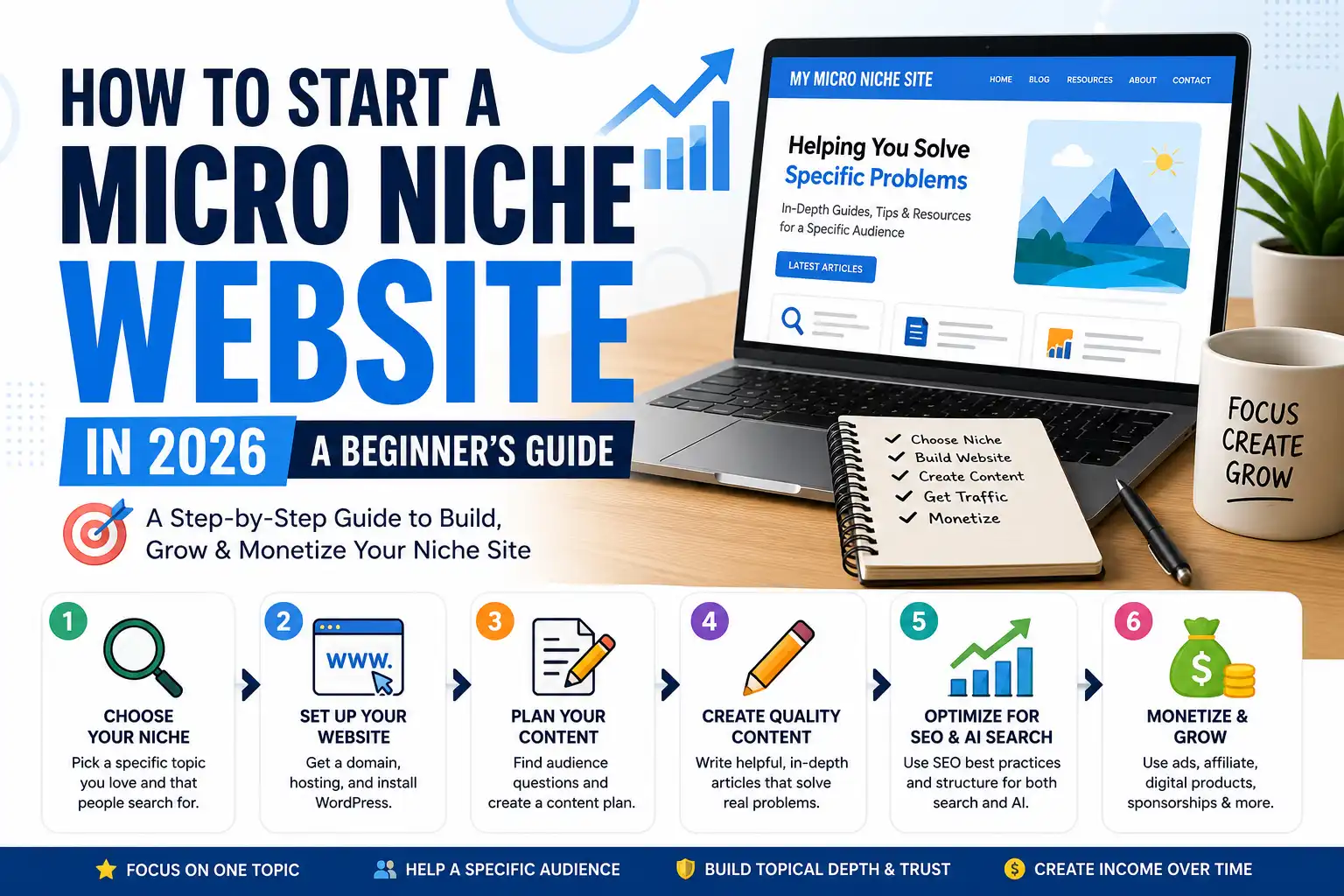
Quick Summary: Starting a Micro Niche Website
|
Step |
What to Do |
|---|---|
|
1. Choose a niche |
Pick a narrow, specific topic you can cover well |
|
2. Research demand |
Check that people search for the topic |
|
3. Set up your site |
Get a domain, hosting, and WordPress |
|
4. Plan content |
Map out the questions your audience asks |
|
5. Create content |
Publish helpful, focused articles |
|
6. Optimize for SEO |
Structure content for search and AI search |
|
7. Monetize |
Add income methods once you have traffic |
A micro niche website succeeds through focus. By covering one specific topic thoroughly, you can build topical depth more efficiently than a broad, unfocused site.
What Is a Micro Niche Website?
A micro niche website is a site focused on one very specific, narrow topic.
The key word is “micro” — meaning small and specific. Instead of covering a broad subject, a micro niche site zooms in on a tiny slice of it.
Here are some examples to make it clear:
- Broad niche: Fitness → Micro niche: Home workouts for busy parents
- Broad niche: Cooking → Micro niche: Air fryer recipes for beginners
- Broad niche: Travel → Micro niche: Budget solo travel in Southeast Asia
- Broad niche: Pets → Micro niche: Caring for senior cats
The advantage of going narrow is focus. When your entire site is about one specific topic, you can cover it thoroughly, build stronger topical relevance, and attract a dedicated audience. You are also competing against fewer and often smaller sites, which can make it easier to get found.
The trade-off is that a micro niche has a smaller total audience than a broad topic. But for beginners, a focused site you can realistically rank and grow is far more valuable than a broad site lost among giant competitors.
Why Micro Niche Websites Work Well in 2026
Micro niche websites have some real advantages in today’s online landscape. Here is why they can work well.
A focused site can make it easier to build topical depth over time. When your whole site covers one specific topic, search engines and readers can more easily see the depth of your coverage. This focused depth is valuable for both traditional SEO and AI search.
Less competition. Narrow topics usually have fewer competing sites than broad topics. This can make it easier for a new site to get noticed.
Easier to cover thoroughly. A micro niche is small enough that you can realistically cover most of the important questions and topics within it — building the kind of complete coverage that helps with rankings.
Dedicated audience. People interested in a specific topic tend to be engaged and loyal, which is valuable for building a real audience.
A note on scale. It is worth being balanced here: broader sites can build stronger overall topical authority at scale, since they cover more ground and can attract more total traffic over time. Micro niches are not automatically “better” — but they are often easier to focus on and manage early, which makes them a practical starting point for beginners. As you grow, you can always expand a focused site into adjacent topics.
AI answer engines may surface sources that are clear, specific, and demonstrate strong topical depth, though this is not guaranteed and results can vary by platform. A focused micro niche site can make it easier to build that kind of depth over time. This connects to generative engine optimization (GEO).
Honest note: Micro niche sites are not a guaranteed path to income or quick success. They take real work, quality content, and patience. But they are a practical, realistic starting point for beginners — more so than trying to build a broad site from scratch.
Step 1: Choose Your Micro Niche
Choosing the right niche is the most important decision you will make. Take your time here.
Look for the Right Balance
A good micro niche balances three things:
- Your interest or knowledge — you will create better content on topics you understand or enjoy
- Audience demand — enough people should be interested in the topic
- Manageable competition — not so competitive that a new site cannot break in
How to Find Niche Ideas
- Think about your hobbies, skills, and interests
- Consider problems you have solved that others also face
- Look at topics you naturally know a lot about
- Explore areas where you notice gaps in existing content
Narrow It Down
Once you have a broad topic, narrow it into a micro niche:
- Broad: “Gardening” → Narrower: “Indoor gardening” → Micro: “Growing herbs indoors in small apartments”
The more specific you go, the more focused and rankable your site becomes — as long as there is still enough audience interest.
A word of caution: going too narrow has a downside. If your niche is extremely specific, the total audience may be too small to generate meaningful traffic or monetization potential. Aim for a niche that is focused enough to manage and compete in, but still large enough to have a worthwhile audience. Balance is key — narrow, but not so narrow that almost no one is searching for it.
Beginner tip: Choose a niche you can happily create content about for a long time. Building a website takes months of consistent work, so genuine interest keeps you going when motivation dips.
Step 2: Research Demand and Competition
Before committing to a niche, check that people actually search for it — and that you can realistically compete.
Check Search Demand
You want a niche that people are actively searching for. Ways to check:
- Use Google’s search suggestions and “People Also Ask” boxes
- Look at related searches at the bottom of Google results
- Explore forums, Reddit, and Quora to see what people ask
- Use keyword research tools to gauge interest
The goal is to confirm there is genuine, ongoing interest in your topic. Strong keyword research in the age of AI is very helpful here.
Assess Competition
Next, look at who else covers your topic:
- Search your niche topics and see what sites appear
- Are the top results huge, established sites, or smaller ones?
- Is there room for a new, focused site to add value?
If the top results are all massive sites, the niche may be tough. If you see smaller sites and gaps in coverage, that is a good sign for a new micro niche site.
Confirm It Is Worth Pursuing
A good micro niche has real search demand, manageable competition, and room for you to add genuine value. If your chosen niche checks these boxes, you are ready to move forward.
Honest note: No research guarantees success. But doing this research significantly improves your chances compared to choosing a niche blindly.
Step 3: Set Up Your Website
Once you have your niche, it is time to build your site. The good news: this is easier and more affordable than ever.
Get a Domain Name
Your domain is your website’s address (like yoursite.com). Tips for choosing:
- Keep it relevant to your niche if possible
- Make it easy to spell and remember
- Choose a .com if available, though other extensions can work
You can register a domain through a domain registrar. Our Namecheap review covers one popular, affordable option for domains.
Choose Hosting
Hosting stores your website and makes it available online. For a new micro niche site:
- Shared hosting is usually the affordable, beginner-friendly starting point
- You can upgrade later as your site grows
Our Hostinger review covers a budget-friendly hosting option, and our guide on VPS vs shared hosting for bloggers explains when to consider upgrading.
Install WordPress
WordPress remains the most widely used CMS in 2026, making it a common choice for niche sites, and it is beginner-friendly. Most hosts offer one-click WordPress installation. It is free, flexible, and works well for micro niche sites.
Choose a Theme
Your theme controls how your site looks. Choose a fast, clean, mobile-friendly theme. Our guide on best WordPress themes for bloggers covers good options for new sites.
Beginner tip: Keep your setup simple at first. You do not need dozens of plugins or a complex design. A clean, fast site with good content beats a fancy, slow one every time.
Step 4: Plan Your Content
Content is the heart of your micro niche website. Planning it well sets you up for success.
Map Out Your Topics
List all the important questions and topics within your niche. Think about:
- What questions do people in your niche ask?
- What problems are they trying to solve?
- What information are they searching for?
Each question or topic can become an article. Aim to cover your niche thoroughly over time.
Understand Search Intent
For each topic, think about what the person actually wants — are they trying to learn, compare, or buy? Matching your content to this intent helps it perform. Our guide on search intent mapping for AI search explains this in detail.
Create a Content Plan
Organize your topics into a simple plan:
- Start with the most important, foundational topics
- Group related topics together
- Plan to publish consistently over time
Beginner tip: Focus on quality over quantity. A few genuinely helpful, thorough articles are worth more than many thin ones. Build your content library steadily.
Step 5: Create Quality Content
Now it is time to create the content that will attract and help your audience.
Write Helpful, Focused Content
Good micro niche content:
- Directly answers the questions your audience asks
- Provides genuine value and useful information
- Is accurate and trustworthy
- Is easy to read and well-organized
Structure Your Content Well
- Use clear headings that match how people search
- Lead with direct answers to questions
- Add FAQ sections where helpful
- Keep paragraphs short and readable
This structure helps both readers and search engines — and it supports visibility in AI search too.
Add Your Unique Value
What makes your content worth reading over competitors’? Add your own:
- Real experience and practical insights
- Genuine expertise on the topic
- A clear, helpful voice
- Original examples and useful details
This is what builds the experience and expertise behind strong E-E-A-T signals. These signals can support content quality and trust, which search engines and AI systems value.
Honest note: If you use AI tools to help create content, always review, edit, and add genuine value. AI can help with drafts, but human review, accuracy, and real insight are what make content genuinely good and trustworthy.
Step 6: Optimize for SEO and AI Search
Creating great content is essential, but you also want people to find it. That is where SEO comes in.
On-Page SEO Basics
- Use your target keywords naturally in your content
- Write clear, descriptive titles and headings
- Add helpful internal links between your articles
- Write descriptive meta descriptions
Our on-page SEO guide covers the fundamentals in simple terms.
Technical Foundations
- Make sure your site loads quickly
- Ensure it works well on mobile devices
- Keep your site structure clean and organized
A strong grasp of technical SEO helps here.
Optimize for AI Search
AI search is increasingly important. To improve your visibility:
- Lead with clear, direct answers
- Build genuine topical depth across your niche
- Structure content clearly with headings and FAQs
- Focus on accuracy and trustworthiness
Because your micro niche site is focused, it is well-positioned to build the depth that AI search rewards. Our guide on how to rank content in Google AI search results explains more.
Build Authority Over Time
- Publish consistently
- Cover your niche thoroughly
- Earn mentions and links from other sites naturally
- Build stronger topical relevance and recognition in your niche over time
Beginner tip: SEO is a long-term game. Results build over months, not days. Stay consistent and patient — focused micro niche sites often see their authority compound over time.
Step 7: Monetize Your Website
Once your micro niche site has traffic and an audience, you can think about earning from it. Here are common, realistic methods.
Display Advertising
You can earn from ads displayed on your site. Ad networks pay you based on views and clicks. This works better once you have steady traffic.
Affiliate Marketing
You can earn commissions by recommending relevant products and earning a percentage when readers buy through your links. This works well for micro niches, since your focused audience trusts your recommendations.
Digital Products
You can create and sell your own products — like ebooks, guides, courses, or templates related to your niche. This can be very profitable since you keep most of the revenue.
Services
If your niche relates to a skill, you can offer services — consulting, coaching, freelancing — to your audience.
Sponsored Content
Once your site has an audience, brands in your niche may pay for sponsored content or partnerships.
Honest note: Monetization takes time and traffic. Do not expect income right away. Focus first on building genuinely helpful content and an audience — the income potential grows from there. And be realistic: not every site becomes highly profitable, but a well-built micro niche site has genuine earning potential over time.
Beginner tip: Start with one or two monetization methods that fit your niche, rather than cluttering your site with everything at once. A clean site with focused income methods works better than an ad-cluttered one.
Common Mistakes to Avoid
Choosing too broad a niche The whole point of a micro niche is focus. Going too broad puts you in competition with huge sites. Stay specific.
Choosing a niche with no demand Passion alone is not enough — make sure people actually search for your topic. Research demand before committing.
Publishing thin, low-quality content Quality matters more than quantity. Thin content will not rank or build authority. Focus on genuinely helpful articles.
Giving up too early Micro niche sites take months to build authority and traffic. Many people quit right before results start. Consistency and patience are essential.
Ignoring SEO Great content that no one can find will not succeed. Learn and apply basic SEO to help people discover your content.
Trying to monetize too early Cluttering a new site with ads before you have traffic hurts the user experience. Build value and audience first, then monetize.
Neglecting quality for AI-generated volume Using AI to publish lots of thin content is a mistake. AI can help, but quality, accuracy, and genuine value are what actually work. Review and improve everything you publish.
Frequently Asked Questions
Q1: What is a micro niche website?
A micro niche website is a site focused on one very specific, narrow topic — like “home workouts for busy parents” instead of the broad topic “fitness.” The narrow focus lets you cover the topic thoroughly, build stronger topical relevance over time, and compete against fewer, often smaller sites. This focused approach makes micro niche sites a practical starting point for beginners.
Q2: Are micro niche websites still worth it in 2026?
Yes, micro niche websites can still be worth building in 2026, especially for beginners. Their focused nature can help build topical depth and relevance, faces less competition than broad topics, and aligns well with how AI search systems may surface focused, in-depth content on specific topics. However, they require real work, quality content, and patience. They are a practical starting point, not a guaranteed path to quick income.
Q3: How do I choose a micro niche?
Choose a niche that balances three things: your interest or knowledge, genuine audience demand, and manageable competition. Start with a broad topic you know or enjoy, then narrow it down to something specific. Research whether people search for it and whether you can realistically compete. Pick something specific enough to focus on but with enough audience to be worthwhile.
Q4: How much does it cost to start a micro niche website?
Starting a micro niche website is relatively affordable. The main costs are a domain name (usually a small yearly fee) and hosting (shared hosting is the affordable starting point). WordPress itself is free. You can start a basic micro niche site for a modest cost, then invest more as it grows. It is one of the more budget-friendly ways to build an online presence.
Q5: How long does it take to see results?
Micro niche websites take time — usually several months of consistent work before you see meaningful traffic and results. SEO and authority build gradually, not overnight. Many people give up too early, right before results begin. Patience and consistency are essential. Treat it as a long-term project, and let your authority and traffic compound over time.
Q6: Can I use AI to build a micro niche website?
You can use AI tools to help with content creation, research, and planning, which can save time. However, AI should support your work, not replace genuine quality. Always review, edit, and add real value and accuracy to AI-assisted content. Publishing lots of thin, unedited AI content is a mistake — quality, expertise, and trustworthiness are what actually help a site succeed.
Q7: How do micro niche websites make money?
Common monetization methods include display advertising, affiliate marketing (earning commissions on recommended products), selling digital products (ebooks, courses), offering services, and sponsored content. Affiliate marketing often works especially well for micro niches, since a focused, trusting audience values your recommendations. Monetization takes time and traffic, so focus on building value and audience first.
Final Verdict
Starting a micro niche website is one of the most practical and realistic ways for a beginner to build an online presence in 2026. By focusing on one specific topic, you can build stronger topical depth and relevance, compete against fewer sites, and create the kind of topical depth that can support visibility in both traditional search and AI-driven answer surfaces.
The honest truth is that success takes real work. You need to choose your niche carefully, create genuinely helpful content, apply basic SEO, and stay patient as your authority builds over months. There are no shortcuts or guarantees — but the focused, manageable nature of a micro niche site makes it an achievable goal for beginners willing to put in consistent effort.
Here is where to start:
1. Choose a focused niche with real demand. Balance your interest, audience demand, and manageable competition — and go specific.
2. Set up a simple, fast site and create quality content. Get your domain, hosting, and WordPress ready, then publish genuinely helpful, focused articles.
3. Optimize, stay consistent, and monetize later. Apply basic SEO, publish consistently, build authority over time, and add income methods once you have traffic.
A micro niche website will not make you rich overnight. But built with focus, quality, and patience, it can become a genuine online asset — a focused site that people trust and search engines respect. Start specific, stay consistent, and let your authority grow.
Disclaimer: Building a successful website takes time, effort, and consistency, and results are not guaranteed. The guidance in this article reflects general best practices as of 2026. Income potential varies widely and depends on many factors including niche, content quality, traffic, and effort. Always verify current tools, pricing, and best practices, and treat website building as a long-term project rather than a quick income scheme.
Sources and Further Reading
Related Guides on TotalInfoHub
- How to Start a Blog — totalinfohub.com/how-to-start-a-blog/
- Keyword Research in the Age of AI — totalinfohub.com/keyword-research-in-the-age-of-ai/
- Search Intent Mapping for AI Search — totalinfohub.com/search-intent-mapping-for-ai-search/
- On-Page SEO — totalinfohub.com/on-page-seo/
- Technical SEO Guide — totalinfohub.com/technical-seo-beginner-to-advanced-guide/
- How to Rank Content in Google AI Search Results — totalinfohub.com/how-to-rank-content-in-google-ai-search-results/
- Best WordPress Themes for Bloggers — totalinfohub.com/best-wordpress-themes-for-bloggers/
- Hostinger Review — totalinfohub.com/hostinger-review/
- Namecheap Review — totalinfohub.com/namecheap-review/
- VPS vs Shared Hosting for Bloggers — totalinfohub.com/vps-vs-shared-hosting-for-bloggers/