How to Rank Content in Google AI Search Results (Complete 2026 Guide)
Introduction: What “Ranking” Means in the Age of AI Search
Three years ago, “ranking” had one meaning: getting your page into the top positions of Google’s blue-link results. If you were in position one, you were winning. If you were on page two, you barely existed.
In 2026, that definition is no longer complete.
Google now generates AI-powered summaries — called AI Overviews — that appear above the traditional search results for a growing percentage of queries. These summaries pull information from multiple sources, synthesize it into a direct answer, and present it to the user before they ever see a single link. According to Ahrefs analysis of 146 million search results, AI Overviews appear on approximately 21% of all Google searches, although visibility varies significantly by query type. AI Overviews are particularly common for informational, research-based, and how-to queries.
For SEO professionals, content creators, and business owners, this creates a new objective alongside traditional ranking: getting your content cited, referenced, or summarized inside Google’s AI-generated results.
Ranking in AI search is not the same as ranking in traditional search. It requires a different kind of content — more structured, more authoritative, more directly useful — and a different kind of strategy. This guide covers both.
About this guide: The strategies outlined here are based on observed patterns in AI search behavior and current best practices from Google’s own documentation. As with all SEO guidance, results vary by niche, competition level, and domain authority. Always apply these strategies with your specific audience and content goals in mind.
How Google AI Search Actually Works in 2026
Before you can optimize for AI search, it helps to understand what is actually happening when Google generates an AI Overview.
Google’s AI systems use advanced generative models to analyze multiple sources, evaluate relevance and credibility, and synthesize useful answers. They do not simply copy and paste from the top-ranking page. Think of it less like a search engine and more like a well-read research assistant pulling together the best available answer from everything it has indexed. According to Ahrefs’ analysis of 146 million search results, AI Overviews tend to appear more frequently for informational and research-based queries — making content structure and credibility especially important for those query types.
Three things determine whether your content gets cited:
1. Does Google trust your content? Trust signals — backlinks from reputable sources, clear authorship, accurate and well-sourced information, consistent publishing history — all influence whether Google treats your site as a reliable reference.
2. Does your content directly answer the query? AI systems are extracting specific answers to specific questions. Content that buries the answer in vague paragraphs or padded introductions is much harder to cite than content that leads with a clear, direct response.
3. Is your content structured in a way that AI can parse? Heading hierarchy, FAQ sections, bullet-point summaries, and schema markup all make it significantly easier for AI systems to identify, extract, and attribute the useful parts of your content.
Understanding this three-part evaluation is the foundation of everything that follows.
Traditional Ranking vs AI Search Ranking: The Key Differences
Many content creators assume that good traditional SEO automatically translates to good AI search visibility. There is significant overlap — but also important differences.
|
Dimension |
Traditional SERP Ranking |
Google AI Search Ranking |
|---|---|---|
|
Primary signal |
Backlinks + keyword relevance |
Topical authority + trust + content structure |
|
Content format |
Long-form keyword-optimized pages |
Direct-answer, question-focused, structured content |
|
Keyword targeting |
Specific keyword phrases |
Conversational intent and topic coverage |
|
What gets rewarded |
Pages that rank well individually |
Sites that demonstrate deep topical knowledge |
|
Role of schema |
Helpful for rich snippets |
Highly influential for AI extraction |
|
Zero-click impact |
Limited |
Significant — AI Overviews often resolve queries without clicks |
|
Brand awareness benefit |
Requires click to build awareness |
Citation in AI Overview builds awareness even without click |
|
Tracking method |
Rank tracking tools |
AI citation monitoring + branded search tracking |
The most important insight from this table: AI search rewards depth and structure, not just optimization. A page that is technically optimized but lacks genuine depth will outperform in traditional search long before it gets cited in AI Overviews.
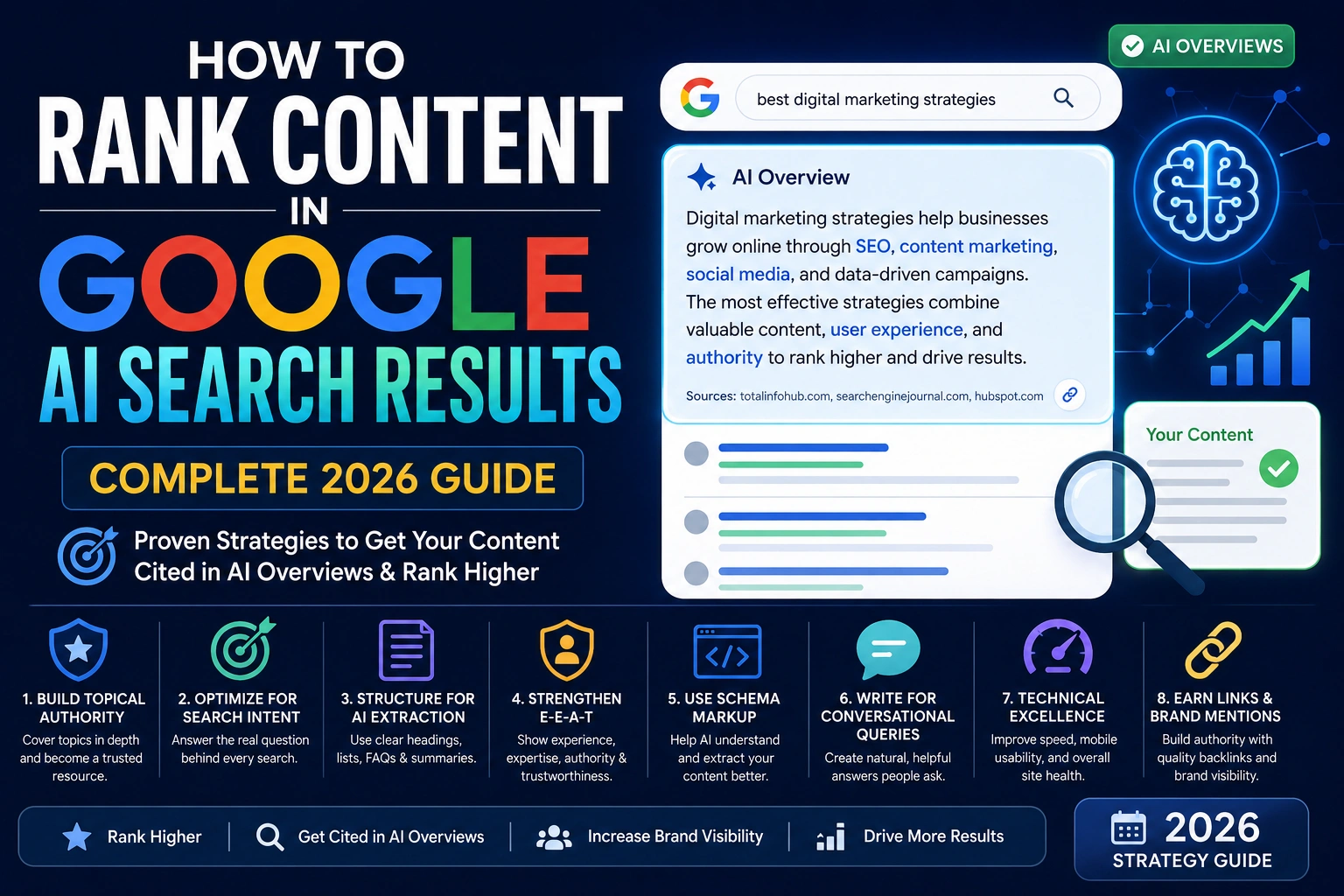
The 8 Core Strategies to Rank in Google AI Search Results
1. Build Deep Topical Authority
If there is one strategy that matters more than any other for AI search visibility, it is this one.
Industry research and observed AI search behavior suggest that topical authority can improve AI citation opportunities, although Google generally emphasizes creating unique, useful, and people-first content rather than officially confirming topical authority as a standalone ranking factor. Sites that cover a subject comprehensively — across multiple interconnected articles — tend to be treated as more reliable references by AI systems.
What topical authority looks like in practice:
- A clearly defined content niche — your site covers specific subjects deeply rather than touching on everything
- Pillar pages that provide comprehensive overviews of core topics
- Supporting cluster articles that address every meaningful subtopic and related question
- Strong internal linking that connects these articles to each other, creating a navigable knowledge structure
- Consistent publishing that keeps your topical coverage current and growing
Think of it this way: Google’s AI is more likely to cite a site that has published twenty interconnected articles on a topic than a site with one excellent page on the same topic. The former demonstrates that someone genuinely knows the subject. The latter could be a one-off.
This is one of the most significant ways AI search is changing SEO — shifting the competitive advantage from individual page optimization to site-wide subject matter expertise.
2. Optimize for Search Intent — Not Just Keywords
Google’s AI evaluates not just what a query says, but what the user actually wants to accomplish. This is called search intent, and matching it accurately is one of the clearest signals you can send that your content belongs in the results.
There are four primary intent types — and each requires a different content approach:
Informational intent (“how does X work,” “what is Y”) → Comprehensive explanations, clear definitions, step-by-step guides, FAQ sections
Navigational intent (“X brand login,” “X official site”) → Clear brand identity pages, structured contact and about information
Commercial intent (“best X for Y,” “X vs Y”) → Honest comparisons, pros and cons, use-case breakdowns, real-world data
Transactional intent (“buy X,” “X pricing”) → Clear product/service information, pricing, trust signals, easy conversion paths
Most AI Overview citations happen for informational and commercial intent queries — the two types where users are actively researching a topic rather than ready to take a specific action. If your content strategy focuses heavily on these intent types, your AI search visibility opportunity is significant.
3. Structure Content for AI Extraction
This is the most immediately actionable strategy in this guide — and one of the most impactful.
Google’s AI systems scan your content looking for clear, extractable answers. The way you structure your writing directly determines how easy or difficult that extraction is. Content that looks good to a human reader may still be structured in a way that makes it difficult for an AI system to identify the core answer to a specific question.
High-extraction content structure looks like this:
- Question-based headings (H2 and H3) — write your headings as the questions your audience actually asks, not as clever titles. “How Does Schema Markup Help SEO?” is more extractable than “The Power of Structured Data.”
- Direct answer in the first sentence after the heading — state your answer clearly and concisely before expanding on it. AI systems often extract just the first sentence or two following a heading.
- Bullet-point and numbered list summaries — lists are among the most commonly cited content formats in AI Overviews. When information can be expressed as a list, use one.
- FAQ sections — dedicated FAQ sections with question-format headings and concise answers are worth including in content aimed at AI search visibility. Industry studies and observed AI search behavior suggest that FAQPage schema can improve content extraction and citation opportunities — though results are not guaranteed and vary by topic and competition level.
- Short, direct paragraphs — avoid long, rambling blocks of text. Two to four sentences per paragraph is a practical target.
- Bold key terms and takeaways — helps AI systems (and human readers) quickly identify the most important information.
A strong command of on-page SEO structure is the foundation on which all of this rests — the structural principles that have always driven good on-page performance are even more critical in the AI search era.
4. Strengthen Your E-E-A-T Signals
E-E-A-T — Experience, Expertise, Authoritativeness, and Trustworthiness — is Google’s framework for evaluating whether content comes from a genuinely credible source. In the AI search era, E-E-A-T has become increasingly important for evaluating content credibility and trustworthiness, although Google describes it as a quality framework rather than a direct ranking factor.
Google’s AI systems are designed to surface content from people and organizations who can demonstrate genuine knowledge of a subject.
Practical E-E-A-T improvements:
- Named, credentialed authors — articles with author bios that include real names, relevant experience, and verifiable credentials signal expertise far more effectively than anonymous content
- First-hand experience — include specific observations, case studies, or data from your own work. “In our testing, we found…” carries more weight than restating what other sources have said
- Cited sources — link to authoritative external references where relevant. Citing Google Search Central, peer-reviewed research, or established industry reports signals that your content is grounded in verifiable information
- Regular updates — outdated content loses trust signals over time. Reviewing and refreshing key pages regularly demonstrates active stewardship
- Clear organizational identity — a well-maintained About page, contact information, and transparent authorship all contribute to the trust component of E-E-A-T
5. Use Schema Markup Comprehensively
Schema markup — structured data added to your page’s code that tells search engines what type of content they are reading — is one of the clearest and most direct signals you can send to AI systems.
When Google’s AI reads a page with proper schema markup, it knows immediately whether it is reading an article, a FAQ, a how-to guide, a product page, a review, or a recipe. This context is enormously useful for determining whether the content is the right answer to a specific query type.
The schema types most relevant to AI search visibility:
|
Schema Type |
Best For |
AI Search Benefit |
|---|---|---|
|
Article / BlogPosting |
Editorial content |
Establishes content type and authorship |
|
FAQPage |
FAQ sections |
Directly maps Q&A pairs for extraction |
|
HowTo |
Step-by-step guides |
Structures process content for AI summaries |
|
Organization |
Brand/about pages |
Builds entity recognition and trust |
|
BreadcrumbList |
Site navigation |
Helps AI understand site structure |
|
Review / AggregateRating |
Product/service pages |
Adds trust signals to commercial content |
Important clarification: Google states that structured data is not required for AI Overviews, and there is no special schema markup specifically designed for AI search. However, structured data remains a valuable SEO best practice and may help search engines better understand and classify your content. As noted in Google Search Central documentation, implementing relevant schema is recommended as part of a well-rounded technical SEO strategy — not as a guaranteed path to AI Overview inclusion.
If you have not yet deployed schema markup across your key content types. For many websites, implementing relevant schema markup remains a valuable technical SEO best practice in 2026. A solid technical SEO foundation — including comprehensive schema implementation — directly improves how AI systems understand and classify your content.
6. Write for Conversational Queries
The way people search has changed fundamentally. Users interacting with Google’s AI Mode, Gemini, or AI-assisted search do not type keyword phrases — they ask complete questions in natural language, often with context and nuance included.
“Best project management software” is a keyword. “What project management tool works best for a small creative agency that does mostly client work and needs budget tracking?” is a conversational query.
These are different queries, and they reward different content. The second query is answered well by content that addresses specific use cases, compares options in context, and acknowledges the nuance in the question.
How to write for conversational queries:
- Research the actual questions your audience asks — Google’s “People Also Ask” boxes, AnswerThePublic, and direct customer conversations are all excellent sources
- Write headings that mirror natural question phrasing
- Address nuance and context within your answers, not just the headline question
- Anticipate follow-up questions and answer them in the same piece or link to dedicated articles that do
- Use natural, conversational language throughout — AI systems evaluate content for readability and natural language quality, not keyword density
7. Build a Technically Sound Foundation
Content strategy and technical SEO are not competing priorities — they are complementary requirements. Even the most expertly written, perfectly structured content will underperform if the technical foundation beneath it is broken.
Google’s AI crawlers, like traditional search crawlers, depend on being able to access, read, and understand your pages efficiently. Pages that load slowly, fail on mobile, have crawl errors, or lack proper indexing signals are at a structural disadvantage regardless of content quality.
Technical priorities that directly affect AI search visibility:
- Page speed and Core Web Vitals — slow-loading pages are deprioritized both for traditional ranking and AI citation
- Mobile-first experience — the majority of searches happen on mobile devices; poor mobile rendering is a meaningful signal
- Clean crawlability — ensure your robots.txt, sitemap, and internal link structure allow search bots to discover and index all important pages
- Canonical tags — prevent duplicate content confusion by using canonical tags correctly
- Internal linking — well-structured internal links help AI systems understand which pages are most important and how topics connect across your site
- Page indexing — regularly audit via Google Search Console to confirm your key pages are indexed and appearing in search
8. Earn Authoritative Backlinks and Brand Mentions
Backlinks remain one of the most powerful trust signals in both traditional and AI-powered search. A page that other credible, topically relevant websites link to is treated as more authoritative — and more citation-worthy — by Google’s AI systems.
But in 2026, backlinks are only part of the off-page picture. Industry research suggests that brand mentions — references to your brand, content, or expertise across the web, even without a hyperlink — may contribute to online authority and entity recognition, although Google has not officially confirmed them as a direct ranking factor. When authoritative sources in your industry reference your brand name, recommend your content, or cite your data, this broader presence can contribute to how Google understands your site as an entity.
Off-page strategies that support AI search visibility:
- Pursue backlinks from topically relevant, high-authority domains — one strong contextual link outweighs dozens of low-quality links
- Get your research, data, or original insights cited by industry publications
- Contribute guest articles or expert quotes to reputable sites in your niche
- Build a presence on authoritative platforms (LinkedIn, industry forums, podcasts) where your expertise is referenced
- Encourage satisfied customers or users to leave reviews and mentions on credible platforms
For a broader framework on building off-page authority, this guide on improving brand visibility in AI search results covers the full landscape of signals that contribute to AI citation frequency.
Step-by-Step Action Plan: Getting Your Content Into AI Overviews
Knowing the strategies is one thing. Having a practical sequence to follow is another. Here is a working action plan for a single piece of content you want to optimize for Google AI search:
Step 1 — Research the query ecosystem Before writing a word, use tools like Semrush, Ahrefs, or Google’s “People Also Ask” to map out every meaningful question related to your target topic. These questions become your heading structure.
Step 2 — Audit the current AI Overview Search your target keyword and examine the current AI Overview if one appears. Note which sources are cited, what content structure they use, how long their answers are, and what subtopics are covered. This is your competitive benchmark.
Step 3 — Write with direct-answer structure Draft your content with question-based H2/H3 headings. Lead each section with a direct, concise answer (2–3 sentences), then expand with supporting detail. Avoid padding the top of each section with context before the answer.
Step 4 — Build a dedicated FAQ section Identify 5–8 questions that users commonly ask about your topic — especially those that appear in “People Also Ask” — and answer each one directly in 2–4 sentences. Add FAQPage schema markup to this section.
Step 5 — Add schema markup Implement Article schema (or the appropriate content type), FAQPage schema on your FAQ section, and any other relevant schema types. Validate using Google’s Rich Results Test tool.
Step 6 — Strengthen E-E-A-T on the page Add or update the author bio. Include at least one original observation, data point, or first-hand example. Cite 2–3 authoritative external sources where relevant. Confirm the page’s last-updated date is current.
Step 7 — Review internal linking Ensure the page links to 3–5 related articles on your site, and that those articles link back to this page where relevant. Internal linking distributes authority and helps AI systems understand topical relationships across your content.
Step 8 — Monitor and iterate After publishing, track whether the page begins appearing in AI Overviews for target queries — either through manual spot-checking or a dedicated AI search monitoring platform. Use what you observe to refine your approach for future content.
Common Mistakes That Keep Content Out of AI Search Results
Understanding what to do is important. Understanding what not to do is equally valuable. These are the most common patterns that prevent otherwise solid content from appearing in AI-generated results.
Mistake 1: Burying the answer Long introductions that take three or four paragraphs to reach the actual answer make extraction difficult. AI systems look for direct answers close to the relevant heading. Lead with the answer, then explain.
Mistake 2: Ignoring FAQ sections Industry studies suggest that FAQ sections are often easier for AI systems to extract and cite because of their structured question-and-answer format. Sites that skip them miss a straightforward opportunity to get content extracted and attributed.
Mistake 3: No schema markup Publishing content without schema markup means search engines have to guess at content type and structure. Schema removes that uncertainty and directly improves AI comprehension of your pages.
Mistake 4: Thin topical coverage A single article on a topic, no matter how well written, is less likely to be cited than a site with a comprehensive cluster of content on the subject. AI systems favor topical depth.
Mistake 5: Anonymous or uncredentialed authorship Content published without author information, credentials, or any indication of who produced it lacks the E-E-A-T signals that AI systems weight heavily.
Mistake 6: Ignoring technical health A page with crawl errors, slow load times, or mobile rendering issues is at a fundamental disadvantage. Technical problems override content quality.
Mistake 7: Writing for keywords instead of questions Keyword-optimized content that doesn’t directly answer the natural language questions users ask in AI search is poorly aligned with how these systems evaluate relevance. Shift from keyword thinking to question thinking.
How to Track Your AI Search Visibility
Traditional rank tracking tools show you where your pages appear in the blue-link results. They do not, by default, tell you whether your content is being cited in AI Overviews, Gemini responses, or other AI-generated summaries.
Tracking your AI search visibility requires a different approach:
Manual spot-checking Regularly search your target queries in Google and observe whether AI Overviews appear and whether your content is cited. Note which pages are included and what content format they use. This is time-consuming but free and informative.
Google Search Console While it doesn’t yet provide AI Overview citation data directly, Search Console does show you which queries drive impressions and clicks. A page generating impressions but low CTR may be appearing in AI Overviews without driving clicks — an important pattern to identify.
Dedicated AI monitoring platforms Tools such as Semrush and SearchAtlas offer varying levels of AI search visibility monitoring — including features for tracking AI Overview appearances and citation frequency. Features may change over time, so verify current capabilities directly with the provider before committing to a platform.
Branded search tracking One of the clearest indicators that your content is being cited in AI Overviews is an uptick in branded search volume — people who saw your brand mentioned in an AI summary searching for your brand directly. Track branded keyword volume in Search Console and any rank tracking tool you use.
The right AI SEO tools make this tracking process significantly more efficient — and help you connect AI visibility data to actual content decisions.
Frequently Asked Questions (FAQ)
Q1: How long does it take to rank in Google AI Search results?
There is no fixed timeline, and results vary significantly by niche, domain authority, and how competitive the target queries are. In our experience, structural improvements — adding FAQ sections, schema markup, and direct-answer formatting — can begin showing effects within 4–8 weeks for pages that are already indexed and have reasonable authority. Building topical authority through content clusters is a longer play, typically taking 3–6 months of consistent publishing before compounding effects become visible.
Q2: Do I need a high-authority domain to appear in AI Overviews?
Domain authority helps, but it is not the only factor. Sites with modest authority but very deep topical coverage and strong content structure do appear in AI Overviews — particularly for niche queries where fewer authoritative sources exist. Targeting specific, underserved questions within your niche is often more achievable than competing for broad, high-competition queries where established domains dominate.
Q3: Is there a difference between ranking in AI Overviews and ranking in traditional search?
Yes — meaningfully so. Traditional search rankings depend heavily on backlink authority, keyword optimization, and CTR signals. AI Overview citations depend more on content structure, topical depth, E-E-A-T signals, and how directly and clearly your content answers the specific query. A page can rank in position 4 in traditional results and still be cited in the AI Overview — and a page in position 1 may not be cited if its content is not structured for extraction.
Q4: Does publishing more content help with AI search visibility?
Publishing more content helps only if that content adds genuine topical depth — not if it repeats what you have already covered or ventures into unrelated areas. Quality and relevance within a defined topic area outperforms volume alone. A site with forty tightly focused, well-structured articles on a single subject will typically outperform a site with two hundred thin articles across twenty different subjects.
Q5: How important is FAQ schema for AI search visibility?
Industry studies and observed AI search behavior suggest that FAQ sections with FAQPage schema markup can improve content extraction and citation opportunities in AI Overviews. The structure maps well to what AI systems need: clear question-and-answer pairs that can be extracted and attributed. That said, results vary by topic, competition, and domain authority — schema alone does not guarantee AI Overview inclusion. If you are not yet using FAQPage schema on your key content pages, it is a worthwhile best practice to implement alongside the other strategies in this guide.
Q6: Can video or image content rank in Google AI Search results?
Currently, Google AI Overviews primarily cite text-based content. However, Google’s search features continue to evolve, and multimodal content — video, infographics, and images with strong surrounding text context — increasingly contributes to overall page quality signals. For now, the core focus for AI search visibility should be on text content structure, schema markup, and E-E-A-T.
Q7: How does this strategy relate to optimizing for ChatGPT Search or Perplexity?
The foundational requirements are largely consistent across AI search platforms: genuine topical expertise, clear content structure, accurate information, strong E-E-A-T signals, and authoritative backlinks. The specific citation patterns differ between platforms — Perplexity, for example, places particular emphasis on credible, sourced information — but a single well-executed content strategy built around these principles tends to perform across multiple AI search environments. For a broader view of where this is all heading, the analysis in this guide on the future of SEO in the answer engine era is worth reading.
📚 Continue Reading: Build Your Complete AI Search Strategy
These TotalInfoHub guides connect directly to the strategies covered in this article:
- 🔍 How AI Search Is Changing SEO (June 2026) — the full strategic picture behind the shift to AI-powered search
- 🛠️ Best AI SEO Tools in 2026 — the tools that make these strategies faster and more scalable
- 📈 Best Ways to Improve Brand Visibility in AI Search Results — go beyond rankings into AI citation strategy
- 🔮 The Future of SEO in the Answer Engine Era — where AI search is heading and how to position your site
Final Thoughts
Ranking in Google AI search results is not a separate discipline from good SEO — it is an extension of it. The fundamentals that have always driven strong organic performance — genuine expertise, well-structured content, technical health, authoritative backlinks — remain essential. What has changed is the weighting, the format requirements, and the additional layer of optimization that AI extraction demands.
The sites that will capture AI Overview citations consistently in 2026 and beyond are the ones that treat their content as a knowledge resource, not a keyword vehicle. They build topical depth. They structure for clarity. They demonstrate real expertise. And they maintain the technical foundations that allow that content to be found, parsed, and trusted.
Start with one high-priority topic. Apply the eight strategies in this guide to your existing content. Build from there. The compounding advantage of getting this right — in both traditional and AI-powered search — is substantial.
Disclaimer: SEO strategies and Google’s AI search features continue to evolve. The guidance in this article reflects best practices as of June 2026. Always refer to Google Search Central documentation for the most current official guidance.
📎 Sources & Further Reading
Official Documentation
- Google Search Central — AI Overviews & Structured Data Guidelines (developers.google.com/search)
- Google Search Quality Evaluator Guidelines — E-E-A-T framework (static.googleusercontent.com)
- Google Rich Results Test (search.google.com/test/rich-results)
AI Search Research & Industry Data
- SparkToro — Zero-Click Search Studies (sparktoro.com/research)
- Search Engine Land — AI Overviews Coverage (searchengineland.com)
- Search Engine Journal — AI Search Optimization Research (searchenginejournal.com)
- BrightEdge — AI Search Impact Research (brightedge.com/resources)
Schema & Structured Data
- Schema.org — Full Schema Vocabulary Reference (schema.org)
- Google Structured Data Documentation (developers.google.com/search/docs/appearance/structured-data)
This guide is reviewed and updated regularly as Google’s AI search features evolve. Last reviewed: June 2026.