AI Search Visibility Audit: How to Check If AI Can Find Your Content (2026)
You have published great content. It ranks reasonably well on Google. But here is a question most website owners cannot answer: can AI tools actually find, read, and cite your content?
As more people get their answers from ChatGPT, Perplexity, and Google AI Overviews, this question matters more every month. If AI systems cannot find or understand your content, you may miss visibility with a growing share of users who now rely on AI-powered answers — no matter how well you rank in traditional search.
An AI search visibility audit is how you check this. It is a simple, structured process to find out whether AI systems can discover your content, understand it, and reference it when answering questions in your topic area.
This guide walks you through exactly how to run that audit — step by step, in plain language. You do not need expensive tools or technical expertise to get started. By the end, you will know where you stand and what to fix.
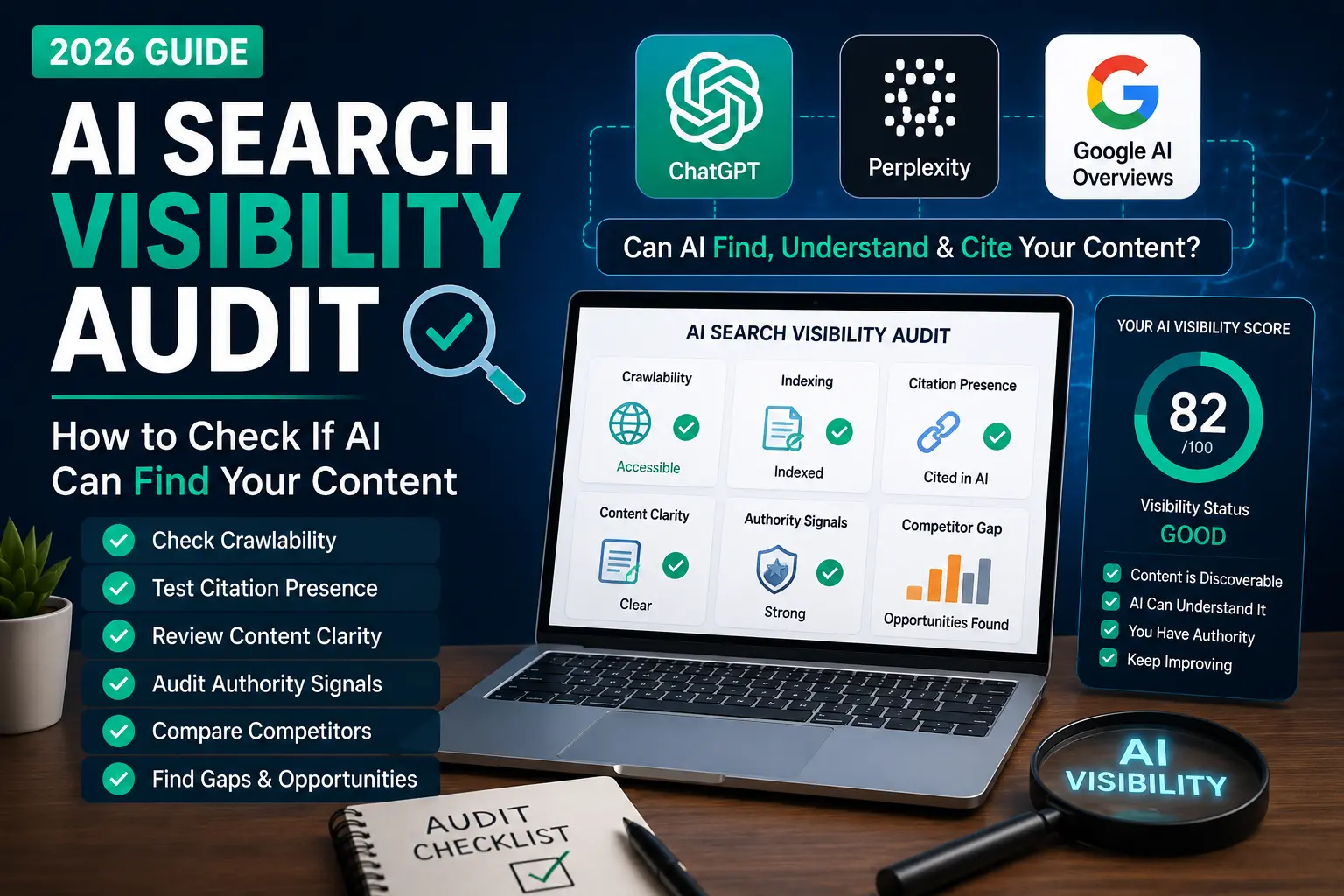
Quick Summary: What an AI Visibility Audit Checks
|
Check |
What It Tells You |
|---|---|
|
Crawlability |
Can AI systems access your content? |
|
Indexing |
Is your content findable on the web? |
|
Citation presence |
Do AI tools actually cite you now? |
|
Content clarity |
Can AI easily understand your content? |
|
Authority signals |
Does your content look credible to AI? |
|
Competitor gap |
Where do competitors appear and you do not? |
What Is an AI Search Visibility Audit?
An AI search visibility audit is a check of how well AI-powered search tools can find, understand, and cite your content.
Think of it like a traditional SEO audit, but focused on AI answer engines instead of just Google’s ranked links. A regular SEO audit asks “can Google find and rank my pages?” An AI visibility audit asks “can ChatGPT, Perplexity, and Google AI Overviews find my content, understand it, and reference it in their answers?”
The audit looks at several things:
- Whether AI systems can technically access your content
- Whether your content is structured clearly enough for AI to understand
- Whether AI tools currently cite you for relevant questions
- Whether your authority signals make your content trustworthy to AI
- Where competitors appear in AI answers and you do not
The goal is simple: understand your current AI visibility, find the gaps, and know what to improve. It is the foundation of any serious effort to show up in AI search.
Why You Need One in 2026
You might already do regular SEO checks. So why add an AI visibility audit? Here are the practical reasons.
AI search is becoming an increasingly important discovery channel. Millions of people use AI tools to find information. If you are invisible there, you are missing a growing audience — even if your Google rankings are strong.
Traditional SEO does not fully cover AI visibility. Ranking on Google helps, but AI systems have their own ways of selecting and citing sources. Good traditional SEO is necessary but not always sufficient. Understanding how AI search is changing SEO explains why.
You cannot fix what you cannot see. Without an audit, you are guessing about your AI visibility. The audit replaces guesswork with a clear picture of where you actually stand.
Competitors may already be ahead. If your competitors appear in AI answers and you do not, they are capturing visibility you are missing. An audit reveals these gaps.
It guides your content strategy. Knowing what AI systems can and cannot find on your site tells you exactly what to fix and create next.
In short, an AI visibility audit turns a vague worry — “am I visible in AI search?” — into concrete, actionable information.
What to Check in an AI Visibility Audit
Before the step-by-step process, here is an overview of the main areas your audit should cover.
Technical access (crawlability) Can AI systems and the crawlers they rely on actually reach your content? If your pages are blocked or hard to access, nothing else matters.
Indexing and findability Is your content indexed and discoverable on the web? Many AI systems rely, at least partly, on web content being findable in the first place.
Citation presence Do AI tools currently cite your content when answering relevant questions? This is the most direct measure of your current visibility.
Content clarity and structure Can AI systems easily understand your content? Clear answers, good structure, and clean formatting all help.
Authority and trust signals Does your content look credible? E-E-A-T signals influence whether AI systems trust and cite your content.
Competitive position Where do competitors appear in AI answers that you do not? This reveals your biggest opportunities.
Each of these maps to a step in the audit process below.
Step-by-Step: How to Run Your Audit
Here is the practical, hands-on process. You can do most of this yourself, for free.
Step 1: Check If AI Can Crawl Your Site
Start with the technical foundation. If AI systems cannot access your content, nothing else matters.
- Check your robots.txt file. Make sure it is not accidentally blocking important pages or compliant search crawlers that some AI systems may rely on. Your robots.txt is usually at yoursite.com/robots.txt.
- Confirm your pages are indexed. Use Google Search Console to check Google-side indexing, crawlability, and generative AI visibility signals.
- Test your site speed and accessibility. Slow or broken pages are harder for any system to access reliably.
- Review your sitemap. Make sure you have an up-to-date XML sitemap submitted to search engines.
This technical layer is the foundation of all visibility. A strong grasp of technical SEO makes this step much easier.
Step 2: Test Your Citation Presence
Now check whether AI tools actually cite you today. This is the most direct test.
- Ask ChatGPT (with web search) questions your content targets. See if your site appears in the cited sources.
- Test the same questions in Perplexity. Perplexity clearly shows its sources, making it easy to see if you are cited.
- Check Google AI Overviews. Search your target queries in Google and note whether AI Overviews appear and which sources they cite.
- Try several phrasings. People ask questions in different ways, so test multiple variations to get a fuller picture.
Keep a simple record: which questions you tested, whether you appeared, and who did get cited. This becomes your baseline.
Step 3: Review Your Content Clarity
If AI can access your content but does not cite it, clarity may be the issue. Review your key pages with AI extraction in mind.
- Do you lead with direct answers? Check whether each section answers its question clearly and early, or buries the answer.
- Are your headings question-based? Headings phrased as real questions are easier for AI to match to queries.
- Do you have FAQ sections? Question-and-answer pairs are highly extractable by AI.
- Is your formatting clean? Short paragraphs, lists, and clear structure all help AI parse your content.
The goal is content that AI can easily read, understand, and pull accurate answers from. This connects closely to SEO for answer engines.
Step 4: Check Your Authority Signals
Based on observed patterns, AI systems often appear to favor credible sources. Review whether your content sends strong authority signals.
- Do you have clear authorship? Named authors with relevant expertise build credibility.
- Is your information accurate and sourced? Content that cites credible references signals reliability.
- Do you have a clear organizational identity? About pages, contact details, and consistent branding matter.
- Do other credible sites reference you? External mentions and links build authority.
These E-E-A-T signals may influence whether AI systems view your content as credible enough to cite. Building this authority connects to broader generative engine optimization (GEO) practices.
Step 5: Run a Competitor Comparison
Understanding where competitors appear — and you do not — reveals your biggest opportunities.
- Identify your main competitors for your key topics.
- Test your target questions in ChatGPT, Perplexity, and Google AI Overviews.
- Note which competitors get cited and for which questions.
- Look for patterns. Are competitors cited for topics you have not covered well? Do they have content formats you lack?
This comparison turns abstract gaps into a concrete list of opportunities to pursue.
Step 6: Document Gaps and Opportunities
Finally, turn everything you found into an action plan.
- List the questions where you should appear but do not.
- Note the technical issues you found in Step 1.
- Identify content clarity problems from Step 3.
- Record authority gaps from Step 4.
- Prioritize your opportunities based on impact and effort.
A documented audit gives you a clear roadmap — not just a vague sense that you should “do more AI optimization.”
Tools That Help with AI Visibility Audits
You can run a basic audit with free tools, but some paid options make it easier and more thorough.
Free tools:
- Google Search Console — check indexing, crawlability, and search performance
- ChatGPT, Perplexity, and Google — manually test your citation presence
- Your website analytics — check for referral traffic from AI platforms
Paid tools:
- AI monitoring platforms — some SEO tools now track AI citations and visibility across platforms. Features vary and change frequently, so verify current capabilities before subscribing.
For most beginners and small sites, the free tools are enough to run a meaningful audit. Paid tools help when you need to track AI visibility at scale or across many queries. Our roundup of the best AI SEO tools in 2026 covers the options in detail, and our guide on AI search monitoring platforms goes deeper on tracking.
How to Fix Common AI Visibility Problems
Once your audit reveals problems, here is how to address the most common ones.
Problem: AI cannot access your content Fix your robots.txt, ensure pages are indexed, improve site speed, and submit a current sitemap. Technical access is the foundation.
Problem: Your content is not cited despite being accessible Improve clarity. Lead with direct answers, add question-based headings, include FAQ sections, and clean up your formatting so AI can extract information easily.
Problem: Your content lacks authority Strengthen E-E-A-T. Add clear authorship, cite credible sources, build out your About page, and earn mentions from reputable sites in your field.
Problem: Competitors appear and you do not Fill the content gaps. Create deeper, clearer content on the topics where competitors are cited, and structure it for AI extraction.
Problem: Your content is outdated Update it. Refresh facts, figures, and examples, and update your “last reviewed” date. Current content is more likely to be referenced.
Problem: Thin topical coverage Build topical depth. Create connected content that thoroughly covers your subject area, supported by strong keyword research in the age of AI.
How Often Should You Audit?
AI search is evolving quickly, so regular audits help you stay on top of your visibility.
For most websites: A full AI visibility audit every three to six months is reasonable. This catches major changes without consuming too much time.
For competitive or fast-moving niches: Monthly spot-checks of your key queries help you respond faster to changes in how AI tools cite sources.
After major content changes: Run a focused audit after publishing significant new content or restructuring your site, to see how the changes affect your AI visibility.
Ongoing monitoring: Beyond formal audits, keep an eye on your referral traffic and branded search trends as continuous signals of your AI visibility.
The key is consistency. AI visibility is not a one-time fix — it is an ongoing part of modern content strategy.
Frequently Asked Questions
Q1: What is an AI search visibility audit?
An AI search visibility audit is a structured check of how well AI-powered search tools — like ChatGPT, Perplexity, and Google AI Overviews — can find, understand, and cite your content. It is similar to a traditional SEO audit but focused on AI answer engines. The audit reveals whether AI systems can access your content, understand it clearly, and reference it when answering relevant questions.
Q2: Can I run an AI visibility audit for free?
Yes. You can run a meaningful audit using free tools: Google Search Console for crawlability and indexing, and ChatGPT, Perplexity, and Google for testing your citation presence manually. Paid AI monitoring tools make the process faster and more thorough, especially at scale, but they are not required to get started. Most beginners can run a useful audit with free tools alone.
Q3: How is this different from a normal SEO audit?
A normal SEO audit focuses on how well you rank in traditional search results — keywords, backlinks, technical health, and rankings. An AI visibility audit focuses on whether AI answer engines can find, understand, and cite your content. They overlap (both care about crawlability and quality), but the AI audit adds checks for citation presence, content clarity for AI extraction, and competitive position in AI answers specifically.
Q4: How do I know if ChatGPT or Perplexity is citing my content?
The most direct way is to test manually. Ask ChatGPT (with web search enabled) and Perplexity the questions your content targets, and see whether your site appears in the cited sources. Perplexity makes this especially easy because it clearly shows its sources. You can also check your website analytics for referral traffic from these platforms.
Q5: What should I do if AI cannot find my content?
Start with the technical basics. Check that your robots.txt is not blocking important pages, confirm your key pages are indexed in Google Search Console, ensure your site loads properly, and submit an up-to-date sitemap. If your content is technically accessible but still not cited, the next step is improving clarity, structure, and authority signals.
Q6: How often should I check my AI visibility?
For most websites, a full audit every three to six months works well. In competitive or fast-moving niches, monthly spot-checks of your key queries help you respond faster. It is also smart to run a focused audit after major content changes. Beyond formal audits, ongoing monitoring of referral traffic and branded search trends gives you continuous signals.
Q7: Does fixing my AI visibility guarantee I’ll be cited?
No. No method can guarantee citation in AI systems — they make their own decisions using their own logic. What an audit and the resulting fixes do is significantly improve your chances by making your content accessible, clear, credible, and well-structured. Think of it like SEO: you cannot guarantee a top ranking, but you can do many things that meaningfully improve your odds.
Final Verdict
An AI search visibility audit answers a question every website owner should be asking in 2026: can AI tools actually find, understand, and cite my content?
Without an audit, you are guessing. With one, you have a clear picture of where you stand and exactly what to improve. The process is not complicated, and you can start with free tools today — no special expertise required.
The most important takeaway is that AI visibility is now a real, measurable part of your content strategy. Just as you check your Google rankings, it makes sense to check whether AI systems can find and reference your content too.
Here is where to start:
1. Run the technical checks. Confirm your content is crawlable, indexed, and accessible — the foundation everything builds on.
2. Test your citation presence. Ask ChatGPT, Perplexity, and Google your target questions and see where you currently appear.
3. Document and fix the gaps. Turn what you find into a prioritized action plan, and improve clarity, authority, and topical depth over time.
AI search will only grow more important. Running regular visibility audits keeps you informed, ahead of competitors, and visible to the growing audience that now relies on AI to find answers.
Disclaimer: AI search tools and their citation behavior evolve rapidly and are not fully documented publicly. The guidance in this article reflects industry understanding and observed practices as of June 2026. No audit or optimization method can guarantee citation in any AI system. Always verify current tool capabilities and best practices, and test with your own content.
Sources and Further Reading
Official and Industry Sources
- Google Search Central — Crawling & Indexing Documentation — developers.google.com/search
- Schema.org — Structured Data Vocabulary — schema.org
- Search Engine Journal — AI Search Coverage — searchenginejournal.com
- Search Engine Land — AI Visibility Analysis — searchengineland.com
Related Guides on TotalInfoHub
- How AI Search Is Changing SEO — totalinfohub.com/how-ai-search-is-changing-seo/
- SEO for Answer Engines — totalinfohub.com/seo-for-answer-engines/
- Generative Engine Optimization (GEO) — totalinfohub.com/generative-engine-optimization-geo/
- Best AI SEO Tools in 2026 — totalinfohub.com/best-ai-seo-tools/
- AI Search Monitoring Platform — totalinfohub.com/ai-search-monitoring-platform-improve-seo-strategy/
- Technical SEO Guide — totalinfohub.com/technical-seo-beginner-to-advanced-guide/
Last reviewed: June 2026