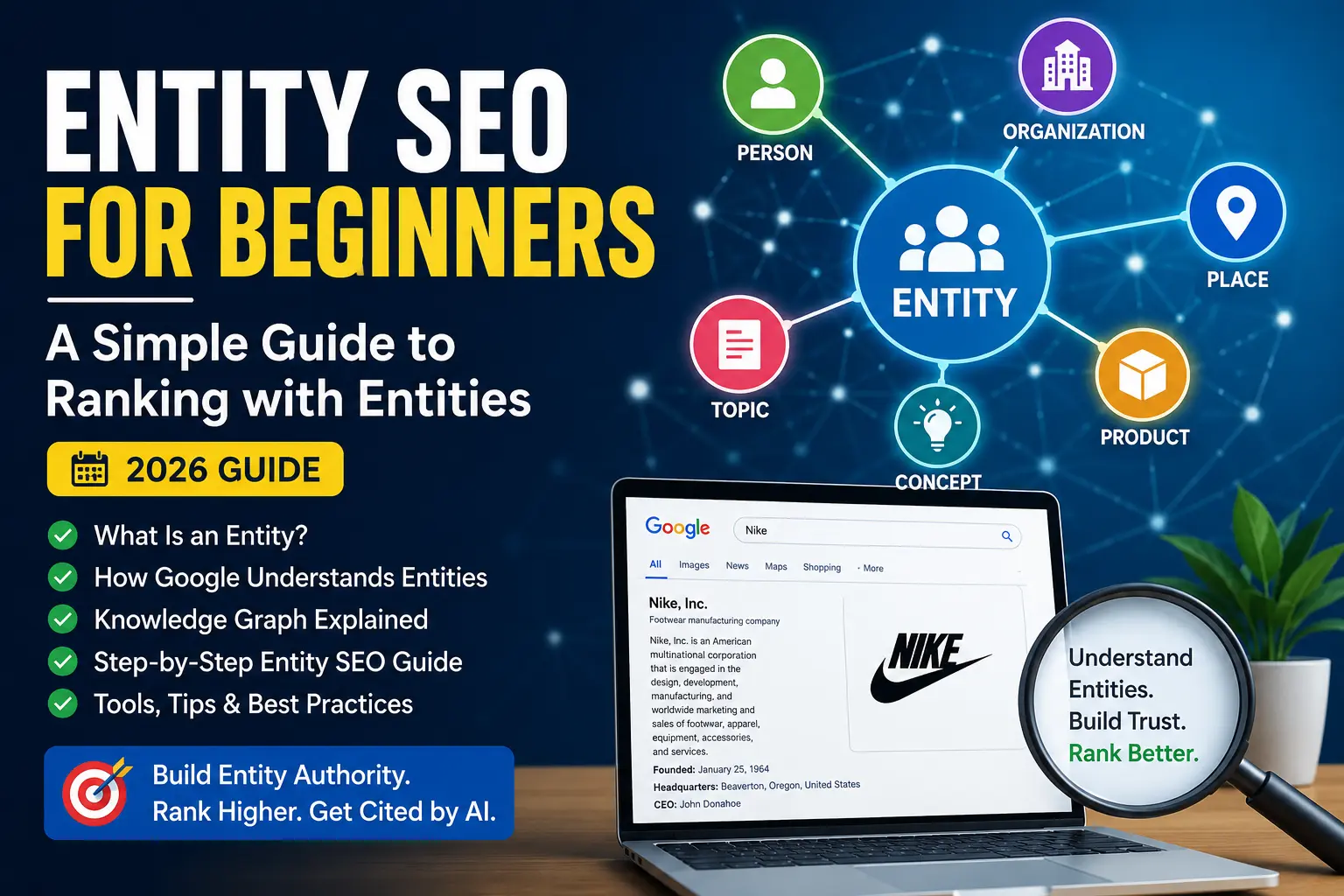
Entity SEO for Beginners: A Simple Guide to Ranking with Entities (2026)
If you have ever wondered how Google knows that “Apple” the company is different from “apple” the fruit, you have already bumped into the idea behind entity SEO.
Search engines no longer rely only on keyword matching. They try to understand the real-world things — people, places, brands, and concepts — that your content is about. These real-world things are called entities, and optimizing your content around them is what entity SEO is all about.
For beginners, this can sound technical and intimidating. It is not. At its core, entity SEO is about helping Google clearly understand who you are, what you do, and what topics you are an authority on.
This guide explains entity SEO in plain language — what entities are, why they matter, and the simple steps you can take to build entity authority for your website in 2026. No jargon without explanation, and every point is something you can actually use.
Quick Summary: Entity SEO at a Glance
|
Element |
What It Means |
|---|---|
|
What is an entity? |
A clearly defined thing — person, place, brand, or concept |
|
What is entity SEO? |
Optimizing content so search engines understand these things |
|
Why it matters |
Helps Google connect your brand to topics and trust your content |
|
Key tool |
Google’s Knowledge Graph |
|
Main benefit |
Better rankings, knowledge panels, and AI citations |
|
How to start |
Be consistent, use schema, build topical authority |
What Is an Entity in SEO?
An entity is a clearly defined thing that exists in the real world — a person, a place, a company, a product, or a concept. It has a distinct identity that sets it apart from everything else.
Here are some simple examples of entities:
- A person — like Albert Einstein
- A place — like Paris
- A company — like Microsoft
- A product — like the iPhone
- A concept — like photosynthesis
What makes something an entity is that it is well-defined and singular. Google understands an entity not just as a word, but as a thing with specific attributes and relationships to other things.
For example, Google understands that “Tom Hanks” is a person, that he is an actor, that he starred in specific films, and that he is connected to other entities like those movies and the people he worked with. That web of connections is what makes entities so powerful for search.
What Is Entity SEO?
Entity SEO is the practice of optimizing your content and online presence so search engines clearly understand the entities you represent and the topics you cover.
In simple terms, entity SEO helps Google answer three questions about your website:
- Who or what are you? (Your brand as a defined entity)
- What topics are you about? (The subjects you cover)
- Can you be trusted on these topics? (Your authority and credibility)
Traditional SEO focused heavily on keywords — matching the exact words people searched for. Entity SEO goes deeper. It focuses on meaning and relationships, helping search engines understand the concepts behind the words.
This matters because modern search engines, and AI answer engines, increasingly think in terms of entities and relationships rather than just keyword matches. When Google clearly understands your brand as a trusted entity in your field, it is more likely to rank your content, show your information in knowledge panels, and cite you in AI-generated answers.
The Knowledge Graph Explained Simply
The Knowledge Graph is Google’s giant database of entities and the relationships between them.
Think of it as a massive web of connected facts. It knows that Paris is a city, that it is in France, that the Eiffel Tower is located there, and that France is in Europe. All these entities are linked together with their relationships clearly mapped.
Google built the Knowledge Graph to understand the world more like a human does — in terms of things and their connections, not just strings of text. It launched in 2012 and has grown enormously since then.
When you search for a well-known entity, the information box that often appears on the right side of the results — with facts, images, and links — is powered by the Knowledge Graph. That box is called a knowledge panel.
For entity SEO, the goal is often to get your brand or yourself recognized as an entity within this Knowledge Graph. When Google recognizes you as a defined entity, it understands your identity, your topics, and your authority more clearly — which supports your visibility across search and AI answer engines.
How Google Builds Entity Understanding
Google does not rely on a single signal to understand an entity. It combines many different signals to build a complete picture. Here is a simple overview:
|
Signal |
Example |
|---|---|
|
Website |
Official homepage |
|
Schema |
Organization markup |
|
Mentions |
News articles, blogs |
|
Profiles |
Social accounts |
|
Databases |
Wikidata, Wikipedia |
|
Links |
Backlinks from trusted sites |
|
Content |
Topic clusters |
Google gathers all these signals and combines them to form an entity profile — its overall understanding of who you are, what you cover, and how trustworthy you are. The more consistent and credible these signals are, the clearer and stronger your entity profile becomes. No single signal does the job alone; it is the combination that builds recognition.
Why Entity SEO Matters in 2026
Entity SEO has become more important than ever, and there are clear reasons why.
Search engines think in entities now. Google’s algorithms have shifted from matching keywords to understanding meaning. Entity SEO aligns your content with how search actually works today.
AI answer engines rely on entities. Tools like Google AI Overviews, ChatGPT, and Perplexity understand and cite content partly based on entity recognition. A clearly defined, trusted entity is more likely to be cited. This connects directly to generative engine optimization (GEO).
Knowledge panels build authority. When your brand has a knowledge panel, it signals legitimacy and authority to both users and search engines.
Topical authority depends on entities. Building authority on a subject means Google understands your site as an entity connected to that topic. This is central to how modern ranking works.
Branded search grows. When your brand is a recognized entity, more people find and search for you directly — strengthening your overall presence.
In short, while Google has not officially defined entity SEO as a ranking factor, industry evidence strongly suggests that entity clarity and topical authority are becoming increasingly important for visibility across both traditional and AI-driven search.
Real Example: How Brands Build Entity Authority
A simple way to understand entity SEO is to look at a brand Google clearly recognizes — like Nike.
Google does not just see “Nike” as a word. It understands Nike as a defined entity: a sportswear company, connected to specific products, people, and topics. Here is how Google builds that understanding:
- Official website — Nike’s homepage clearly establishes its identity and acts as the central source of truth about the brand
- Consistent brand presence — Nike’s name, logo, and messaging are the same everywhere online, which helps Google connect all its mentions to one entity
- Product pages — detailed pages for shoes, apparel, and gear connect Nike to specific products and categories
- Social profiles — verified accounts on major platforms reinforce Nike’s identity and activity
- News mentions — frequent coverage in credible publications signals that Nike is a notable, real-world entity
- Backlinks — links from trusted websites across the web strengthen Nike’s authority
- Knowledge Panel — when you search “Nike,” Google shows an information box with facts, logo, and links, drawn from its understanding of Nike as an entity
All these signals work together. Because Google has so many consistent, credible signals about Nike, it understands the brand clearly and trusts it as an authority on sportswear. That trust makes Nike easier for both Google and AI systems to reference confidently.
You do not need to be Nike to benefit from this. The same principles — a clear identity, consistency, quality content, and credible mentions — help any brand, large or small, become a recognized entity in its own niche.
Entity SEO vs Keyword SEO: What’s the Difference?
Both matter, but they work differently. Here is a simple comparison.
|
Aspect |
Keyword SEO |
Entity SEO |
|---|---|---|
|
Focus |
Exact words people search |
Real-world things and meaning |
|
Goal |
Match search terms |
Build recognized identity and authority |
|
How it works |
Targets specific keywords |
Connects your brand to topics and entities |
|
Example |
Ranking for “best running shoes” |
Being known as an authority on running shoes |
|
Strength |
Direct, specific targeting |
Deeper understanding and trust |
|
Best used |
Together — they complement each other |
Together — they complement each other |
The key takeaway: entity SEO does not replace keyword SEO. They work together. Keywords still help you target specific searches, while entity SEO builds the deeper understanding and authority that makes your content trustworthy. The best approach uses both. To understand how keyword strategy fits in, our guide on keyword research in the age of AI is a helpful companion.
How to Do Entity SEO: Beginner Steps
You do not need to be a technical expert to start with entity SEO. Here are practical, beginner-friendly steps.
1. Define Your Entity Clearly
Before search engines can understand your entity, you need to define it clearly yourself.
- Decide exactly what your brand is and what it stands for
- Write a clear, consistent description of who you are and what you do
- Identify the main topics you want to be known for
- Make sure your “About” page clearly explains your identity, mission, and expertise
A clear self-definition is the foundation. If you are not clear about your entity, Google will not be either.
2. Be Consistent Everywhere
Consistency is one of the most important — and most overlooked — parts of entity SEO.
Use the same brand name, description, logo, and contact details across:
- Your website
- Social media profiles
- Business directories
- Industry listings
- Any platform where your brand appears
This consistency, often called NAP consistency (Name, Address, Phone) for local businesses, helps Google connect all your mentions to a single, clearly defined entity. Inconsistent information confuses search engines and weakens your entity signals.
3. Use Schema Markup
Schema markup is structured data — code added to your website that tells search engines exactly what your content is about.
For entity SEO, the most useful schema types are:
- Organization schema — defines your brand as an entity, with name, logo, and details
- Person schema — for personal brands and author profiles
- WebSite schema — establishes your site’s identity
- BreadcrumbList schema — shows your site’s structure
Schema markup helps Google understand your entity directly, rather than guessing from your content. A solid grasp of technical SEO makes implementing schema much easier.
A note of honesty: schema does not guarantee a knowledge panel or any specific result. But it clearly helps search engines understand your entity, which supports your overall visibility.
4. Build Topical Authority
Entities become authoritative by demonstrating deep knowledge of a subject.
To build topical authority:
- Cover your main topics thoroughly, not just superficially
- Create connected content — a main pillar page supported by related articles
- Link these pieces together so Google sees the full scope of your coverage
- Answer the questions your audience actually asks
When your site covers a topic comprehensively, Google starts to recognize your brand as an entity connected to and trusted on that topic. Our guide on how to rank content in Google AI search results explains how this depth supports modern ranking.
5. Earn Mentions and Links
Entities gain authority partly through how others reference them.
- Earn backlinks from credible, relevant websites
- Get your brand mentioned across authoritative platforms — even without links
- Contribute to industry publications, podcasts, and interviews
- Build a presence on platforms where your expertise is referenced
Credible brand mentions — even without links — can strengthen entity signals. While Google has not explicitly confirmed this in official documentation, industry testing and Google patents around implied links strongly support it. This is similar to how off-page SEO works, but with a focus on entity recognition rather than just link building.
6. Claim Your Knowledge Panel
If your brand or you personally have become a recognized entity, a knowledge panel may appear in search results.
- Search for your brand name and see if a knowledge panel exists
- If it does, you can verify and claim it through Google to manage the information
- Keep the information accurate and up to date
- A Wikidata entry and a consistent online presence can strengthen entity recognition. A Wikipedia page can also help if your brand meets notability guidelines, but neither Wikipedia nor Wikidata is strictly required for Knowledge Panel eligibility.
Knowledge panels are not guaranteed and depend on Google recognizing your entity. But building consistent, authoritative signals over time increases your chances.
Useful Tools for Entity SEO Beginners
You do not need expensive tools to start with entity SEO, but a few can make the process easier. Here are some beginner-friendly options:
- Google Search Console — a free tool from Google that shows how your site appears in search, which queries you rank for, and how your visibility grows over time. Essential for tracking branded search and overall performance.
- Google Trends — a free tool that shows how interest in your brand or topics changes over time. Useful for spotting whether your branded searches are growing.
- InLinks — an entity-focused SEO tool that helps you identify entities in your content and build internal links around them. Designed specifically with entity SEO in mind.
- Semrush — an all-in-one SEO platform with tools for keyword research, backlink tracking, and brand monitoring. Helpful for tracking mentions and authority signals.
- Ahrefs — a powerful SEO tool known for backlink analysis. Useful for seeing who links to and mentions your brand, which supports entity authority.
For beginners, start with the free tools — Google Search Console and Google Trends — before investing in paid platforms. They give you a solid foundation for understanding your entity’s growth.
Entity SEO and AI Search
Entity SEO has become especially important in the age of AI search — and understanding the connection helps you see why it matters so much.
AI answer engines like Google AI Overviews, ChatGPT, and Perplexity appear to rely heavily on entity understanding. While Perplexity publicly emphasizes entity clarity and topical authority, Google’s exact AI Overviews mechanics are not fully disclosed. When these systems generate answers, they draw on recognized, trusted entities to decide which sources to reference.
Here is why entity SEO supports AI search visibility:
AI systems trust recognized entities. A brand that is a clearly defined, recognized entity is more likely to be cited than an unknown one.
Entities connect you to topics. When AI understands your brand as an entity tied to specific topics, it is more likely to cite you for questions on those topics.
Consistency builds AI trust. The same consistency that helps Google’s Knowledge Graph also helps AI systems recognize and trust your brand.
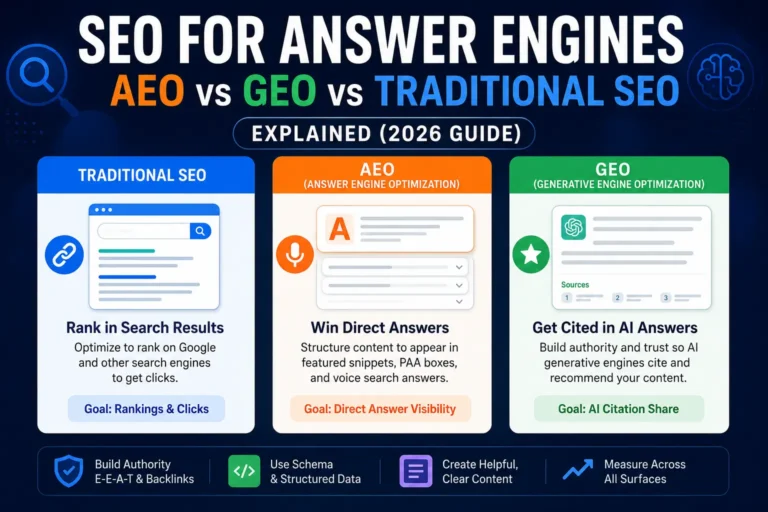
This is why entity SEO and AI optimization go hand in hand. Building your brand as a recognized entity supports your visibility across both traditional search and AI answer engines. For the broader picture, our guide on SEO for answer engines ties these ideas together.
Common Beginner Mistakes
Focusing only on keywords Beginners often optimize for keywords alone and ignore entity signals. Both matter — keywords target searches, while entities build identity and trust.
Inconsistent brand information Using different brand names, descriptions, or details across platforms confuses search engines and weakens your entity. Consistency is essential.
Skipping schema markup Without schema, you are leaving it to Google to guess your entity from your content. Schema makes your identity explicit and clear.
Expecting instant results Entity SEO and knowledge panels build over time. Expecting overnight recognition leads to frustration. It is a long-term strategy.
Ignoring topical authority Some beginners think entity SEO is only about technical setup. In reality, building genuine authority on your topics through quality content is central to it.
Neglecting your About page Your About page is one of the clearest signals of your entity. A vague or missing About page weakens your entity definition.
Frequently Asked Questions
Q1: What is entity SEO in simple terms?
Entity SEO is the practice of helping search engines clearly understand who you are, what you do, and what topics you are an authority on — by treating your brand as a defined “thing” (an entity) rather than just a collection of keywords. It focuses on meaning, identity, and relationships, which is how modern search engines and AI systems understand the web.
Q2: What is the difference between an entity and a keyword?
A keyword is the specific word or phrase someone types into search, like “best laptops.” An entity is a real-world thing with a defined identity, like the company “Dell” or the concept “laptop.” Keywords are about matching search terms; entities are about understanding meaning and relationships. Modern SEO uses both — keywords to target searches, and entities to build understanding and trust.
Q3: Do I need a Wikipedia page for entity SEO?
No, a Wikipedia page is not required for entity SEO. While a Wikipedia page can strengthen your entity recognition and support knowledge panel eligibility, you can build entity authority through consistent branding, schema markup, topical authority, and credible mentions without one. Wikipedia helps, but it is not a requirement to get started.
Q4: How long does entity SEO take to work?
Entity SEO is a long-term strategy. Building a recognized entity, earning topical authority, and potentially getting a knowledge panel all take time — usually months of consistent effort. Some technical steps, like adding schema markup, can be done quickly, but the recognition and authority benefits build gradually. Patience and consistency are key.
Q5: Is entity SEO only for big brands?
No. While big brands often have established entities, small businesses and personal brands can absolutely benefit from entity SEO. In fact, entity SEO can help smaller brands stand out by clearly defining their identity and building authority in a specific niche. A focused small brand with consistent signals and genuine topical authority can become a recognized entity in its field.
Q6: How does entity SEO help with AI search?
AI answer engines like Google AI Overviews, ChatGPT, and Perplexity appear to rely heavily on entity understanding when deciding which sources to trust and cite. While Google’s exact AI Overviews mechanics are not fully public, industry testing and Perplexity’s public documentation strongly support this. When your brand is a clearly recognized entity connected to specific topics, AI systems are more likely to reference your content when answering related questions. Entity SEO and AI search optimization support each other directly.
Q7: What is the easiest way to start with entity SEO?
The easiest starting points are: writing a clear, detailed About page that defines your brand; keeping your brand name and information consistent across all platforms; and adding Organization or Person schema markup to your site. These three steps give search engines a clear understanding of your entity and form the foundation for everything else.
Beginner Entity SEO Checklist
Ready to start? Here is a simple checklist you can follow to build your entity step by step:
✅ Create a clear About page ✅ Add Organization or Person schema ✅ Keep brand information consistent ✅ Build topic clusters ✅ Get mentioned on trusted websites ✅ Create social profiles ✅ Set up Google Search Console ✅ Build internal links ✅ Monitor branded search growth ✅ Keep your entity signals updated
Work through these one at a time — you do not have to do everything at once. The most important thing is consistency. Entity SEO rewards steady, ongoing effort more than any single big action.
Final Verdict
Entity SEO might sound complex at first, but the core idea is simple: help search engines clearly understand who you are and what you are an authority on.
As search engines and AI answer engines increasingly think in terms of entities and relationships rather than just keywords, building your brand as a recognized, trusted entity has become essential. While Google has not officially defined “Entity SEO” as a ranking factor, industry evidence strongly suggests that entity clarity, topical authority, and brand recognition are becoming increasingly important for visibility across both traditional and AI-driven search.
The encouraging part is that the basics are within reach for any website owner. You do not need to be a technical expert. You need to be clear about your identity, consistent across platforms, and committed to building genuine authority on your topics.
Here is where to start:
1. Define your entity clearly. Write a strong About page and decide exactly what topics you want to be known for.
2. Be consistent everywhere. Use the same brand name, description, and details across your website and every platform you appear on.
3. Add schema and build authority. Implement Organization or Person schema, and create deep, connected content on your core topics.
Entity SEO is a long-term investment, but it is one that pays off across traditional search and AI answer engines alike. Start with the basics, stay consistent, and build your authority over time — and search engines will increasingly understand and trust your brand as the entity it is.
Disclaimer: Search engine behavior, Knowledge Graph recognition, and AI citation systems evolve over time. The guidance in this article reflects industry understanding as of June 2026. Knowledge panels and entity recognition are determined by Google and are not guaranteed. While industry experts and data strongly support entity-focused SEO strategies in 2026, Google has not explicitly published “Entity SEO” as an official ranking factor. Claims about AI search engine entity recognition are based on industry testing and public documentation, not official Google confirmation. Always verify current best practices through official documentation.
Sources and Further Reading
Official Documentation
- Google Knowledge Graph — Official Launch Blog — blog.google
- Google Knowledge Panel — Help Documentation — support.google.com
- Google Search Central — Structured Data Documentation — developers.google.com/search
- Schema.org — Organization Documentation — schema.org/Organization
- Wikidata — Official Documentation — wikidata.org
Industry Coverage
- Search Engine Journal — Entity SEO Coverage — searchenginejournal.com
- Search Engine Land — Entities and Knowledge Graph — searchengineland.com
Related Guides on TotalInfoHub
- Generative Engine Optimization (GEO) — totalinfohub.com/generative-engine-optimization-geo/
- SEO for Answer Engines — totalinfohub.com/seo-for-answer-engines/
- How to Rank Content in Google AI Search Results — totalinfohub.com/how-to-rank-content-in-google-ai-search-results/
- Keyword Research in the Age of AI — totalinfohub.com/keyword-research-in-the-age-of-ai/
- Technical SEO Guide — totalinfohub.com/technical-seo-beginner-to-advanced-guide/
- Off-Page SEO Strategies — totalinfohub.com/off-page-seo-strategies/
Last reviewed: June 2026