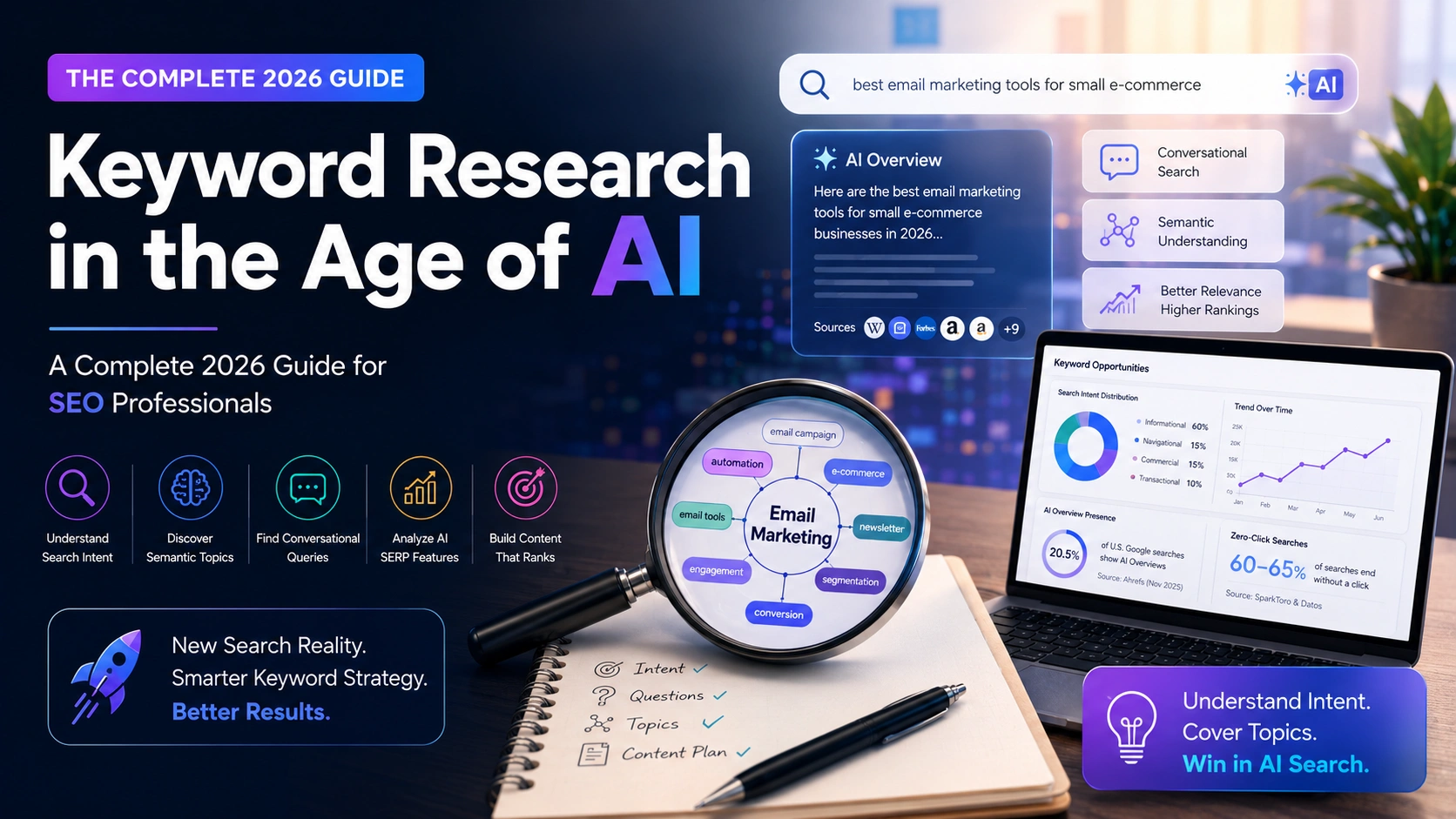
Keyword Research in the Age of AI: A Complete 2026 Guide for SEO Professionals
Introduction: Why Keyword Research Has Changed
For most of SEO’s history, keyword research followed a straightforward process. You identified search terms your audience used, checked their monthly search volume, evaluated keyword difficulty, and built content around those terms. The goal was simple: match your page to a query, rank in the top positions, and collect the traffic.
That process has not disappeared — but it has become considerably more complex.
In 2026, search engines use advanced natural language processing (NLP) and machine learning to understand the meaning behind queries, not just the words themselves. AI Overviews synthesize answers from multiple sources and present them above traditional results. Conversational search interfaces such as ChatGPT Search, Perplexity AI, and Google AI Mode (where available) interpret multi-turn, context-rich queries that no keyword tool from 2019 was designed to handle.
The result is that effective keyword research today requires a fundamentally different mindset. It is no longer about finding the right words. It is about understanding the right topics, intentions, and questions — and building content that serves all three at once.
This guide covers exactly how to do that.
About this guide: Recommendations here are grounded in observed industry patterns, publicly available search data, and established SEO best practices as of June 2026. Specific data points are attributed to their sources throughout.
How AI Has Transformed Search Behavior
Before updating your keyword research process, it helps to understand exactly what has changed in how people search — and why those changes matter.
The Rise of Conversational Queries
The most visible shift in search behavior over the past two years has been the move from short, keyword-style queries to longer, conversational, intent-rich questions. When users interact with AI-powered search interfaces — Google AI Mode (currently rolling out and not universally available in all countries), ChatGPT Search, Perplexity AI — they do not type fragments. They ask complete questions with context included.
A user who once searched “email marketing tools” now asks: “What email marketing platform works best for a small e-commerce store sending fewer than 5,000 emails per month?”
This behavioral shift has significant implications for keyword research. Targeting short-head keywords alone no longer captures the full landscape of how your audience actually searches.
Semantic Search Has Replaced Literal Matching
Modern search engines use semantic search technology — powered by NLP models — to understand the conceptual meaning behind queries rather than matching exact keyword strings. Google’s algorithms evaluate context, synonyms, related entities, and user intent signals to determine relevance.
This means a page no longer needs to contain an exact keyword phrase to rank for it. A well-written article on “home office productivity” can rank for “working from home tips,” “remote work setup,” and “best desk setup for focus” — because the search engine understands the semantic relationship between these topics.
Effective keyword research in this environment means identifying the full semantic field around a topic, not just a primary keyword and a handful of variations.
Zero-Click Searches and AI Overviews
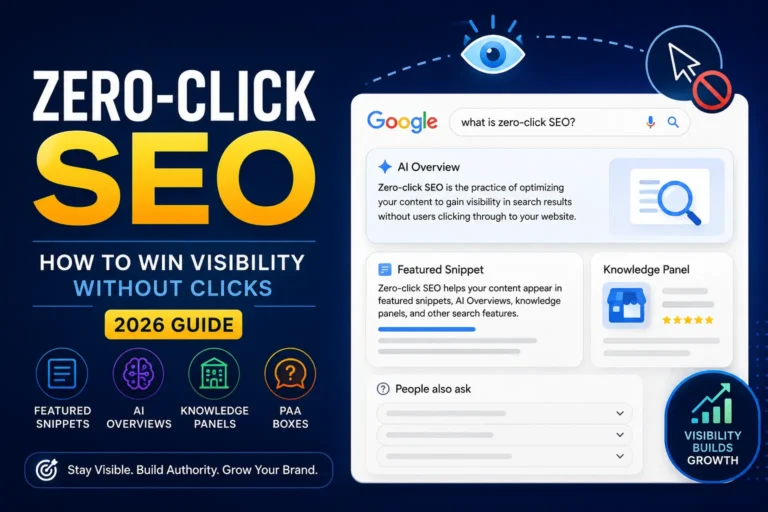
AI Overviews appear in approximately 20.5% of U.S. Google searches, according to Ahrefs’ November 2025 analysis of 146 million SERPs. The prevalence of AI Overviews varies significantly by country and query type. Industry research indicates AI Overviews appear far more frequently for informational queries than for commercial or transactional searches.
Separately, approximately 60–65% of U.S. Google searches end without a click to an external website, according to SparkToro and Datos research. Note that zero-click rates vary by region and query type, and these figures primarily reflect U.S. search behavior.
For keyword research, this means search volume alone is no longer a reliable proxy for traffic potential. A keyword with 10,000 monthly searches but strong AI Overview coverage may deliver far fewer clicks than a lower-volume keyword that consistently drives click-through to content.
Understanding how AI search is changing SEO at the strategic level helps frame why keyword research methodology needs to evolve alongside it.
Traditional Keyword Research vs AI-Era Keyword Research
|
Dimension |
Traditional Approach |
AI-Era Approach |
|---|---|---|
|
Primary metric |
Search volume + keyword difficulty |
Search intent + topic coverage + AI trigger potential |
|
Query type focus |
Short-head and mid-tail keywords |
Conversational, question-based, and long-tail queries |
|
Keyword grouping |
By topic or volume tier |
By semantic cluster and user intent stage |
|
Content goal |
Rank one page per keyword |
Build topic clusters that cover an intent ecosystem |
|
Intent analysis |
Basic (informational / transactional) |
Deep — full user journey, follow-up questions, conversational context |
|
SERP analysis |
Blue-link position tracking |
SERP features, AI Overview triggers, People Also Ask, featured snippets |
|
Competitive analysis |
Who ranks in position 1–10 |
Who gets cited in AI Overviews for this query type |
|
LSI/Semantic terms |
Optional enrichment |
Core component of topic coverage strategy |
|
Voice search |
Rarely considered |
Relevant — natural language and question format overlap |
|
Keyword mapping |
One keyword per page |
Intent clusters mapped across pillar + supporting content |
The New Keyword Research Framework for AI Search
Step 1: Start With Search Intent, Not Search Volume
Search intent — the underlying goal behind a user’s query — is now the most important signal in keyword research. Google’s algorithms, as well as AI search systems, are designed to match content to what users actually want to accomplish, not just to the words they use.
There are four core intent categories, each requiring a distinct content approach:
- Informational intent — the user wants to learn or understand something. Keywords: “how does,” “what is,” “why does,” “guide to.” Content: educational articles, how-to guides, explainers, FAQ-rich pages.
- Navigational intent — the user is looking for a specific brand, website, or resource. Keywords: brand names, product names, “official site.” Content: landing pages, brand pages, login pages.
- Commercial investigation intent — the user is researching options before making a decision. Keywords: “best X for Y,” “X vs Y,” “X review,” “alternatives to X.” Content: comparison articles, review roundups, buying guides.
- Transactional intent — the user is ready to take action. Keywords: “buy X,” “X pricing,” “X free trial,” “X discount.” Content: product pages, pricing pages, conversion-optimized landing pages.
In practice, keyword research should begin with intent classification — asking “what does someone searching this term actually want?” — before evaluating volume or difficulty. A high-volume keyword misaligned with your content’s intent will underperform regardless of how well optimized it is.
Step 2: Research Conversational and Question-Based Queries
Conversational queries — the kind users type into AI chat interfaces and voice search — represent a growing and underserved opportunity for many content teams. These queries are typically longer, more specific, and less competitive than short-head keywords, while aligning strongly with AI Overview triggers.
Where to find conversational and question-based keywords:
- Google’s “People Also Ask” (PAA) boxes — one of the most underutilized sources of question-based keyword data. PAA questions reflect the actual follow-up queries users have after an initial search, revealing the full conversational arc around a topic.
- Google Autocomplete and Related Searches — type your seed keyword and observe the suggestions. These reflect real, high-frequency query patterns.
- AnswerThePublic and AlsoAsked — tools specifically designed to map question ecosystems around a core topic.
- Reddit, Quora, and niche forums — where your audience discusses problems in their own natural language, often revealing queries no keyword tool surfaces.
- Your own search data — Google Search Console’s query report shows exactly how real users are finding your content, including long-tail and question-format queries you may not have targeted intentionally.
When building your keyword list, include question-format variants (“how to,” “what is,” “why does,” “which is better”) alongside traditional keyword phrases. These often have lower competition, align with featured snippet opportunities, and — importantly — match the conversational query patterns that AI search interfaces handle.
Step 3: Build Semantic Keyword Clusters
Semantic keyword clustering — grouping related keywords by meaning, topic, and intent rather than by literal similarity — is one of the most significant methodological shifts in modern keyword research.
Rather than treating each keyword as an independent target requiring its own page, semantic clustering asks: which of these keywords are answering the same underlying user need? Those keywords belong in the same content piece or content cluster.
How to build semantic keyword clusters:
- Start with a seed topic (e.g., “content marketing”)
- Gather all related keywords using research tools — including synonyms, related terms, semantic keywords, and question-format variants
- Group keywords that share the same search intent and could be satisfied by the same piece of content
- Identify clusters that represent distinct subtopics — these become candidate articles within your content cluster
- Map the clusters to a pillar-and-spoke content architecture: one comprehensive pillar page for the broad topic, supported by focused articles addressing each major subtopic
Semantic clustering helps organize content, reduce keyword cannibalization, and improve topical coverage. While many SEO practitioners believe these practices may support visibility in AI-generated search experiences, there is currently no published research proving a direct impact on AI citation frequency.
Step 4: Target Long-Tail and Natural Language Keywords
Long-tail keywords — specific, multi-word phrases that individually attract lower search volumes but collectively represent a substantial share of total search traffic — have always been valuable for SEO. In the AI search era, their importance has grown significantly.
Why long-tail keywords matter more in 2026:
- They align closely with conversational search queries, which are more common in AI-powered interfaces
- Long-tail keywords often align closely with conversational search behavior and specific user intent. However, current published research does not confirm that long-tail keywords trigger AI Overviews more frequently than head terms.
- They reflect specific user needs, making content easier to tailor and intent easier to satisfy
- Competition is generally lower, meaning newer or smaller sites can gain visibility without competing against established domains for high-volume terms
- They often represent commercial investigation or transactional intent — high-value stages of the user journey
Natural language keywords — phrases that mirror how people actually speak, rather than the compressed keyword syntax of traditional search — deserve specific attention. Phrases like “what should I look for when choosing a project management tool” or “how long does it take to see results from SEO” are natural language keywords. They are longer, more specific, and increasingly common as AI search interfaces normalize conversational query behavior.
Step 5: Identify Entity-Based and Topical Gaps
Entity-based SEO — optimizing content around clearly defined entities (people, places, organizations, products, concepts) rather than just keyword strings — has become more important as search engines have shifted to knowledge graph and entity-based understanding.
When Google’s systems evaluate a page, they are not just matching keywords — they are identifying which entities the page discusses, how those entities relate to each other, and whether the page adds meaningful information to the entity’s established knowledge profile.
For keyword research, this means:
- Identify the key entities in your topic area — the brands, people, tools, concepts, and events your audience cares about
- Research how those entities are discussed across top-ranking content and AI-generated answers
- Look for gaps — entities or relationships that are underrepresented in existing content
- Target questions about entities that are frequently asked but not thoroughly answered
Topical gap analysis — identifying questions and subtopics your site has not yet covered — is a natural extension of entity-based keyword research. Tools like Ahrefs’ Content Gap, Semrush’s Topic Research, and MarketMuse’s Content Inventory can surface the topics competitors rank for that your site does not yet address. Filling these gaps may improve overall topical coverage and can help serve a wider range of audience needs.
A comprehensive understanding of search engine positioning helps frame where entity-based and topical coverage fits within a broader organic search strategy.
Step 6: Analyze SERP Features and AI Overview Triggers
Not all keywords are equal — and in 2026, understanding the SERP landscape for a given keyword is as important as understanding its volume and difficulty.
Before targeting a keyword, analyze what the current SERP actually shows:
- Does an AI Overview appear? If yes, note what sources are cited, what content format they use, and what questions the summary addresses. Industry research indicates AI Overviews appear far more frequently for informational queries than for commercial or transactional searches — so the presence or absence of an AI Overview is itself a signal about query intent. This is your benchmark for AI search optimization.
- Are there featured snippets? Content optimized for featured snippets often shares characteristics with content frequently surfaced in AI-generated search experiences, such as clear structure and direct answers. However, published research has not established a direct causal relationship between featured snippet optimization and AI Overview citation.
- What does “People Also Ask” show? PAA boxes reveal the follow-up questions users have. These are direct keyword research inputs — each PAA question is a potential FAQ section item or supporting article topic.
- What content formats rank? Does the first page show listicles, how-to guides, comparison pages, or detailed explainers? The dominant content format tells you what Google currently rewards for this intent type.
- What is the competitive landscape? Are the top results dominated by large established domains, or is there room for well-structured, authoritative content from mid-tier sites?
For keywords where AI Overviews are active, pay particular attention to the structure of cited content — question-based headings, direct-answer formatting, FAQ sections, and strong E-E-A-T signals tend to characterize pages that earn citations.
LSI Keywords, Semantic Keywords, and Semantic Search: What They Mean in 2026
LSI keywords — a term that stands for Latent Semantic Indexing keywords — remains widely used in SEO content, which is why this section addresses it directly. However, it is important to clarify: Google does not use Latent Semantic Indexing as part of its ranking systems. In modern SEO, these are more accurately described as semantic keywords, related terms, and topical entities.
The term “LSI keywords” persists in the industry largely because it became embedded in SEO vocabulary before the distinction was widely understood. When SEO professionals refer to LSI keywords today, they generally mean semantically related terms — words and phrases that share conceptual relevance with a primary keyword and help signal the topical context of content.
In practical terms, semantic keywords and related terms:
- Help search engines understand the full topic context of your content
- Reduce the need for keyword repetition by naturally covering related concepts
- Can improve relevance for a wider range of related queries without targeting each individually
- Signal topical completeness — content that mentions relevant entities, related concepts, and natural semantic variants may read as more authoritative to modern search algorithms
Note that while incorporating semantically related terms is considered good practice, Google’s published guidance does not specify a direct ranking benefit from their inclusion. The value comes from producing genuinely comprehensive, natural content — not from mechanically inserting related terms.
Example — Primary keyword: “content marketing strategy”
|
Category |
Semantic Keywords / Related Terms |
|---|---|
|
Core related terms |
content planning, editorial calendar, content distribution, content ROI |
|
Process terms |
audience research, content brief, content audit, publishing schedule |
|
Intent-related terms |
brand awareness, lead generation, organic traffic, customer journey |
|
Tool-related terms |
CMS, analytics, keyword research tool, social media scheduler |
|
Format terms |
blog posts, video content, infographics, case studies, white papers |
|
Metric terms |
engagement rate, bounce rate, conversion rate, dwell time |
Incorporating these terms naturally throughout your content — not forced or repeated, but woven into genuinely useful sentences — can help signal to search engines that your page covers the topic with appropriate depth and context.
Best AI-Assisted Keyword Research Tools in 2026
The tools available for keyword research have evolved significantly alongside the AI search landscape. Several platforms now offer AI-powered features that go beyond traditional volume and difficulty metrics.
Semrush Semrush’s keyword research suite includes intent classification, keyword clustering, and topic-level analysis alongside traditional volume and difficulty data. Its Keyword Magic Tool surfaces semantic variants and related questions at scale. Widely used by agencies and in-house teams for comprehensive competitive research.
Ahrefs Ahrefs’ Keywords Explorer offers search volume data, keyword difficulty scoring, and AI-assisted content and keyword research features. Its Content Gap tool is particularly valuable for topical gap analysis — surfacing keywords competitors rank for that your site does not. Ahrefs also publishes original AI search research, including its widely cited November 2025 SERP analysis.
Google Search Console Often underused as a keyword research tool, Search Console’s query report reveals the actual search terms driving impressions and clicks to your site — including long-tail and conversational queries that third-party tools may miss. An essential starting point for any keyword research process.
Google’s People Also Ask and Autocomplete Free, real-time, and directly reflective of current search behavior. PAA boxes and autocomplete suggestions reveal the conversational query ecosystem around any topic — and they update continuously as search behavior evolves.
AnswerThePublic and AlsoAsked Specialized tools for question-based and conversational keyword research. Both map the question landscape around a seed topic, making them useful for FAQ planning, featured snippet targeting, and conversational query identification.
MarketMuse Particularly useful for topical gap analysis and content inventory management. MarketMuse evaluates your site’s existing content coverage against a topic area and identifies which questions and subtopics are missing — a direct input to both keyword strategy and content planning.
For a comprehensive overview of how these and other tools fit into a broader AI SEO workflow, this guide on best AI SEO tools in 2026 covers the full landscape.
Keyword Mapping for AI and Traditional Search
Keyword mapping — assigning target keywords and intent clusters to specific pages or planned content — ensures that your keyword research translates into a coherent content architecture rather than a disconnected collection of individually optimized pages.
In the AI search era, effective keyword mapping accounts for two distinct use cases simultaneously:
1. Traditional SERP targeting Each page is mapped to a primary keyword (or tightly clustered semantic group) that defines its ranking target in traditional search results. On-page elements — title tag, H1, meta description, body content — are optimized around this primary keyword and its semantic variants.
2. AI Overview and conversational query targeting The same page is also mapped to the question-format and conversational query variants that users ask in AI search interfaces. These become the page’s FAQ section questions, question-based H2/H3 headings, and structured data targets.
A well-mapped content architecture serves both objectives without requiring separate content tracks. The pillar-and-cluster structure that many SEO practitioners believe may support topical coverage and citation potential is the same structure that helps prevent keyword cannibalization and can build domain authority over time for traditional rankings.
Strong on-page SEO implementation is where keyword mapping becomes tangible — translating the research and planning into page-level signals that search engines can evaluate.
Common Keyword Research Mistakes in the AI Era
Mistake 1: Prioritizing volume over intent A keyword with 50,000 monthly searches but ambiguous or mismatched intent will consistently underperform a keyword with 2,000 searches and clear, well-defined intent. Intent alignment is the primary qualification; volume is a secondary consideration.
Mistake 2: Ignoring conversational and question-based variants Many keyword research processes still focus almost exclusively on short-head and mid-tail keyword phrases, missing the long-tail and conversational queries that drive a growing share of AI-era search traffic. Systematically researching PAA boxes, autocomplete suggestions, and forum discussions surfaces this layer.
Mistake 3: Treating each keyword as an isolated target Building a separate page for every keyword variant leads to thin content, keyword cannibalization, and fragmented topical authority. Semantic clustering — grouping related keywords by intent and covering them within a single well-structured article — can help improve topical coverage, reduce keyword cannibalization, and strengthen traditional SEO performance.
Mistake 4: Skipping SERP analysis Keyword research that does not include SERP analysis for each target query misses critical context: whether AI Overviews are active, what content formats dominate, whether featured snippets are available, and how competitive the landscape actually is at the page level.
Mistake 5: Underusing Google Search Console data Search Console query data reveals exactly how your existing content is performing — including ranking for queries you never explicitly targeted. Regular review of this data surfaces long-tail keyword opportunities, identifies content worth refreshing, and provides real-world insight into your audience’s search language.
Mistake 6: Ignoring entity and semantic coverage Content that targets a keyword but ignores the broader entity and semantic context reads as thin to modern search algorithms. Including relevant entities, related concepts, and natural semantic variants throughout content signals topical completeness and improves relevance across a wider range of related queries.
Mistake 7: Not updating keyword research regularly Search behavior evolves, new topics emerge, and AI search patterns shift. Keyword research is not a one-time activity — it is an ongoing process. Revisiting your keyword strategy quarterly, and updating content based on what Search Console data shows, keeps your targeting aligned with current search behavior.
Frequently Asked Questions (FAQ)
Q1: Has AI made traditional keyword research obsolete?
No — but it has made it insufficient on its own. Traditional keyword research metrics like search volume and keyword difficulty remain useful inputs. What AI search has added is the requirement to research conversational queries, question-based variants, semantic keyword clusters, and SERP feature patterns alongside those traditional metrics. The process has expanded rather than been replaced.
Q2: What are LSI keywords and do they still matter in 2026?
LSI keywords — Latent Semantic Indexing keywords — are terms semantically related to a primary keyword that help establish the topic context of content. While Google has stated it does not use LSI as a direct technical mechanism, the practice of naturally incorporating related terms, synonyms, and entity references into content remains well-supported by observed search behavior. Content that covers a topic with appropriate semantic breadth may rank for a wider range of related queries and provide clearer topical context for search systems.
Q3: How do I find keywords that rank in AI Overviews?
Industry observations suggest that AI Overviews appear most frequently for informational and research-oriented queries — particularly those beginning with “how,” “what,” “why,” “which,” and “best.” Researching People Also Ask boxes for your target topic surfaces the specific question-format queries that commonly trigger AI Overviews. Analyzing the content structure of pages currently cited in AI Overviews for your target queries gives you a benchmark for what extractable, authoritative content looks like in your niche.
Q4: What is the difference between keyword clustering and topic clustering?
Keyword clustering groups individual keyword variants by shared meaning and intent — combining keywords that could be satisfied by the same piece of content. Topic clustering operates at a higher level — organizing an entire content strategy around central topics, with pillar pages and supporting cluster articles covering the full scope of a subject. Both are related practices. Keyword clustering informs what goes on each page; topic clustering determines the overall content architecture.
Q5: How important are long-tail keywords in 2026?
Very important — and increasingly so. Long-tail keywords align closely with conversational search queries used in AI interfaces and typically have lower competition. For newer sites or those in competitive niches, long-tail keywords often represent the most accessible path to meaningful organic visibility. They tend to reflect specific, high-intent user needs — making them valuable beyond just traffic volume. Note that current published research does not confirm that long-tail keywords trigger AI Overviews more frequently than head terms.
Q6: Should I optimize for voice search separately?
Voice search queries and conversational AI search queries share significant overlap — both tend to be longer, question-based, and phrased in natural language. Optimizing for conversational and question-based queries as part of your standard AI-era keyword research process generally covers voice search requirements without needing a completely separate track. The key principles — natural language phrasing, direct answers, FAQ structure, featured snippet targeting — apply to both.
Q7: How does keyword research connect to AI citation strategy?
Keyword research identifies the questions your audience is asking. AI citation strategy determines how to structure answers to those questions so that AI systems can more easily extract and attribute them. The connection is practical: question-based keywords can become FAQ section items and question-format headings. Conversational query research informs the direct-answer structure of each content section. Semantic keyword clusters guide topical depth and coverage. While this can help create more comprehensive content, direct causal evidence linking semantic clustering to AI citation frequency is currently limited. For a full tactical guide on this connection, this article on how to rank content in Google AI search results covers the practical implementation in detail.
📚 Continue Reading: Build Your Complete AI Search Strategy
- 🔍 How AI Search Is Changing SEO (June 2026) — the strategic context behind every keyword research decision in this guide
- ⚖️ AI SEO vs Traditional SEO — understanding where keyword research fits in both frameworks
- 🛠️ Best AI SEO Tools in 2026 — the platforms that make AI-era keyword research faster and more scalable
- 📈 How AI Search Optimization Tools Improve SERP Rankings — how keyword research feeds into the broader optimization workflow
- 🔮 The Future of SEO in the Answer Engine Era — where keyword strategy is heading beyond 2026
Final Thoughts
Keyword research in the age of AI is not simpler than it used to be — but it is more meaningful. The shift from keyword matching to intent understanding, from isolated page optimization to topic ecosystem building, and from volume-first prioritization to intent-first thinking reflects a maturation of the discipline that rewards genuine audience understanding over technical exploitation.
The SEO professionals and content teams that will perform best in this environment are those who treat keyword research as an ongoing process of understanding their audience — what questions they ask, what language they use, what intent drives them at each stage of their journey — rather than a periodic exercise in finding high-volume terms to target.
The tools are better than ever. The data is more accessible. And the search landscape, complex as it has become, consistently rewards content that genuinely serves the people searching for it.
Disclaimer: Keyword research methodologies and AI search features continue to evolve. Information in this article reflects industry knowledge and current best practices as of June 2026. Always complement this guidance with your own SERP analysis and audience research specific to your niche.
📎 Sources & Further Reading
Official Documentation
- Google Search Central — Search Quality Guidelines & How Search Works (developers.google.com/search)
- Google Search Console Help — Search Analytics & Query Data (support.google.com/webmasters)
Industry Research & Data
- Ahrefs — AI Overview Frequency: November 2025 analysis of 146 million SERPs (ahrefs.com/blog)
- SparkToro & Datos — Zero-Click Search Research (sparktoro.com/research)
- Similarweb / Bain & Company — Search Behavior & Zero-Click Estimates
- Search Engine Journal — Keyword Research & AI Search Coverage (searchenginejournal.com)
- Search Engine Land — Semantic Search & AI Overview Analysis (searchengineland.com)
Tools Referenced
- Semrush Keyword Magic Tool — semrush.com
- Ahrefs Keywords Explorer — ahrefs.com
- AnswerThePublic — answerthepublic.com
- AlsoAsked — alsoasked.com
- MarketMuse — marketmuse.com
This guide is reviewed and updated regularly. Last reviewed: June 2026.