Search Intent Mapping for AI Search: A Practical Guide (2026)
Every search starts with a reason. Someone wants to learn something, buy something, find a specific website, or compare options. That reason is called search intent — and understanding it has always been the heart of good content.
But in 2026, there is a new layer to consider. People no longer just type keywords into Google. They ask full questions to ChatGPT, Perplexity, and Google’s AI Overviews — and these AI systems try to understand the real meaning behind each question before answering.
This is why search intent mapping for AI search has become so important. It is the practice of understanding what users truly want, and organizing your content so it matches that intent — in a way both traditional search and AI answer engines can understand and reward.
This guide explains search intent in simple terms, shows how it works differently in the age of AI, and gives you a practical process for mapping intent to content. Every step is something you can act on, even if you are new to SEO.
Quick Summary: Search Intent Types and AI
|
Intent Type |
What the User Wants |
AI Search Example |
|---|---|---|
|
Informational |
To learn or understand |
“How does X work?” |
|
Navigational |
To find a specific site or brand |
“X company login” |
|
Commercial |
To compare before buying |
“Best X for beginners” |
|
Transactional |
To take action or buy |
“Buy X” / “Sign up for X” |
AI tools often handle informational and comparison-style queries especially well, since people ask them detailed, conversational questions.
What Is Search Intent?
Search intent is the reason behind a search — what the person actually wants to achieve when they type a query or ask a question.
For example, imagine two people search for “coffee.”
- One wants to learn how coffee is made.
- Another wants to buy coffee beans online.
Same word, completely different intent. Good content understands which intent it is serving and delivers exactly what that person needs.
Search engines and AI systems both try to figure out intent so they can give the best answer. If your content matches the intent behind a query, it is much more likely to be shown, ranked, or cited. If it misses the intent — for example, giving a buying guide to someone who just wants to learn a concept — it will not satisfy the user, no matter how well-written it is.
Understanding intent is the foundation of content that actually helps people. And helping people is exactly what both search engines and AI answer engines are designed to reward.
The Four Types of Search Intent
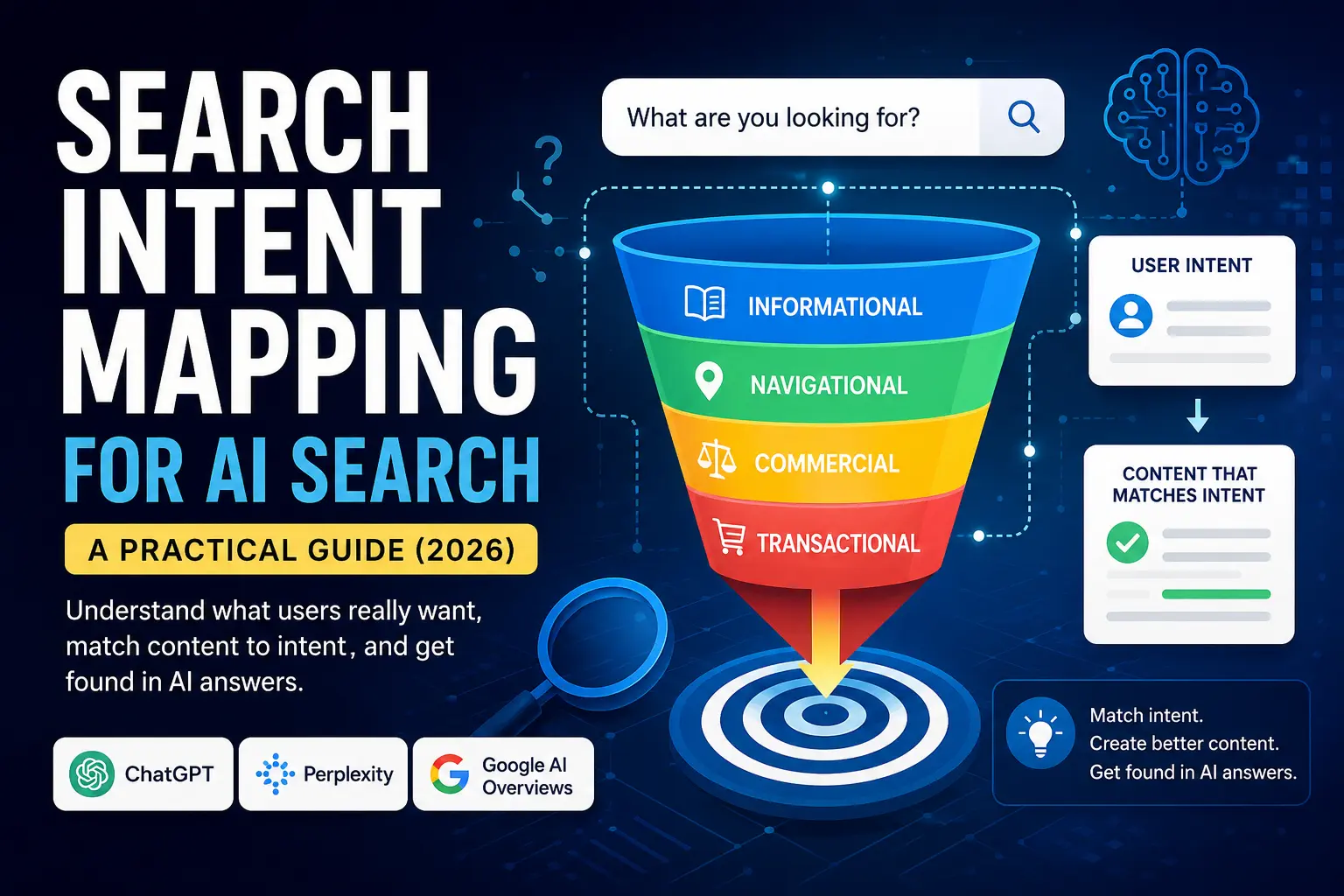
Search intent is usually grouped into four main types. Understanding these helps you create the right content for each situation.
1. Informational Intent
The person wants to learn something or find an answer. They are not ready to buy — they want knowledge.
Examples: “how does AI search work,” “what is search intent,” “why is my website slow.”
This is the most common intent type, and the one AI answer engines handle most often. People ask AI tools informational questions constantly.
2. Navigational Intent
The person wants to find a specific website, brand, or page. They already know where they want to go.
Examples: “Namecheap login,” “TotalInfoHub blog,” “Gmail.”
For navigational intent, the user is looking for a particular destination, so brand recognition matters most here.
3. Commercial Intent
The person is researching before making a decision. They are considering a purchase but want to compare options first.
Examples: “best web hosting for beginners,” “Hostinger vs Namecheap,” “top WordPress themes.”
This intent is valuable because the person is close to a decision. Comparison content, reviews, and “best of” guides serve this intent well.
4. Transactional Intent
The person is ready to take action — usually to buy or sign up.
Examples: “buy domain name,” “sign up for hosting,” “Namecheap pricing.”
For transactional intent, the user wants to complete an action, so clear, direct paths to that action matter most.
How Search Intent Works in AI Search
Here is where things get interesting for 2026. AI search engines often interpret conversational intent differently from traditional keyword matching, though the exact behavior varies by platform.
AI systems are generally better at handling conversational, context-rich queries than simple keyword matching alone. When someone types “coffee” into Google, the intent is ambiguous. But when they ask ChatGPT “what is the best way to brew coffee at home without a machine,” the intent is crystal clear. AI search rewards content that matches these detailed, specific questions.
AI systems are designed to interpret context and nuance in user questions. AI systems are designed to understand the meaning and context behind a question, not just match keywords. This means content that genuinely addresses the user’s real need may perform better, based on observed patterns.
AI tools often surface informational and comparison-focused content. People frequently turn to AI tools to learn things and to compare options. These two intent types are especially important to map well for AI search.
AI combines multiple sources per answer. Because AI answers often pull from several sources, your content needs to clearly serve a specific intent to be selected as one of those sources for a given question.
The practical takeaway: AI search makes intent more important, not less. Because AI systems are designed to interpret questions and context, content that precisely matches intent has a real advantage. This connects closely to how AI search is changing SEO.
Why Intent Mapping Matters More with AI
You might wonder whether intent mapping is worth the effort. In the AI era, it matters more than ever. Here is why.
AI systems often attempt to match answers to user intent as accurately as possible. AI systems are designed to interpret questions and often match content based on relevance and intent. Content that clearly serves a specific intent is easier for AI to select.
Content that mismatches user intent is less likely to be selected or cited. If your content does not match the intent behind a question, AI is unlikely to use it. Intent mapping ensures your content actually fits what people are asking.
It guides your content strategy. Mapping intent tells you exactly what content to create — and how to structure it — to serve your audience and get found in AI search.
It improves both traditional and AI visibility. Intent-matched content performs better in traditional search and AI search at the same time. You are not optimizing for one at the expense of the other.
It connects to topical authority. Mapping all the intents around a topic helps you build comprehensive coverage, which builds the topical authority that AI systems reward. This pairs well with strong keyword research in the age of AI.
In short, intent mapping turns “creating content and hoping it works” into “creating content that precisely matches what people want.” That precision is exactly what AI search rewards.
How to Map Search Intent for AI Search
Here is a practical, step-by-step process you can follow.
Step 1: Identify Your Topics
Start by listing the main topics your website covers or wants to cover.
- Write down your core subject areas
- Think about what your audience cares about
- Focus on topics where you have genuine knowledge or value to offer
This gives you the foundation to build from. You cannot map intent without knowing your topics first.
Step 2: Find the Real Questions People Ask
Next, discover the actual questions people ask about your topics. This is where intent mapping gets practical.
- Use Google’s “People Also Ask” boxes for your topics
- Check related searches at the bottom of Google results
- Look at questions on Reddit, Quora, and forums in your niche
- Ask AI tools like ChatGPT what people commonly ask about your topic
- Review your own customer questions and feedback
Collect these questions. They are the raw material of intent mapping, because each question reveals an intent.
Step 3: Identify the Intent Behind Each Question
Now, for each question you collected, identify which intent type it represents.
- Is the person trying to learn something? (Informational)
- Are they looking for a specific site or brand? (Navigational)
- Are they comparing options before deciding? (Commercial)
- Are they ready to take action or buy? (Transactional)
Label each question with its intent. This simple step transforms a list of questions into an intent map. Some questions may have mixed intent — note those too, as they often need content that addresses more than one need.
Step 4: Match Content to Each Intent
With your questions labeled by intent, decide what content serves each one best.
- Informational questions → guides, explainers, how-tos, definitions
- Navigational questions → clear brand pages, well-named pages
- Commercial questions → comparisons, reviews, “best of” lists
- Transactional questions → clear product, pricing, or signup pages
Map each intent to the right content type. This tells you exactly what to create or improve.
Step 5: Structure Content for AI Understanding
Creating the right content is not enough — you need to structure it so AI can understand and extract it.
- Lead with direct answers to the questions you are targeting
- Use question-based headings that match how people ask
- Add FAQ sections to cover related questions
- Keep formatting clean with short paragraphs and clear organization
This structure helps AI systems match your content to the right intent and extract it accurately. It connects directly to SEO for answer engines.
Step 6: Review and Refine
Intent mapping is not a one-time task. Review and refine over time.
- Test your target questions in ChatGPT, Perplexity, and Google
- See whether your content appears for the intents you mapped
- Identify gaps where you should appear but do not
- Update and improve your content based on what you find
This ongoing refinement keeps your content aligned with how people actually search. An AI search visibility audit is a useful companion process here.
Common Intent Mapping Mistakes
Targeting keywords instead of intent Focusing on keywords alone misses the deeper need behind them. Always ask what the person actually wants, not just what words they use.
Mismatching content and intent Giving a buying guide to someone who wants to learn a concept — or vice versa — frustrates users and fails to get cited. Match the content type to the intent.
Ignoring conversational questions AI users ask full, natural questions. Optimizing only for short keyword phrases misses how people actually query AI tools.
Covering only one intent type Many topics have multiple intents. Covering only informational questions while ignoring commercial ones leaves gaps. Map the full range.
Forgetting to structure for AI Even intent-matched content needs clear structure to be extracted by AI. Skipping question-based headings and FAQ sections reduces your visibility.
Treating intent mapping as one-time Search behavior evolves. Intent mapping needs periodic review to stay aligned with how people currently search.
Tools That Help with Intent Mapping
You can do meaningful intent mapping with free tools, and paid options add depth.
Free tools:
- Google Search — People Also Ask boxes and related searches reveal real questions and intent
- ChatGPT and Perplexity — ask them what people commonly want to know about your topic
- Google Search Console — see which queries already bring people to your site
- Reddit, Quora, and forums — real questions from real people in your niche
Paid tools:
- Keyword and SEO platforms — many now include intent labels and question research features. Capabilities vary, so verify current features before subscribing.
For most beginners, the free tools are more than enough to build a solid intent map. Our roundup of the best AI SEO tools in 2026 covers paid options for those who want more depth.
Frequently Asked Questions
Q1: What is search intent mapping?
Search intent mapping is the process of understanding what users really want when they search, and organizing your content to match those needs. It involves identifying the questions people ask, determining the intent behind each one (informational, navigational, commercial, or transactional), and creating content that precisely serves each intent. In the AI era, it also means structuring that content so AI search engines can understand and cite it.
Q2: How is intent mapping different for AI search?
The core idea is the same — understand what users want and match content to it. The difference is that AI search engines are designed to handle conversational, detailed questions effectively, which makes precise intent matching even more important. AI reads context and meaning, not just keywords, so content that genuinely serves the right intent has an advantage. You also need to structure content clearly so AI can extract and cite it.
Q3: What are the four types of search intent?
The four main types are: informational (the user wants to learn something), navigational (the user wants to find a specific site or brand), commercial (the user is comparing options before deciding), and transactional (the user is ready to take action or buy). Each type calls for a different content approach, which is why mapping them matters.
Q4: Why does intent matter more with AI search?
Because AI systems understand questions so well, they are better at matching the right content to the right intent — and ignoring content that does not match. This means precise intent matching is rewarded, while mismatched content gets passed over. AI makes intent more important, not less, because it can tell the difference between content that truly serves a need and content that just contains the right keywords.
Q5: How do I find the real questions people ask?
Use Google’s People Also Ask boxes and related searches, check Reddit, Quora, and niche forums, ask AI tools like ChatGPT what people commonly want to know about your topic, and review your own customer questions. These sources reveal the actual questions people have — which is the raw material for intent mapping. Each question points to an underlying intent you can map.
Q6: Can one piece of content serve multiple intents?
Yes, and sometimes it should. Some questions have mixed intent — for example, a “best web hosting” guide serves commercial intent (comparing options) but may also include informational content (explaining what to look for). Well-structured comprehensive content can serve multiple related intents. The key is being clear about which intents you are serving and structuring the content to address each one.
Q7: Do I need paid tools for intent mapping?
No. You can do effective intent mapping with free tools alone: Google’s People Also Ask and related searches, AI tools like ChatGPT, Google Search Console, and community sites like Reddit and Quora. Paid SEO platforms add convenience and depth — like intent labels and large-scale question research — but they are not required to get started or to do meaningful work.
Final Verdict
Search intent mapping has always been important, but AI search has raised the stakes. Because AI systems understand questions so precisely, content that truly matches user intent has a clear advantage — while content that misses the mark gets passed over.
The encouraging part is that intent mapping is not complicated. It comes down to a simple discipline: understand what people actually want, and create content that gives it to them clearly. Do that consistently, and you serve your audience better while improving your visibility across both traditional and AI search.
Here is where to start:
1. List your topics and find the real questions. Use People Also Ask, AI tools, and community sites to discover what your audience actually asks.
2. Label each question by intent and match content to it. Decide whether each question is informational, navigational, commercial, or transactional, and create the right content type for each.
3. Structure for AI and refine over time. Use clear, question-based structure so AI can extract your content, and review your results regularly to close gaps.
Intent mapping turns guesswork into strategy. In a world where AI systems understand exactly what people want, giving them precisely that is the surest path to staying visible — in traditional search and AI answers alike.
Disclaimer: Search behavior and AI search systems evolve over time. The guidance in this article reflects industry understanding and best practices as of June 2026. AI citation and ranking behavior is not fully documented publicly. Always test strategies with your own content and verify current best practices.
Sources and Further Reading
Official and Industry Sources
- Google Search Central — Search Quality & Helpful Content — developers.google.com/search
- Search Engine Journal — Search Intent Coverage — searchenginejournal.com
- Search Engine Land — Intent and AI Search — searchengineland.com
Related Guides on TotalInfoHub
- How AI Search Is Changing SEO — totalinfohub.com/how-ai-search-is-changing-seo/
- Keyword Research in the Age of AI — totalinfohub.com/keyword-research-in-the-age-of-ai/
- SEO for Answer Engines — totalinfohub.com/seo-for-answer-engines/
- AI Search Visibility Audit — totalinfohub.com/ai-search-visibility-audit/
- Best AI SEO Tools in 2026 — totalinfohub.com/best-ai-seo-tools/
- How to Rank Content in Google AI Search Results — totalinfohub.com/how-to-rank-content-in-google-ai-search-results/
Last reviewed: June 2026