
Off Page SEO Directory Submission: A Complete Step-by-Step Guide (2026)
Section 1: Welcome to the New Rules of Directory Submission (Setting the Stage)
1.1 So, You Thought Directory Submission Was Dead? Let’s Talk.

I’ll bet when you saw the title of this guide, you probably rolled your eyes. I get it. The whole concept of Off Page SEO Directory Submission sounds like something straight out of a 2010 SEO playbook, right next to stuffing keywords in white text at the bottom of your page.
For a long time, marketers have been shouting from the rooftops that it’s a dead, spammy tactic. And you know what? They were half-right.
The old method—using some clunky software to blast your website link to a thousand random, garbage directories—is more than dead. It’s toxic. Doing that today is like asking Google to penalize your site. Please, don’t do it.
But here’s the thing that often gets lost in the noise: the strategy behind directory submission didn’t die. It just grew up. It’s no longer about volume. It’s about being smart, selective, and building a foundation of trust that search engines can actually respect.
While we focus on one specific tactic today, it’s important to remember that this is just one piece of a much larger puzzle. For a complete look at all the high-impact techniques you should be using, I highly recommend checking out my comprehensive guide on Off-Page SEO: The Most Powerful Strategies to Rank Higher in 2026.
It’s about being smart and selective. While directory submission builds your foundation, combining it with a solid guest posting sites list is what truly drives massive ranking growth in 2026.
1.2 What Are We Actually Doing Here? (The No-Nonsense Explanation)
Let’s forget the fancy SEO terms for a minute.
Think about opening a new coffee shop in your neighborhood. One of the first things you’d do is make sure you’re listed in local guides, on Google Maps, and in the local business association’s list, right? You want people to be able to find you.
That’s all Off Page SEO Directory Submission is. You’re creating a listing—a small digital storefront—for your website in reputable online “neighborhoods.” These neighborhoods can be big general directories (like Yelp) or super-specific ones (like a directory just for handmade leather goods).
Every time you create one of these listings, you’re putting down a little breadcrumb that leads back to your site. More importantly, you’re verifying to the world, and to Google, that you’re a real, legitimate operation.
1.3 The Game Has Changed: It’s Quality, Not a Headcount
You might be wondering, what is the major shift between the past and the present? In a word: care.
- The Old Way: It was a chaotic free-for-all. The goal was simple: get the most links, period. It didn’t matter if they came from a sketchy-looking site in another country. It was pure automation, and it created a lot of junk on the internet.
- The New Way (How We Do It in 2026): Now, the goal is to get your business listed in the right places. We’re talking about a handful of directories that actually make sense for your business. It’s about finding 10 perfect spots instead of 1,000 random ones. It’s a manual process because it requires a human brain to decide, “Does my website belong here?”
Google is obsessed with one thing: showing its users the best, most trustworthy results. When it sees your business listed in a well-respected, industry-specific directory, that’s a massive trust signal. It tells Google that you’re not just noise; you’re part of the conversation.
1.4 Building Your “Trust Score” with Google (E-E-A-T)
This whole idea of trust boils down to a concept Google calls E-E-A-T (Expertise, Experience, Authoritativeness, and Trustworthiness).
Don’t get hung up on the acronym. Just think of it as your website’s reputation. Is your site a credible source? Can it be trusted?
Strategic directory submission is one of the most straightforward ways to start building that reputation. Each quality listing you create is like a solid reference on your resume. It’s proof that you exist, that you’re serious, and that you’re a legitimate part of your industry.
And that’s exactly what this guide is about: showing you how to build that rock-solid reputation, one smart listing at a time.
Section 2: Directory Types: Know Where to Play and Where to Stay Away
2.1 The Directory Ecosystem in 2026: Categorizing the Landscape
Here is the honest truth: most people mess this part up. They think every website with a “Submit” button is the same. That is a huge mistake.
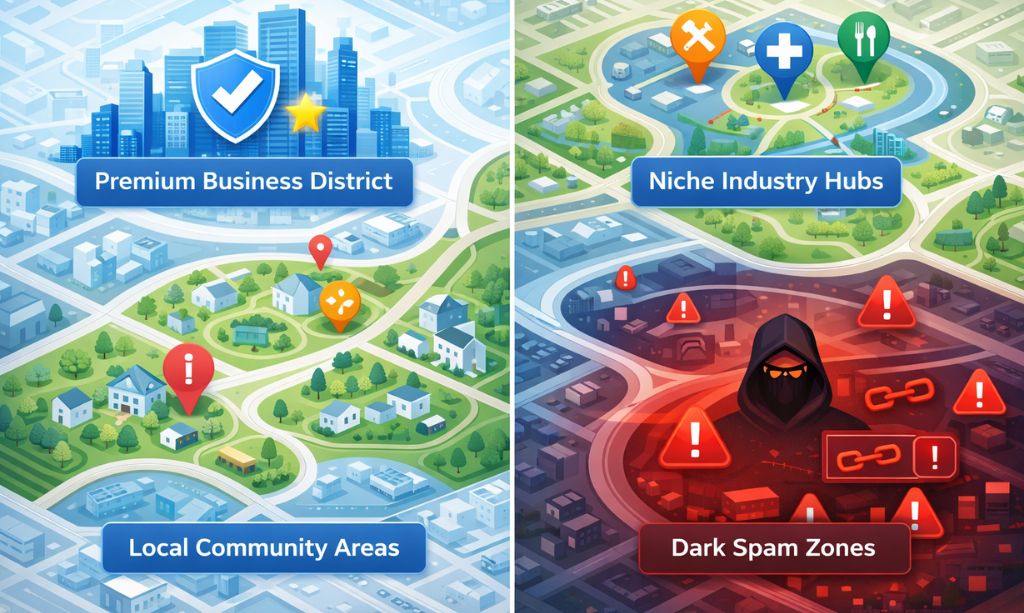
When you sit down to plan your Off Page SEO Directory Submission strategy, you have to treat the internet like a physical city. You have your high-end business districts, your helpful local community centers, and then you have the bad neighborhoods where you definitely don’t want to be seen.
If you just start submitting your link everywhere without looking, you are going to land in those bad neighborhoods. And Google will notice. Your job is to be picky. You need to know exactly which doors to knock on and which ones to ignore.
2.2 The Heavyweights: Prestigious Platforms with Strict Editorial Standards
When you are aiming for high-authority links, your Off Page SEO Directory Submission should focus on platforms like Yelp or BBB.
Let’s start with the heavy hitters. These are the websites that everyone knows and trusts. We are talking about platforms like Yelp, the Better Business Bureau (BBB), or major national business lists.
Getting your site onto these platforms isn’t always easy. Unlike the spammy sites, these guys usually have real human editors reviewing every single entry. They want to verify that you are a legitimate business before they let you in.
But that effort is worth it. A single link from a powerhouse site like the BBB is worth more than a hundred links from random, unknown websites. It tells search engines that you are a verified, serious player in your market.
2.3 The Specialists: Laser-Targeted Listings for Your Specific Market
If you asked me where you should focus most of your energy, I’d point you right here. These are directories that focus entirely on your specific industry.
Think about it. If you run a law firm, a link from “Avvo” (a legal directory) means a lot more to Google than a link from a general web directory. If you are a designer, a profile on “Houzz” is incredibly powerful.
This is all about relevance. When you get listed on a site that is dedicated to your specific field, it connects the dots for Google. It confirms exactly what you do. These links prove you aren’t just some random website; you are an active part of that specific community.
2.4 Local Power: Essential Local Business Directories (NAP Consistency Focus)
For anyone running a business that serves a local area—like a coffee shop, a dentist, or a plumber—this is non-negotiable.
You need to be on the obvious ones like your Google Business Profile, but don’t forget your local Chamber of Commerce or city-specific guides. These are the places your actual neighbors look.
Here is the one thing you cannot mess up: your contact info. Your Name, Address, and Phone Number (NAP) must be identical everywhere. I mean literally character-for-character. If you are “Main St.” on Google, don’t be “Main Street” here. Consistency builds trust. When Google sees the same info across all these trusted local sites, it feels safe ranking you higher on the map.
2.5 The Danger Zone: Identifying and Avoiding Spammy, Toxic Directories (A Critical Warning)

Now, let’s look at the places you need to avoid like the plague. There is a dark side to Off Page SEO Directory Submission, and falling into it can actually get your site penalized.
There are thousands of “zombie” directories out there. They exist only to trick search engines (which doesn’t work anymore) or to sell links.
How do you spot them?
- Zero Standards: If a site lets you publish your listing instantly without any review, stay away. It’s likely a spam bucket.
- The “Link Farm” Look: If you see a listing for a lawyer right next to an ad for cheap pills and an online casino, leave immediately.
- Pay-to-Play Schemes: Be very careful with sites that demand money for a generic link or ask you to link back to them.
Your reputation is everything. It is always better to have zero links than to have a backlink profile full of garbage. Stick to the quality tiers we talked about, and you will be fine.
Section 3: Preparing Your Arsenal: Before You Click Submit
3.1 On-Page Checkup: Making Sure Your Site is Ready to Receive Links
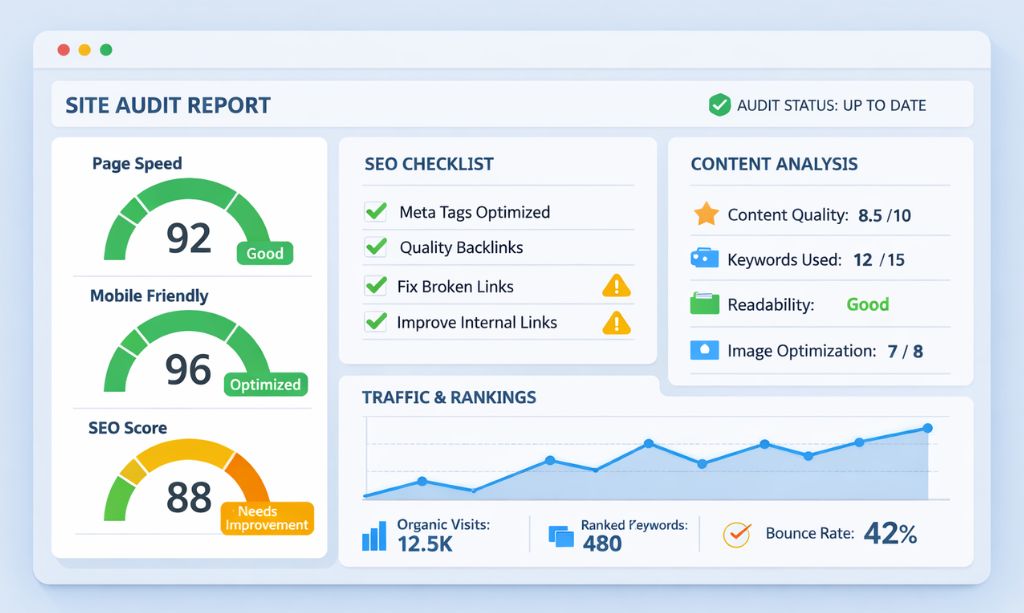
In fact, you must ensure your on-site elements are perfect before you even think about building external links. If you need a refresher on how to optimize your content, headings, and meta tags, I suggest you go through my [On Page SEO: The Complete Beginner’s Guide to Rank Higher in Google (2026)]. It’s the perfect prerequisite for any off-page work you’re about to do.
Before we dive into the actual submission process, we need to hit the pause button for a second. There is a crucial step that most people skip, and it ends up costing them dearly.
Think of it this way: You wouldn’t invite a bunch of important guests over for a dinner party if your house was a complete mess and the kitchen was on fire, right? You would clean up first. The same logic applies to your website.
Directory submissions are basically invitations for new users (and Google) to come visit you. If they click a link and land on a website that takes ten seconds to load, looks broken on their phone, or has confusing content, they are going to leave immediately. That “bounce” sends a bad signal to Google that hurts you more than the link helps.
So, before you build a single backlink, take a hard look at your site. Is it mobile-friendly? Is it fast? Is the content actually helpful? If the answer is yes, then you are ready to open the doors.
However, don’t forget about the hidden gears of your website. Even if your content is great, technical glitches can stop your SEO efforts in their tracks. If you’re unsure whether your site’s backend is healthy, I highly recommend checking out my Technical SEO: A Complete Beginner-to-Advanced Guide. It’s the best way to ensure that search engines can crawl and index your new directory links without any hiccups.
3.2 Crafting the Perfect Business Profile (The NAP Golden Rule)
This part sounds boring, I know. But if you get this wrong, you might as well not bother with the rest of the work. We need to talk about your NAP. That stands for Name, Address, and Phone Number.
The golden rule here is absolute consistency. Google acts like a very strict librarian regarding this data. It wants your details to be identical everywhere they appear on the internet.
If your business address is listed as “123 Main St.” on your website, do not write “123 Main Street” on a directory. If you use a specific format for your phone number on Google, stick to that exact format everywhere else. It seems like a tiny detail, but these small discrepancies confuse search engines. Decide on one “master format” right now, write it down, and stick to it like glue.
3.3 Creating Magnetic Descriptions: The Art of Writing for Directories
Here is the biggest mistake I see people make when they start their Off Page SEO Directory Submission campaigns: they write one generic business description and copy-paste it fifty times.
Please, do not do that. It looks spammy, and search engines really dislike duplicate content. To win at this game, you need to treat each listing as a unique opportunity to pitch your business. You are writing for humans, not robots.
I recommend writing three or four different versions of your business description before you start.
Create a short “elevator pitch” of about 50 words that gets straight to the point. Then, write a longer “storyteller” version that explains your mission and history. Finally, create a service-focused version that highlights exactly what you sell. Having these variations ready will make your link profile look much more natural and professional.
3.4 Anchor Text Strategy for Submissions (Natural Variation)
“Anchor text” is just the technical term for the clickable blue text in a hyperlink. In the old days of SEO, people would force keywords like “Best Pizza New York” into every single link they built.
Today, that is a massive red flag. It looks completely unnatural to Google’s algorithms.
When you are submitting to directories, simplicity is your best friend. Most of the time, you should use your brand name (like “Total Info Hub”) or your naked URL (like “totalinfohub.com”) as the anchor text. Occasionally, generic words like “Visit our website” work too. This creates a natural, safe link profile that won’t trigger any spam filters.
3.5 Setting Up Your Tracking Sheet: What to Log for Success
Trust me on this one: you will forget where you submitted. Two weeks from now, you won’t remember if you already submitted to that local business directory or if you are still waiting for their approval email.
You need a simple system to keep track of your hard work. Open up a spreadsheet right now—Excel or Google Sheets, it doesn’t matter.
You just need columns for the directory name, the URL, the date you submitted, and your login details. I also like to have a “Status” column to mark whether a listing is pending or approved. This simple sheet will be your command center. It saves you from submitting to the same place twice and helps you see your progress over time as you master your Off Page SEO Directory Submission strategy.
Section 4: The 5-Step Manual Submission Blueprint (Actionable Steps)
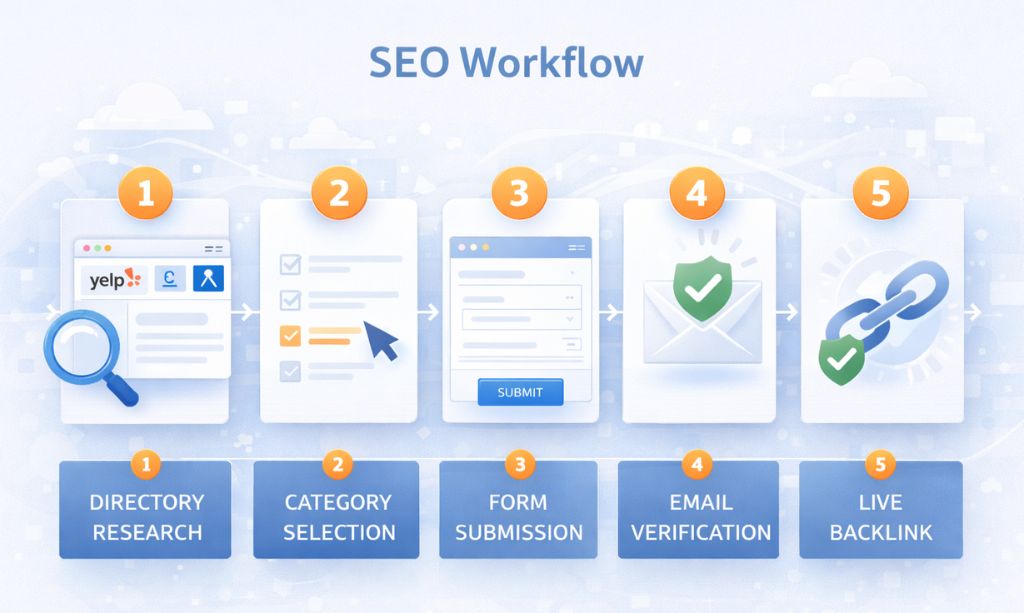
Now that we have done the prep work, it is time to roll up our sleeves and get to the actual work. This is the moment where we turn our strategy into real action.
Don’t rush this. The difference between a link that boosts your ranking and a link that does nothing is often just a matter of paying attention to the details during these next five steps.
4.1 Step 1: Rigorous Directory Vetting – The “Quality Scorecard”
Before you type a single letter into a submission form, you need to take one last look at the directory itself. I call this the “sniff test.”
Does the site look alive? Click on a few of the “Recent Listings.” Do they look like real businesses, or are they obvious spam sites selling weird pills or gambling services? If the recent listings look sketchy, yours will too.
You should also do a quick check on the site’s authority. You don’t need fancy tools for this. Try this simple gut check: Imagine a potential client finding your brand on this page. Would it build their trust or make them suspicious? If it feels off, leave the site immediately. We only want to associate your brand with quality.
Remember, checking the quality of the site is the first rule of a successful Off Page SEO Directory Submission process.
4.2 Step 2: Perfect Category Selection (The Secret to Relevance)
This step is arguably the most critical part of the entire Off Page SEO Directory Submission process, yet so many people glaze over it.
Finding the right category is not about “close enough.” It is about precision. If you run a digital marketing agency, don’t just dump your listing in the generic “Business” category if there is a sub-category for “Internet Marketing” or “Advertising.”
Think of it like a library. If a librarian puts a cookbook in the science fiction section, nobody looking for recipes will ever find it. Google works the same way. The more specific your category, the better Google understands what your website is actually about.
4.3 Step 3: Navigating the Off Page SEO Directory Submission Form
Now we get to the form itself. This is where your spreadsheet and your pre-written descriptions come in handy.
Fill out every single field that is relevant to you. If the directory allows you to add photos, social media links, or opening hours, add them. A complete profile always looks more trustworthy than a half-empty one.
Please, I beg you, do not use automated software to fill these out. These forms often have unique fields or CAPTCHAs that bots can’t handle properly. Taking the hands-on approach is the only way to guarantee that every single detail is correct.This manual attention to detail is the hallmark of a successful Off Page SEO Directory Submission campaign.
4.4 Step 4: The Confirmation and Follow-Up Game
Once you hit that “Submit” button, you are not quite done. Most legitimate directories have a verification process to stop spam bots.
Head over to that dedicated email address you created. You will likely see a confirmation email asking you to verify your account or submission. If you don’t click that link, your listing might never go live.
Sometimes, these emails land in the spam folder, so keep an eye on that junk box. It is annoying, but verifying these emails is the only way to cross the finish line.
4.5 Step 5: Checking for Indexing and Link Activation
Congratulations, you are submitted! But is the link actually working?
Update your tracking sheet to mark the status as “Submitted.” Then, give it some time. Some directories approve listings instantly (after email verification), while others might take a few days or even weeks if a human editor is reviewing them.
Check back on your live links once a week. Once a link is live, copy that URL into your spreadsheet. You can also do a quick Google search for the directory page URL after a few weeks to see if Google has “indexed” it (meaning they have added it to their search results). If the link is live and indexed, you have officially scored a point for your website’s SEO.
Section 5: Real-World Examples and Practical Application
Theory is great, but sometimes you just need to see how things work in the real world to truly get it. Let’s step away from the abstract rules for a moment and look at what a successful Off Page SEO Directory Submission strategy actually looks like when the rubber meets the road.
5.1 Case Study Concept: How a Small Business Leveraged Local Directories
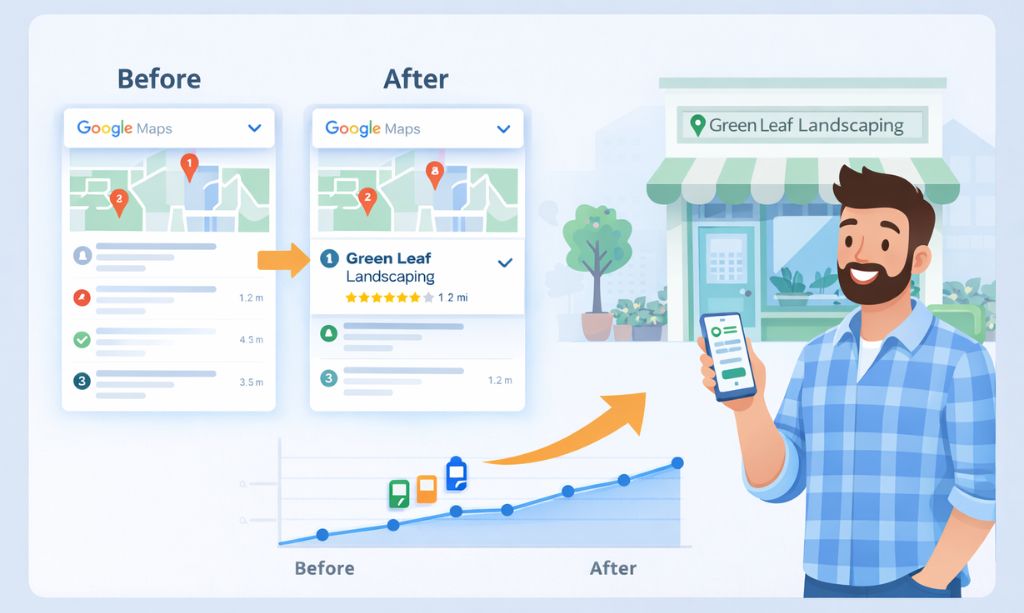
Let me tell you a quick story about a fictional local business, let’s call it “Green Leaf Landscaping.”
When they launched their website, it was a ghost town. They had great photos of their work, but nobody in their town could find them online. They didn’t have the budget for expensive ads, so they decided to focus on directory submissions.
But they didn’t just blast their link everywhere. They were smart about it.
First, they claimed their Google Business Profile. Then, they joined their local Chamber of Commerce directory. Next, they found three local city guides that listed “Best Home Services” and submitted their details there. Finally, they got listed on “Houzz,” a specific directory for home improvement.
They only built about 10 links in total. But because those links were hyper-local and hyper-relevant, Google took notice. Within three months, they started popping up in the “Local Pack” (the map results) when people searched for “landscapers near me.” It wasn’t magic; it was just strategic placement.
5.2 Visual Guide: A Sample Successful Directory Listing Walkthrough
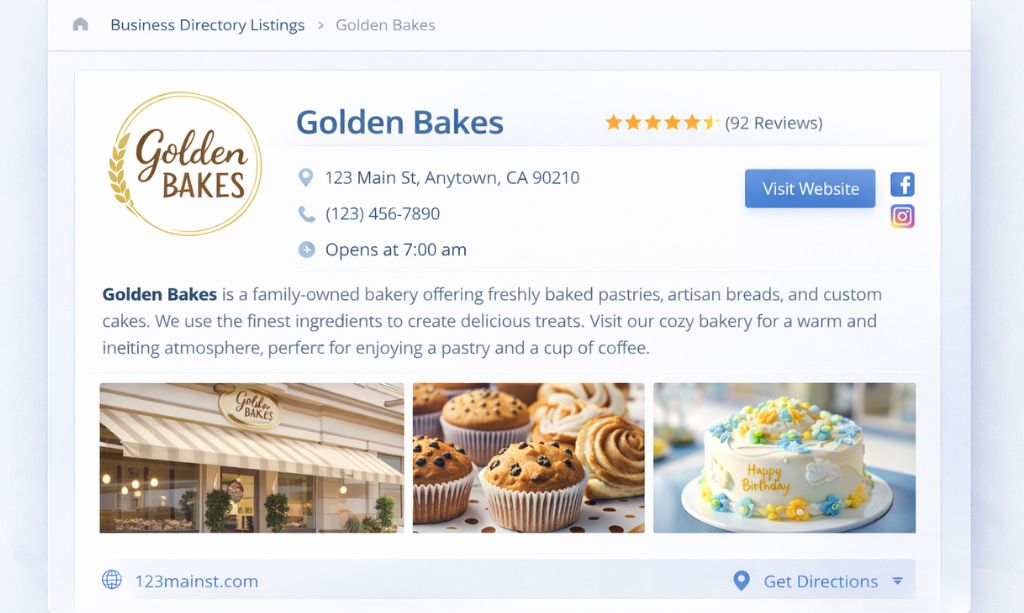
If you were to look at one of Green Leaf’s successful listings, you would notice a few things immediately. It doesn’t look like a spammy link; it looks like a complete business profile.
First, their logo is crisp and clear. The business name is spelled exactly as it appears on their shop sign. The address isn’t just a generic city name; it includes the street, suite number, and zip code, matching their website perfectly.
But the real winner is the description. They didn’t just write “We do landscaping.” They wrote a friendly paragraph about how they specialize in eco-friendly garden designs for the local climate. They even uploaded a few photos of their recent projects. A listing like this tells Google (and customers) that this is an active, professional business that cares about its image.
5.3 Common Mistakes Beginners Make During Submission (And How to Fix Them)
Even with the best intentions, I see people mess this up all the time. The biggest blunder in Off Page SEO Directory Submission is usually impatience.
I see site owners grabbing a software tool that promises to submit to 500 directories in an hour. That sounds efficient, but it is actually destructive. Those tools often dump your link into irrelevant categories or spammy sites that trigger Google’s penalties.
Another common mistake is treating the “Business Description” field as an afterthought. I have seen so many listings where the description is just a string of keywords like “plumber plumber cheap plumber.” That is a waste of space. Write for the human who is reading it. Remember, if your writing feels mechanical and lifeless, real humans are going to ignore it.
5.4 Balancing Directory Submissions with Other Off-Page Activities
Finally, it is important to remember that directory submission is a foundation, not the entire building.
Think of it like laying the concrete slab for a house. It is absolutely necessary for stability, but you can’t live on a concrete slab. Once you have established your presence in the key directories we discussed, you need to branch out. To help you with that, we’ve put together a verified Top 150+ Free Guest Posting Sites List for 2026 to take your authority to the next level. Combining these listings with active social media and high-impact outreach is what truly makes your SEO efforts work.
5.5 Handpicked Directory Submission List for 2026 (Starter Pack)
To save you some time, I have curated a small list of high-quality directories that are still relevant and powerful for your Off Page SEO Directory Submission strategy. These sites have good authority and are generally trusted by search engines.
1. High-Authority General Directories (Tier 1)
- Google Business Profile (Essential for Local SEO)
- Yelp (Global reach with high trust)
- Yellow Pages (The digital version of the classic)
- Bing Places (Often overlooked but very powerful)
- Apple Maps (Critical for mobile search visibility)
2. Trusted Business & Professional Directories (Tier 2)
- Better Business Bureau (BBB) (Ultimate trust signal in the US/Canada)
- AboutUs.com (A classic, reputable web directory)
- Crunchbase (Perfect for startups and tech companies)
- Clutch.co (Excellent for service-based agencies)
3. Niche & Local Focused Opportunities
- Your Local Chamber of Commerce (Search: [Your City] + Chamber of Commerce)
- Nextdoor (Hyper-local community directory)
- Foursquare (Great for location-based authority)
Pro Tip: Don’t try to submit to all of these in one day. Pick 2 or 3 that are most relevant to your niche and start there. Quality always beats quantity in a modern Off Page SEO Directory Submission campaign.
Section 6: Maintenance and Long-Term Link Health
Most people think that once they hit “Submit” and get their approval email, the job is done forever. They high-five themselves and never look back.
But here is the reality: SEO isn’t a statue; it’s a garden. It is impossible to just drop the seeds in the dirt and completely ignore them after that. You have to water them, pull out the weeds, and make sure everything is still growing. If you ignore your directory profiles for years, they can actually start to look messy and outdated, which sends the wrong message to Google.
6.1 How Often Should You Submit? Setting a Sustainable Monthly Goal
The single question that lands in my inbox more than any other is, ‘What is the safe number of directories to target weekly?
My answer is always the same: Slow down.
If you have a brand new website and you suddenly blast it with 500 directory links in one weekend, Google is going to look at that and think, “This looks fake.” It triggers spam alarms. A natural Off Page SEO Directory Submission strategy looks like a slow, steady drip, not a firehose.
For a new site, aiming for maybe 5 to 10 high-quality submissions a month is plenty. It shows consistent, organic growth. If your site has been around for years, you can even dial that back to just a few highly relevant niche directories per month. It is always better to have steady growth over a year than a massive spike that disappears the next month.
6.2 Link Audit Cycle: Cleaning Up Your Directory Footprint Periodically
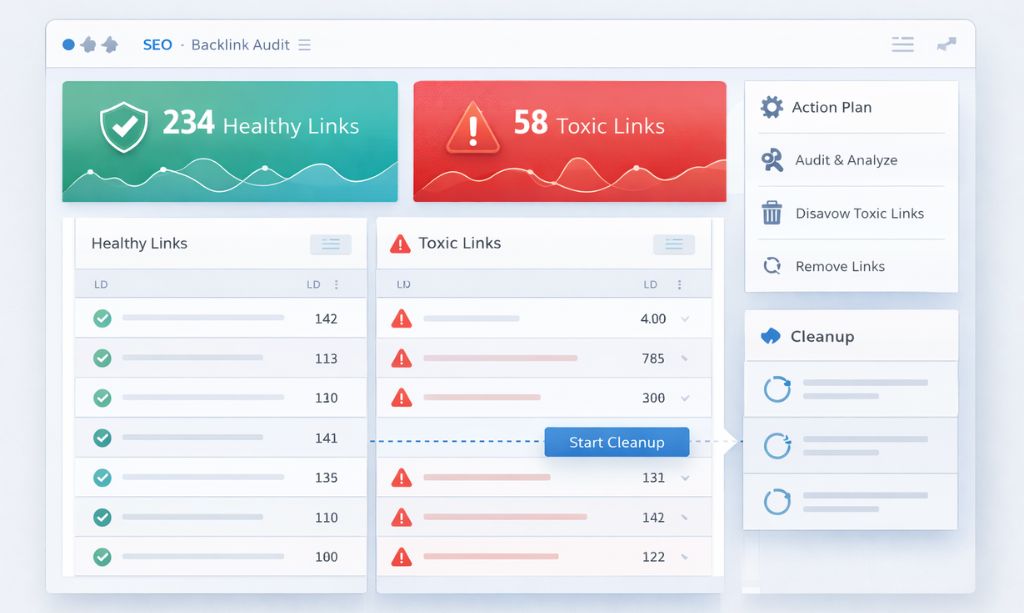
The internet changes fast. A directory that was high-quality in 2024 might get sold to a spammer in 2026 and turn into a junk site.
This is why you need to do a bit of “spring cleaning” once in a while. An audit is necessary to ensure that your past Off Page SEO Directory Submission links are still helping and not hurting your rankings. I recommend setting a reminder on your calendar—maybe once every six months or once a year—to audit your backlinks.
The good news is that you do not need advanced coding skills or a computer science degree to figure this out.Just look at your tracking sheet, click on your live links, and make sure the websites still look respectable. If you find that one of your directories has turned into a spam farm full of gambling ads, you might want to “disavow” that link (which basically tells Google to ignore it). Keeping your link profile clean is just as important as building new links.
6.3 Dealing with Broken or Outdated Listings
“Link rot” is a real thing. Directories go out of business, they change their URL structures, or they just disappear offline.
When you are doing your periodic checkups, you will inevitably find that some of your links are dead (returning a 404 error). Don’t panic; it happens to everyone.
If the directory is gone, just mark it as “Dead” in your spreadsheet and move on. If the page is still there but your link is missing, it might be worth sending a polite email to the site owner asking what happened. But honestly, if a directory deletes your listing without asking, it probably wasn’t a great partner to begin with. Just focus your energy on finding new, better opportunities.
6.4 Updating Information When Your Business Details Change
This is the nightmare scenario for local businesses, but you have to stay on top of it.
Let’s say you move your office to a new building, or you change your phone number. You now have a serious problem. If Google sees your old address on Yelp but your new address on your website, it gets confused. And the moment the algorithm starts second-guessing your details, your visibility takes a nosedive.
This is where that tracking spreadsheet we made earlier becomes a lifesaver. If you change your NAP (Name, Address, Phone Number), you need to go down that list and update every single profile manually. It is a tedious, boring job, but it is absolutely critical for keeping your Off Page SEO Directory Submission efforts effective. A consistent business is a trustworthy business.
Section 7: FAQs: Your Quick Answers on Off Page SEO Directory Submission
We have covered a lot of ground, but I know you probably still have a few specific questions bouncing around in your head. Whenever I talk to business owners about this topic, these are the same five questions that always come up.
Let’s tackle them straight up, no fluff.
7.1 Is directory submission actually safe in 2026?
To put it simply: Yes, absolutely, as long as you play by the book.
If you are thinking about the old-school method where you use a bot to spam 5,000 random sites, then no, that is definitely not safe. Doing that is practically begging search engines to tank your rankings.
However, manual Off Page SEO Directory Submission to high-quality, relevant websites is 100% safe. In fact, it is necessary. Google expects legitimate businesses to be listed on legitimate industry sites. As long as you are prioritizing quality over quantity and doing the work by hand, you have nothing to worry about.
7.2 How many directory submissions should I do per month?
There is no magic number, and anyone who gives you one is lying. However, consistency is key.
For a brand-new website, I usually suggest starting with maybe 10 to 15 submissions in the first month to establish a base. After that, slow it down. Aiming for 5 to 8 high-quality submissions a month is a great, sustainable pace. It looks natural to Google’s algorithms. If you suddenly build 500 links in a day and then zero for the rest of the year, that looks suspicious.
7.3 Free vs. Paid Directory Submissions – Which offers better ROI?
This is a tricky one. Most of the time, free directories (if they are reputable) are all you need to get started.
However, there are exceptions. Some top-tier directories (like the Better Business Bureau or specific industry associations) charge a membership fee. In these cases, paying is often worth it because the trust signal is so strong, and they often send actual paying customers to your site.
But be careful. If a random, low-quality directory asks for $50 to list your link, keep your wallet in your pocket. That is usually a waste of money.
7.4 Does directory submission still work for brand new websites?
For those starting from scratch, Off Page SEO Directory Submission remains one of the fastest ways to gain initial trust.
Absolutely. In fact, I would argue it is most effective for new websites.
When you launch a new site, you are basically a ghost to Google. You have no history, no trust, and no connections. Off Page SEO Directory Submission is the fastest way to tell search engines, “Hey, I exist, I’m a real business, and here is where I am located.” It builds that initial layer of trust that allows you to start ranking for other keywords later on.
7.5 Can I use AI tools to do the submissions for me?
Please don’t.
You can definitely use AI to help you write those unique business descriptions we talked about earlier (it’s great for that). But do not use AI bots or software to actually fill out the forms and hit submit.
These automated tools often mess up the categories, miss important fields, or get stuck on CAPTCHAs. Plus, directory owners hate bots and often delete those listings immediately. The submission part needs a human touch to ensure everything is accurate and categorized correctly.
Section 8: Conclusion: Mastering Directory Submission for Lasting SEO Impact
8.1 Key Takeaway Summary: Quality, Relevance, Consistency
We have reached the end of the road. If you forget everything else I wrote in this guide, just remember this one truth: The old days of treating directories like a spammy numbers game are over.
In 2026, a successful Off Page SEO Directory Submission strategy isn’t about how many links you can scatter across the internet. It is entirely about reputation. It is your way of proving to Google that you are a legitimate business, that you are active in your specific industry, and that you deserve to be trusted.
We talked about picking the right “neighborhoods” so you don’t end up on bad websites. We covered why your name and address need to be identical everywhere. And we discussed why doing this by hand—the hard way—is actually the only way that works.
Think of these links as the bedrock of your website. They might not be as exciting as a viral social media post, but without them, your site lacks that foundational trust.
8.2 Your Final Action Plan for Off Page SEO Directory Submission Success
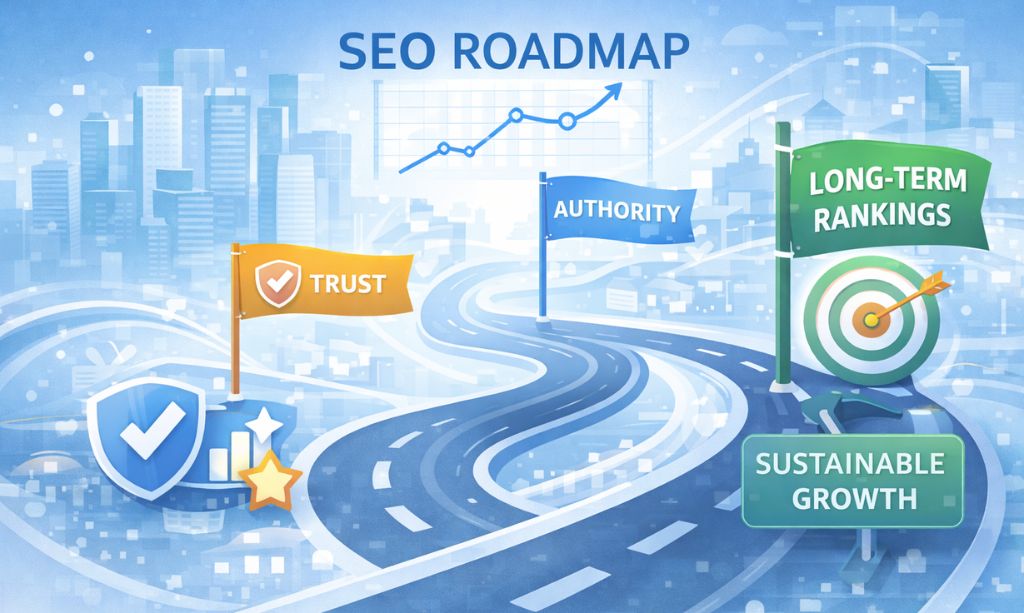
So, where do you go from here? Please don’t just close this tab and say, “I’ll do it later.” We both know “later” usually means “never.”
Here is a straightforward game plan to get the ball rolling immediately.
Start by opening a simple spreadsheet. Write down your official business name, address, and phone number exactly how you want them to appear. Commit to that format. Next, spend fifteen minutes writing a few different versions of your business description so you aren’t copy-pasting the same text everywhere.
Once that is ready, don’t try to conquer the world. Just find five high-quality directories. Maybe start with a big one like Yelp and then find a couple that are specific to your niche.
Set aside an hour, pour yourself a coffee, and manually submit your site to just those five. Log them in your sheet, and you are done for now. It really is that simple. You are now building a real Off Page SEO Directory Submission foundation that will support your rankings for years to come. Start small, keep it real, and the results will follow.
After you’ve submitted your site to these five directories, your next big move should be contextual link building. Check out our ultimate list of guest posting sites and start planning your next expert contribution today.